
All Content
Principal Responsibilities
In many Anabaptist schools, principals wear two hats—teacher and administrator. Clarification of both roles is essential in helping a principal do his job well. Jonas provides helpful and practical insights into this multifaceted position.
- Principals must be clear on their administrative responsibilities, which include hiring, inspiring, and supporting teachers; fostering unity among faculty, board, and parents; evaluating curriculum; and handling procedural tasks such as ordering supplies.
- Principals must fight against factors that lead to mediocre schools, which include absent or ineffective leadership, overloaded administrators, unclear expectations, or inherited approaches that don’t align with current needs.
- Principals must do their part to build successful schools, which includes finding capable teachers, nurturing a positive school culture, promoting unity, and evaluating curriculum.
- Principals must learn to work efficiently, which includes using the 80/20 rule to prioritize impactful tasks, planning strategically, delegating tasks, and leveraging the summer for administrative work.
- Principals must strive for personal health and servant leadership, which includes balancing their personal life to avoid burnout, discernment, vision, and being accessible to support teachers.
The role of a teaching principal requires wisdom, discernment, and hard work.
“Principal Responsibilities” was presented by Jonas Sauder at CASBI 2025 held at United Christian School in Napanee, Indiana.
Treasurer Responsibilities
A treasurer is primarily responsible for managing the school’s finances. Speaking from years of experience as a treasurer, Steve covers the specifics of what this role involves, including the following:
- Budgeting. A budget is critical, must be approved by the school’s stakeholders, and drives all financial decisions.
- Expenditures. Staff spending must align with the budget and should include some sort of reporting of expenses.
- Accounting records. Various accounting software can be used, such as QuickBooks or Wave.
- Financial reports. Reports should be presented regularly to the school board and patrons to provide transparency and build trust.
- Staff wages. Wages should be the largest budget item and take fair community standards into consideration, as well as a plan to incrementally increase wages to retain long-term staff.
- Compliance and auditing. Treasurers must stay updated on regulations, and complete annual bank reconciliation and financial verification reports, along with occasional full audits.
The role of treasurer is important and requires collaboration with the board and school administrator. Treasurers ought to view their role as a noble task, as it ensures financial stability for quality education.
“Treasurer Responsibilities” was presented by Steve Burkholder at CASBI 2025 held at United Christian School in Napanee, Indiana.
Working with Struggling Teachers
It may surprise you to learn that 44% of K-12 teachers report frequent burnout. Along with burnout, teachers may struggle with: declining classroom morale, lack of respect from students, personal/emotional distress (often exacerbated by heavy workloads, unrealistic expectations, or lack of support).
Doug provides an overview of both the symptoms to watch for to recognize a struggling teacher as well as the causes that may be driving those struggles. He provides three principles for helping a struggling teacher:
- Taking time
- Building good relationships
- Maintaining open communication
He also suggests many practical suggestions for both board members and individuals in the community to support teachers.
“Working with Struggling Teachers” was presented by Doug Meyers at CASBI 2025 held at United Christian School in Napanee, Indiana.

Need has been filled! First Grade Teacher Needed for 2025-2026
Northwoods Mennonite School is a Christian School serving around 50 students in northern Wisconsin. We are in need of a first grade teacher for the coming school year. Approximately 6-8 students. Most of our curriculum is CLE, although we use Beginning Steps for Reading for teaching first grade reading, and Living Threads for history. We would love to talk to you if you have a heart for teaching children in a Christ centered environment! Teaching experience would be excellent, but not necessarily required.
Science Teacher needed for High School
Faith Mennonite High School is a patron run High School in Lancaster County PA. We serve around 100 students from a variety of conservative anabaptist churches. We are searching for a Science teacher who is interested in promoting Biblical and Acedemic excellence.

The Heavens Declare - Sizing up the Universe
In his The Heavens Declare series, Morris Yoder uses astronomy to illustrate God’s glory, blending biblical references (e.g., Psalm 19, Job 38) with cosmic phenomena like Betelgeuse, the Hubble Ultra Deep Field, and Voyager’s “pale blue dot.” He critiques secular theories (e.g., Big Bang, evolution), highlights humanity’s unique yet humble place in the vast universe and encourages worship through awe-inspiring celestial examples and personal faith reflections.
"The universe reveals God's attributes," says Morris. "Because God is strong his creation shows power. Because God is great his creation is vast. Because God is beautiful, his creation reflects glory. Because God is love, his creation includes you." Join Morris as he explores the vastness of the universe, digs into questions such as what makes stars twinkle, and reminds us of our own smallness before a great and loving God. Come magnify the lord by magnifying in his creation and exalting his name together!
The Universe and Scripture
Psalm 34:3 O magnify the Lord with me, and let us exalt his name together
Job 38:31 Canst thou bind the sweet influences of Pleiades, or loose the bands of Orion?
Amos 5:8 He who made the Pleiades and Orion, who turns midnight into dawn and darkens day into night, who calls for the waters of the sea and pours them out over the face of the land - the Lord is his name.
Psalms 33:6 By the word of the Lord the heavens were made, their starry host by the breath of his mouth.
Isaiah 40:18 With whom, then, will you compare God? To what image will you liken him?
Isaiah 40:12 Who has measured the waters in the hollow of his hand, or with the breadth of his hand marked off the heavens? Who has held the dust of the earth in a basket, or weighed the mountains on the scales and the hills in a balance?
The Universe and our Minds
Why do Stars twinkle?
The size of the universe
Numbers - some context
The milky way galaxy
Methods of measurements
stellar parallax
red and blue shift
Listen to more from this series:
"The Heavens Declare: Sizing up the Universe" was presented by Morris Yoder at Teachers Week 2015.
The Advantages of Teaching in a Small School

When I first taught in a small parochial school several years ago, I found myself wishing that I could teach in a big school. It just seemed like it would be more exciting and academic. The building and classrooms were larger. They had better equipment. And the idea of only teaching one or two grades instead of four or five seemed delightful.
After several years, I got my wish. For several years, I taught in a much larger school. I only had to teach two grades or one subject, and I even had a planning period. Yet, I eventually decided that I favored teaching in a smaller school, and that’s where I’ve been ever since. Here are a few things I appreciate about teaching in a smaller school.
- We get to teach every subject. While English is probably my favorite, I thoroughly enjoy teaching algebra, physical science, and history—not to mention music and art.
- No bells! If I need an extra ten minutes in science, I can take it without having to worry about bells ringing and students leaving my room. I am able to be much more flexible, and I sincerely appreciate that.
- I get to teach the same students year after year. I get to know them as well as their strengths and weaknesses much better. I also get to see their academic and character growth. That is very rewarding.
- Smaller schools have more of a family-type atmosphere. The older students have music and recess with the younger students and can help lead and encourage them. The younger students learn how to relate to and respect the older students. That’s a good thing.
- Fewer papers to grade! Because we don’t have twenty or thirty students in a class, our grading load is lighter. Although this is probably balanced with us having to do more preparation work to teach more lessons, it’s still an advantage.
- Fewer discipline problems. I have discovered that it is easier to teach in a classroom with a mixed number of grades and levels of maturity than it is to teach a class of seventeen seventh graders.
While God has given each of us different gifts, talents, and preferences, there certainly are advantages of teaching in a smaller school, and I am very grateful for the opportunity to do just that. If you are teaching in a smaller school, I hope you are grateful as well.
Photo by Meg Boulden on Unsplash
The Heavens Declare: Astronomy and the Bible
In his The Heavens Declare series, Morris Yoder uses astronomy to illustrate God’s glory, blending biblical references (e.g., Psalm 19, Job 38) with cosmic phenomena like Betelgeuse, the Hubble Ultra Deep Field, and Voyager’s “pale blue dot.” He critiques secular theories (e.g., Big Bang, evolution), highlights humanity’s unique yet humble place in the vast universe and encourages worship through awe-inspiring celestial examples and personal faith reflections.
It is impossible for man with his own judgment to accurately discern the nature of the origin of the cosmos. We need a guide. The Bible not only answers the question of where we came from but also references complicated scientific concepts long before they were discovered or articulated by man. Explore what the scripture has to say about astronomy and how the heavens truly declare the glory of God!
Astronomy and the Bible
The heavens declare the Glory of God. Psalm 19:1
In the beginning God created the heavens and the earth. Genesis 1:1
Why are we here?
The Steady State Theory
The Big Bang Theory
We can't trust our own judgment.
Look at what the scripture says about astronomy. (Job, Psalms, Ecclesiastes, Isaiah, and Hebrews)
The earth is:
supported by nothing
round
turning
The stars are innumerable.
Creation created a framework for days and weeks.
Matter and energy are constant.
Time, Space, Matter, and Energy are all represented in the Creation story.
The earth is growing old like a garment.
Listen to more from this series:
"The Heavens Declare: Astronomy and the Bible" was presented by Morris Yoder at Teachers Week 2015.
Elementary Subject Teacher | HCS | Baltimore, MD
Elementary Subject Teacher (Reading, Math, History, Science, PE)
Hampden Christian School – Baltimore, MD
Hampden Christian School, located in the vibrant neighborhood of Hampden in Baltimore, MD, is seeking an elementary subject teacher for the 2025–2026 school year. This role includes teaching reading, math, history, science, and physical education in a school with 90+ students of varying races and religious backgrounds.
At HCS, we are committed to nurturing both the academic and character growth of our students. As a teacher here, you’ll be part of a collaborative, Christ-centered team that values strong relationships, rigorous academics, and a joyful school culture.
What We Offer:
- A highly supportive team of experienced educators eager to mentor and collaborate
- Professional development opportunities throughout the year
- Small class sizes
- An opportunity to teach the Kingdom message and develop children of character in a mission school
Ideal Candidates Will:
- Be 20 years of age or older; mature, energetic, and a team player
- Be committed to developing and growing as a teacher
- Be willing to work closely with colleagues and school leadership
- Be enthusiastic about contributing to the broader school community
Position Details:
- Full time
- Not a homeroom position
- Housing is provided if needed
- Begins August 2025
If you have a heart for teaching, a love for children, and a desire to make a meaningful impact in a small school setting, we would love to hear from you.
To Apply:
Please contact Darrell Hershberger. dbh@hampdencs.org, 540-292-6827.

Ripples

It began on a Sunday morning. A first-grade lad sat on a church pew and listened to the minister speaking. His ears perked up when he heard the minister make a lesson application just for children. He heard him explain about surprises and keeping a happy secret. The little lad’s mind wheels started rolling.
Enter a few more lads and lasses. The first little lad explained his idea. His fellow classmates enthusiastically added a few more details. Soon they had a full-blown plan in place.
The next day at school the teacher heard whispers of, “Shh, don’t tell her. Don’t let her know.” And since these whispers were right in front of her, she pretended she didn’t notice. But soon one little lass exclaimed, “We’ve got a secret, but you can’t know what it is.”
All day long, little bits of planning came out. At recess, one lass asked the teacher, “Will it be okay if we do the surprise tomorrow at break?” And later another child said, “Can we ask Ms. Breanna (the aide) to help us?” And at dismissal, a concerned individual told the teacher, “Now, in the morning, don’t look in our backpacks!” (As if the teacher ever did.)
But though the teacher was well informed that something was up, no one had divulged what it was.
The next morning, first graders popped into the library and out again with their backpacks a bit lighter.
At break time, the teacher was banished and then invited into her classroom where she discovered a box on her desk full of “love”. Scented candles, homemade cards, a thank you letter, money for coffee, soap, an arrowhead treasure, quarters, hand towel, candy, treat mix, hand-drawn pictures, mugs, and more filled the box to say, “thank you for teaching us”.
The teacher’s heart was full and over-flowing as she viewed the special surprise her first graders planned and pulled off, because a minister had said something in church that triggered a lad’s thoughts.
And all the rest of the day, a happy glow shone through the classroom.
_________________
That Sunday morning sermon pebble, dropped into the ear of a small boy, left ripples that grew and grew. In reflecting on this incident, there are several points that come to mind.
- Never underestimate the power of your words. A teacher can feel like their words are making no impact on student lives. A minister may feel like their words are not taken to heart. A parent can feel that their words go in one ear and out the other. But one never knows what ripple effect a short snippet of words may have. Ministers, teachers, parents, take heart. Your words are not insignificant. And one day, they may return to you and bless you.
- Truly selfless giving gives back to the giver. My students were just as pleased as I was with the surprise they pulled off. A child is a grand example of delighting to give – even if it means giving up of your own personal treasures.
- It wasn’t the treasures that made my day. The students who unselfishly gave, the teamwork it took to plan and organize, the care that went into the cards and notes, the thoughtfulness behind the idea, the parents who allowed the project to proceed – that is what made my heart full.
- It was not only me that was blessed. I think each parent also went to bed with fuller hearts, as they explored their children’s idea and the nugget that sparked it.
All because a minister preached a sermon, and a small boy listened.
Photo by Linus Nylund on Unsplash

Extracurricular Games and Activities

There are many things that can create pockets of unexpected time in your classroom. Maybe it’s a fire drill that disrupts your math class, leaving you with an awkward ten minutes to fill and students that are too hyped up to think about fractions again. Maybe your history lesson didn’t take nearly as long as you expected. Maybe it’s the fourth rainy day in a row, and you’re stuck inside at recess and desperately in need of something new and fun. Maybe it’s near the end of the school year and you’re running out of things to do. Maybe everyone finished their unit test early and you have fifteen minutes of extra class time.
In moments like these, teachers often have their reflexive fallback options, like extra recess or silent reading. But not every student enjoys extra recess, and not every student thrives on reading. Instead, having some in-classroom games can be an opportunity for creative and rapport-building experiences.
I recently saw a post by a teacher who has what she calls a “Change of Plans Box,” which is basically a box of games and activities to fall back on regardless of the day’s surprises (credit to Amy B. on WeAreTeachers). The idea is that a teacher would put a bit of time into preparing these activities beforehand so that they are ready to go at a moment’s notice.
Here are a few activities you might consider if you want to build your own Change of Plans Box (some of them take a bit of prep, and some of them take no prep at all!)
Ideas for Any Age
The Counting Game
The aim of the game is for students to work together to count aloud from 1-20, with only one student saying a number at a time. The catch is that they may not communicate first to determine an order of who speaks when. If two students speak at the same time, they must start over again from 1.
Twenty Questions
This game is a classic for a reason. The teacher chooses a word, whether a person, place, or thing (for younger students you might want to make it easier by telling them the general category first). Students then work together to guess the item by only asking yes/no questions. As the name implies, the aim of the game is to guess the word within twenty questions.
Apple Pie
The teacher chooses one student to come to the front of the room and stand with their back to the class. The teacher then silently chooses another student to say, “apple pie.” The student at the front needs to guess who spoke. Students can try to make it tricky by disguising their voice, standing up, or moving to another part of the room. Repeat as many times as desired with different students doing the guessing and speaking.
Source: https://oscarlessons.com/time-killer-games/
Ideas for Lower Elementary
My Favorite Things
Give each child a piece of paper divided into four sections with the labels Toy, Animal, Person, and Game. Give the students time to draw their favorite of each label in the appropriate section of the paper. Once they have finished, collect all the papers and put them on a stack. Let each child pick up someone else’s paper from the stack. The class must then guess whose paper it is.
From https://gokidpower.org/group-games-for-kids/
Look Up, Look Down
Have the students stand in a circle, around one or two feet apart. The teacher calls out, “Look down!” All the students must stare at the ground. Once some time has passed, the teacher says, “Look up!” The children must immediately look up and at another person in the circle. If two students are looking at each other, they need to sit down. The remaining players must keep staring at their chosen person until they are told to look down. The game repeats until there is nobody left.
From https://gokidpower.org/group-games-for-kids/
BINGO
A slight twist on the classic game, this version has squares that are filled in with things like, “I have a dog,” or “I am wearing green today.” See the attached PDF for printable bingo cards to give to each of your students, along with a calling card for the teacher and instructions for use. (Made using https://myfreebingocards.com/)
Telephone
The teacher starts by whispering a sentence into a student’s ear. That student then whispers it to another student, who whispers it to another student, and so on, until it has reached the last student. That student stays it aloud. Usually the sentence has changed drastically from its original form by the time it reaches the end!
Various Individual or Small Group Games
If you’d like some games that can be played by an individual child or perhaps in pairs or small groups, things like Play-Doh or puzzles are great options. Another fun one for children in younger elementary is pattern block puzzles (also called tangrams), which can be purchased online in a wooden or plastic version or printed for free as paper form. Lacing cards are a similar activity that can be purchased or made yourself. (You could make your own by printing them on heavy paper such as cardstock, making holes with a single hole punch, and attaching yarn to them).
Ideas for Upper Elementary
Wordle
This online game has gained intense popularity since it first became public in 2021 and now has millions of users. If you’re not familiar with it, the aim of the game is to guess a five-letter word within six guesses. For each guess you make, you gain more information, as correct letters that are in the right spot turn green, letters that are in the word but in the wrong spot turn yellow, and letters that aren’t in the word at all turn grey. You can play a classroom version with your students by thinking of your own five-letter word. Write students’ guesses on the chalkboard and circle appropriate letters with green or yellow chalk. Younger students may need more than six guesses.
Boggle
Play a classroom version of this classic board game by writing up either a 4x4 or 5x5 grid of random letters. Students work individually to see who can make the most words (or you could work as a whole class to create one large list). Remind students of the following rules: words must be at least three letters long, consecutive letters must be touching either on an edge or corner, and you may not use the same letter more than once in a single word. Students are often amazed by how many words it’s possible to make from a single grid.
What’s Going On in This Picture?
This is an online conversation the New York Times has facilitated for students for years, in which they post a Times photo stripped of its caption and have students try to guess what’s happening in the picture. You can facilitate the same discussion in your classroom with your own students. There are hundreds of past “What’s Going On in This Picture” photos at https://www.nytimes.com/column/learning-whats-going-on-in-this-picture. You can print or project these pictures and have your students try to use context clues to sleuth out what’s going in the picture. They must back up their guesses with evidence, which builds critical thinking skills.
Drawing Challenge
This activity encourages creativity and imagination with a touch of silliness thrown in. Students are first instructed to write a list of fifteen random things that they know they can draw. Then, they are given a descriptive paragraph with fifteen blanks in it. They input their fifteen words into the fifteen blanks, resulting in a description of a scene that they are supposed to then draw. Students love the random nature of this activity. See the attached PDF for one such drawing challenge or make up your own!
Dollar Words
Create a list on the chalkboard with each of the letters of the alphabet and a corresponding cents value. A is 1¢, B is 2¢, C is 3¢, etc., all the way to Z being 26¢. The aim of the game is to try to come up with a word that is worth exactly one dollar. (Variations could be made where they try to create a word or phrase worth two dollars, three dollars, etc.)
Rebus Puzzles
These puzzles are a visual representation of a name, word, or phrase. They range from text only to including images and symbols. For example, Lang4uage is a rebus puzzle standing for “foreign language” (four in language). Or Apple would mean “apple pie.” Hundreds of rebus puzzles can be found online.
Stop the Bus
Write several categories on the board, like animals, food, colors, countries, sports, names, household items, etc. Either in small groups or individually, students write those categories on a piece of paper. The teacher says a letter, like “R,” and each team/individual needs to fill in each of the categories with a word starting with “R.” Whoever finishes first calls out, “Stop the bus!” and everyone must stop. Points may be awarded for how many answers each team/individual wrote. This can be repeated as many times as you want with different letters and different categories.
Source: https://oscarlessons.com/time-killer-games/
Various Individual or Small Group Games
If you’d like some games that can be played by an individual child or perhaps in pairs or small groups, crossword puzzles, word searches, logic puzzles, or Sudoku puzzles can be good options. Sometimes older students enjoy things like adult coloring pages or adult dot-to-dots, which hearken back to activities they enjoyed when they were younger but are challenging enough to stretch them now. You could also consider finding some brain teasers or pulling out a few 500- or 1000-piece puzzles.
Why Some Students Learn Differently
The human brain, with approximately 80 billion cells, is highly complex. Learning and behavioral challenges often stem from this complexity, making this a nuanced topic to explore.
Anthony provides an overview of two main areas of learning differences:
- Academic struggles stemming from dyslexia
- Behavioral challenges stemming from trauma
He also emphasizes the need for understanding these challenges as brain-based, not merely willful. The latter blames the child, emphasizing punishment, while the former focuses on discipleship and mentoring over punitive measures.
Addressing learning difficulties requires an arsenal of practical strategies, collaboration between all involved parties, and relying on available resources. Most of all, there is a great need for a compassionate, Jesus-like approach in supporting children who struggle.
“Why Some Students Learn Differently” was presented by Anthony Hurst at CASBI 2025 held at United Christian School in Nappanee, Indiana.
Onboarding New Teachers
“Onboarding,” defined as the process of preparing a new teacher to teach efficiently and effectively from the first day of school, is an invaluable process. Linford makes a clear case for the importance of onboarding, both for new and established schools.
Considerations in onboarding new teachers may include the timing of the hiring, individual personality considerations, and systems of training and mentorship.
Linford also includes many practical details, such as specific questions to ask during the interview process and a list of materials to give to new teachers to set them up for success.
There is often high turnover in Anabaptist schools, making the need for an effective onboarding process essential. This lecture provides an excellent framework for any school seeking to refine their own onboarding structure.
“Onboarding New Teachers” was presented by Linford Horst at CASBI 2025 held at United Christian School in Nappanee, Indiana.
Discipline Policies
What are discipline policies, and why are they important? Linford provides a robust exploration of this topic by overviewing the need for discipline policies, the role they play in a school, and how they simplify communication and authority structures.
Linford also explores the following questions that come along with forming a discipline policy:
- How do discipline plans impact enrollment?
- What is an example of a discipline plan?
- How effective are various disciplinary measures?
- How can a school work toward redemptive discipline?
- How do current trends in discipline play into the formation of a discipline policy?
A clear, flexible discipline policy can be a helpful guide for Christian schools by emphasizing direct communication, structured authority, and practical strategies for misbehavior.
“Discipline Policies” was presented by Linford Horst at CASBI 2025 held at United Christian School in Napanee, Indiana.
Chairman Responsibilities
When a school board chairman fulfills his responsibilities well, it fosters a unified, effective board that supports the school’s mission and community. Tony provides four areas for chairmen to focus on:
- Carrying the vision. Chairmen should understand the school’s history and mission and should be able to communicate that vision to parents and the community.
- Leveraging the entire board. Chairmen should recognize and utilize the diverse skills and gifts, ensuring that everyone contributed effectively.
- Preparing for and leading board meetings. Chairmen should lead meetings effectively and efficiently, acting as a moderator to foster productive discussions.
- Enabling the staff. Chairmen should support teachers and administrators by providing resources, listening to their needs, maintaining clear expectations, and facilitating long-term planning.
“Chairman Responsibilities” was presented by Tony Burkholder at CASBI 2025 held at United Christian School in Napanee, Indiana.
A New Board Member Orientation
A school board is only as strong as its members, but how can a board enable new members to gain a vision for the work of the school and confidently contribute from their own talents? Rod emphasizes three ways to integrate new members and create a cohesive, committed school board:
- Sharing the vision for the work. Helping to inspire new board members with a vision for the work of the school is vital. Boards should inspire less-engaged members and learn from those with fresh perspectives.
- Explaining basic functions and expectations. New members need clear guidance on procedures such as agendas, motions, and voting, as well as being tasked with responsibilities that align with their strengths. Tools like a board handbook or a mentorship period can ease transitions for new members.
- Building strong and lasting relationships. A strong board is one in which collaboration is fostered, members are treated with kindness and forbearance, and unity is reached even in difficult decisions. This sort of board culture can only be achieved through active listening and valuing the voices of all members.
“A New Board Member Orientation” was presented by Rod Horst at CASBI 2025 held at United Christian School in Napanee, Indiana.

When They Ask
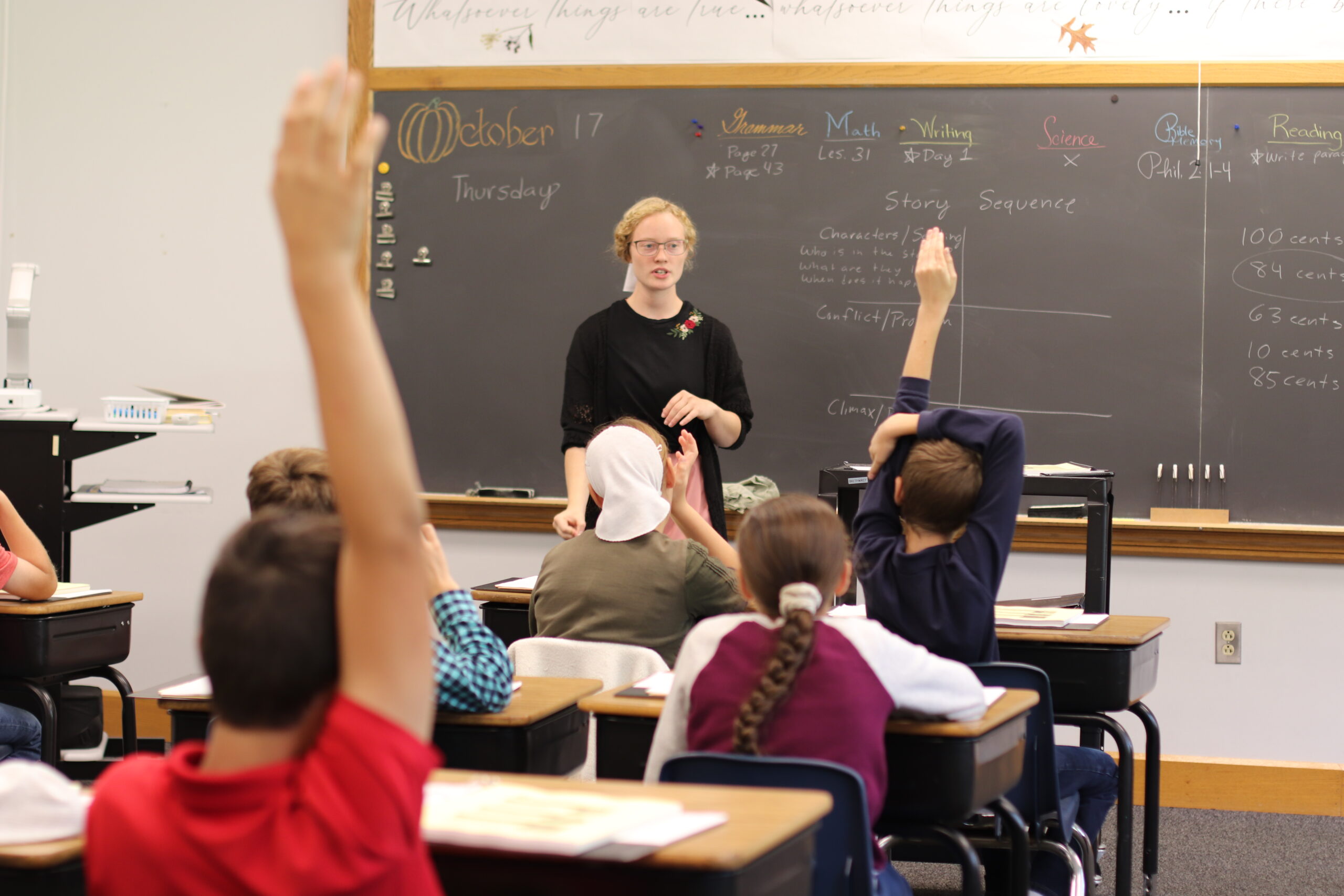
“So, I was thinking,” my student said to me with a serious look on his face. “How do we know that the Bible is true and that Christianity is the only right religion? How do we know that other religions like Islam aren’t the right way?”
It was lunchtime, and many of the other students had finished eating and had gone off to play. I was glad for the opportunity to be able to give my full attention to this child. I knew that he was a deep thinker and that he would not be content with pat answers. Since we had just studied Islam in history class, I could understand what had sparked his questioning.
If a nine-year-old came to you with questions like that, how would you respond? As I recall, I said something like this, “That’s a really good question. I’ve often wondered the same thing myself, and I don’t have an easy answer for you. But I can tell you this: I have done lots of studying, and I’ve read many books and listened to many speakers, and after all that, I still believe that Christianity is the right way.” I then encouraged my student to keep thinking and asking questions and to search out answers for himself.
I am sure there are other things I could have said. I do not claim infinite wisdom in responding to my students’ questions. But I was honored that he felt safe in asking me those questions in the first place.
Children wonder about everything. Do you remember that from your childhood? I do. When I first studied philosophy, I was surprised at how simple it seemed. These are the things I thought about when I was seven years old, I thought, as I read some of the writings of ancient philosophers. In my third-grade history class, we have a unit of study on ancient Greece. As a wrap-up to the lesson about Socrates, I often say, “Socrates wondered about many things and asked all kinds of questions. What are some things that you wonder about?” Here are some responses I have gotten:
“How could God not have a beginning or ending?”
“Why do people sin so much?”
“Why doesn’t God just make people be good?”
“Why is there death?”
“Why didn’t Jesus just stay on earth so that we could see Him too?”
“How can it be that we will live on forever?”
“Can people in heaven see us?”
I also recall a class discussion from when I was in fourth grade. One of my classmates was trying to ask a question and was struggling to articulate it. My ten-year-old self understood what he was asking, because I wondered the same thing. Though I didn’t have the vocabulary to express it in this way at the time, the question was this: Is heaven a physical place, or is it merely a disembodied spiritual experience? I wish I could remember how my teacher answered that question, but I have no idea. What I do remember though is that discussions of that nature were not unusual, and questions like that were welcomed and encouraged.
Is your classroom a safe space for children to ask hard questions? Our students’ honest questions should not make us feel threatened or intimidated. Their questions are an opportunity for us to search our own hearts and to learn and grow with them. We need to keep in mind that God is well able to protect His own reputation, the Bible can defend itself, and the Holy Spirit is at work in our students’ lives in ways we often underestimate. Rather than thinking that we must have answers for everything, we can point them to the Answer, resting in the assurance that He will teach them.
Teaching Students Gratitude

I splurged last Christmas and got my students three gifts. One was free—a collection of about twelve different kinds of seashells and a shell identification guide. I collected those all myself during a rare vacation weekend to Florida in November. The second was a $3.50 laminated colored map of the world, which they all loved and many taped to the tops of their desks–with permission, of course. The third was my splurge. I bought each one of them a hardcover Merriam-Webster combination dictionary and thesaurus. I carefully placed one on each student’s desk and wrote “To _____ from Mrs. Swanson, 2024” on the inside front cover.
I got one thank you note from a very sweet student who obviously was grateful. The student even informed me that it had already been useful. But, I had another student who walked up to me at the end of the day, with the brand-new hardcover book in hand, asking, “Do you want this?”
Aghast but with a smile, I replied, “I bought that just for you.”
“I won’t really use it,” was the answer. Imagine a junior high student not needing a dictionary.
I figured it wasn’t the time for a lecture as I didn’t want that to be the student’s last memory of me for 2024, but it really hurt my feelings.
G.K. Chesterton wrote, “Thanks are the highest form of thought; and gratitude is happiness doubled by wonder.” That is so incredibly true. My brightest students are the ones who are grateful and appreciative. And the ones who are often more difficult to deal with are the least thankful. I’m rarely content with a situation that I know can and should be improved, so I began to ponder: What can we as teachers do to teach our students gratitude? Here are a few of my suggestions.
- Model thankfulness yourself. In morning prayers, thank God for your church, school building, parents, and supporting churches. Show gratitude for the mothers bringing in a hot lunch or a snack.
- Teach it! Have the students write thank you notes to places you visit on field trips, or to the pastor of the church for letting your school rent their basement. Sing at nursing homes, rake leaves for widows, and donate coins to a Christian Aid Ministries project. Give the students opportunities to experience what it feels like to be unselfish and to think of others.
- Gently point out wrongs. We had a friendly discussion about what returning a gift communicates to the giver, and what it reveals about the receiver as well. Obviously, students either have not been taught or have not internalized these concepts, so use these times as opportunities for short discussions and lessons on gratitude.
- Don’t take selfishness or thoughtlessness personally. It is usually more a reflection on their ages and lack of experience. Use these moments for gentle correction, and point them in the way they should go.
Sometimes teaching involves a little more parenting, and this would be one of those situations. Also, be thankful yourself, as you have the privilege to be involved in the art of teaching, assisting parents and the church in the all-important work of training up godly men and women for the church of tomorrow. That’s a noble thing to be doing.
Photo by Alexas_Fotos on Unsplash
- 261Page 24