
All Content

Positive and Negative Examples in Literature
When reading novels authors present readers with two distinct types of characters: Positive examples and negative examples. Both are useful for character development and moral instruction.
Positive examples
A character is a positive example when he or she makes wise choices that please God and bring about some kind of blessing for that character or others. Novels with positive examples clearly show that obedience to God's commands brings about a positive result (either in this life or in eternity). These positive examples provide role models for readers to emulate.
In the novel The Shepherd of Bethlehem, King of Israel, Mr. Eardley is an excellent positive example. He is a new minister in town and on his first day in his new role he slips on some ice that was purposely made by a young boy looking to cause trouble. Mr. Eardley breaks his leg so badly that he needs to be on bed rest for a long time; yet, does not get angry at the young boy, nor does he complain and pity himself. Despite the challenge Mr. Eardley carries on his work of reaching the lost and holds Bible studies in his home. This novel encourages readers to be hardworking for the Kingdom, to resist self-pity and complaining, and also be resourceful in reaching the lost. This novel also contains a Bible study on the character of David presented by the minister and examines his life as a shepherd and later as the king of Israel. The author has done a very good job of slipping in direct instruction of Biblical principles in a natural way to the novel. These Bible studies also lead to the transformation of a number of characters in the novel.
Negative examples
A negative example is when a character makes poor choices that displease God and that bring about a negative repercussion for that character or others. Novels with negative examples clearly show that disobedience to God's commands bring about a negative result (either in this life or in eternity). These negative examples provide warnings for readers to avoid.
In the novel Helen the character Helen is a very good negative example. She is knowledgeable of the Bible and is able to answer many questions in Sunday school; however, she does not love God, nor bear good fruit. Helen's sister, Betty, on the other hand has a limited understanding of the Bible, yet is quick to put into action the simple truths that she does understand, which includes walking home a crippled girl named Louisa and inviting her to Sunday school. Helen is most concerned about pleasing her classmates and does not want Louisa to walk with her and Betty to Sunday school or have anything to do with her. Helen's hatred for Louisa grows in the novel and ultimately leads to a severe consequence. This novel encourages readers to not act like Helen and to instead act like Betty. It teaches readers to not simply have head-knowledge of the Bible, but to let it penetrate their hearts and to put into practice what it teaches. The specific issues this novel speaks on is hypocrisy, self-control, anger, and being a good Samaritan.
Many Christian novels provide a combination of both positive and negative examples. Some novels begin with a character exhibiting a particular sin and suffering or causing others to suffer because of it; yet, as the story progresses this character repents and, with God's help, learns to root out this sin in their life. Another combination of both positive and negative examples is when there are two characters that are presented in a novel alongside each other: one that is a positive example and the other who is a negative example. As the novel progress readers are shown that adherence to the teachings of Christ bring blessings to the one character and indifference to the teachings of Christ bring trouble to the other character.
Positive Traits in Secular Literature
Characters in secular novels today may still have some positive attributes that are presented in good light. Perhaps a character might risk his or her life to help someone else or might give generously to someone in need; however, these positive traits are often present alongside of negative ones and thus younger readers need to be instructed in which actions are to be admired and which actions are to be avoided. In addition secular novels do not acknowledge God as the source of all good; however, parents and teachers can emphasize this and thus still allow the novel to be useful. Therefore I would warn against allowing a young person to read a secular text without any guidance but instead that a parent or teacher lead a student in the study of a secular novel and clearly communicate which actions and attitudes honor God and which do not.
Negative Traits in Secular Literature
Although there are some secular novels today that Christians can benefit from, there are also many secular novels that are harmful. One type of harmful novel is a novel that attempts to make negative traits look positive. For example they might glorify warfare or getting revenge. Another type of harmful novel is one that shows a character with a negative trait, but does not have that character suffer hardship because of this trait. These two types of harmful novels give the impression to readers that someone can sin without it negatively impacting them or others. This is certainly untrue.
In conclusion I wanted to reiterate that readers can learn a lot from both positive examples and negative examples. I would also say readers should be seeing these examples primarily from wholesome Christian literature, but that some secular literature is acceptable as long as it comprises a small amount of their reading and the reader can correctly identify the negative traits in characters. It is best for young readers to have limited exposure to secular literature until they have a good foundation and will be able to read under the guidance of a parent or teacher.
Find free Christian literature and study guides.
Our Master Teacher Longs to Celebrate
 Photo by Hello I'm Nik ? on Unsplash
One afternoon, a group of camp workers in training for the summer program were taken to the front lawn and confronted with a challenge. Across the lawn were strewn large puzzle pieces. They were to find the pieces and put the puzzle together. Sounds easy, until you hear some of the rules that limited the typical skills used to accomplish this. These brave people were given two limitations: they must remain blindfolded the entire time, and they could only ask questions or respond to questions. These limitations were designed to develop a certain set of skills in these young people.
When we signed the contract for the 2019-2020 school year, the limitations we face now as teachers were nowhere in sight. Working with these limitations has caused us to create a new style of education. Just as those summer camp youths had to call upon different skills, so we, our students, and parents are needing to use new skills.
I have noticed students’ growth in writing. One of my students declared they never worked so hard in school. They never had to write so much. The limitation that has been put on verbal communication has increased the need of writing for both me and my students. The increased writing is a challenge, but I can’t wait to see the payoff next year.
All of us are working hard, learning new skills, and serving the best we can. We teachers are amazed with some of the drawings, math skills, and writing pieces dropped off at our door. We brainstorm ways we can take some of the skills we see being developed at home now into the classroom next year. Growth is happening in areas we may not have expected.
But that doesn’t change the fact we miss our students. Our ability to love them well feels feeble. The depth of relationship we can have and amount of teaching we can do is limited.
I hold to the hope that one day I will celebrate with my crew in a cafeteria filled with chatter, laughter, and a spill or two if that must come with the package.
Our Master Teacher knows our feeling of limitations. He knows our longing to give more, but that circumstances prohibit it.
His ability to lavishly love us is limited while we are on earth. He knows His intangible presence in our life leaves us grasping for more, and He has to say, “Not yet, child.” I bet there are many times he longs to burst a huge piñata of blessings on us, yet He holds back and just gives us one chocolate.
If I long for that day to be with my students, how much more must Jesus be anticipating a celebration with us. The joy at that celebration will be immense!


The Riot and the Dance | A Documentary Review
The relationship between Good Friday, COVID-19, and Easter
“We are extremely wet inside.”
The simple, innocent opening statement by Dr. Gordon Wilson in "The Riot and the Dance | Water" caused me to weep myself to sleep. The documentary told me that the death of a father gets harder with time. It said that anything can release a bunch of pent up emotions. I didn’t expect such a trigger from a nature documentary with the subtitle, “A cinematic celebration of creation.” If I had spent a little more time contemplating the unique title, I would have had a better warning.
Dr. Gordon Wilson, a marine biologist and college professor, has a contagious passion and an amazing teaching ability. A passion for educating everyone about our amazing Creator by showing off His marvelous creation. An ability for explaining these marvels in a clear, compelling, and connected manner. This combination makes his products so immensely valuable and eye opening. His foundational biology textbook for high school or undergraduate students, and both documentaries, Earth and Water, all bear the same eye-catching title. With those simple titles, Dr. Wilson reveals both his passion and skill.
The Riot speaks of all the brokenness in our world. Good Friday, the day we remember the intense sufferings of our Savior on our behalf, is a time for deep reflection on the depravity of our race. COVID-19 is a reminder of the curse of sin and the greed, sickness, and death that goes along with it. The soul wrenching experience of watching your father’s earthly body dry up, as his “incredible wetness” poured out of all his pores, and his only replenishment was through a sponge to his cracking lips, is more than any son should have to bear. The soul wrenching experience of your Heavenly Father turning His back on you, as your earthly body is enduring excruciating pain, and your only refreshment is a sponge of vinegar to your cracking lips, is more than any Son should have to bear. Yet, God Almighty willing endured the full wrath of the Riot, so we can enjoy the Dance.
The Dance speaks of all the beauty in our world. The physical outpouring of the Triune creative power in every nook and cranny of our world. Even the places that are yet to be discovered. For millennia, God has been sustaining life in the deepest, darkest expenses of water and space. The unimaginable Holy suspense He must feel as He carefully directs each explorer to the next God-exalting discovery. The suspense with which He longed for my Daddy to be rid of his failing earthly tabernacle and be clothed with immortality. The suspense with which He longed for the early morning of the third day when He could defy death and bring His Son from the measly confines of an earthly grave. All three kinds of suspense demonstrate to the awe-struck world the intensity with which He longs for us to join Him in the Dance.
What difference does the Dance make in our daily lives if the Riot is so real? If God incarnate could not avoid the Riot, but insisted on enduring every anguishing moment, how much more must we embrace the brokenness of this sinful world. God has placed us, where we too, may contract COVID-19 or suffer in other ways, yet He has not left us comfortless. He was present in the valley of the shadow of death as I said goodbye to my earthly father. He’s present in each day that He grants us to live. Because He conquered death, we can face the Riot with a Dance.
Mr. Todd Hawbaker, our high school English teacher used his poetic skills to reflect deeply on this matter. With his permission I share it here. May his words inspire you to live the Riot and the Dance.
#red
Come share with Me.
Come share with Me the pain,
The shame.
Of being human.
If you’re not too hardened,
Too pompous.
If you haven’t isolated yourself.
With your agenda.
With your pursuit of happiness.
Come be with Me.
Be with me in the pain,
The shame.
I came to share. To share with you,
In the pain, in the shame.
Of being human.
I drank deep of sorrow.
Dwell with evil.
Baptized into death.
Temptation.
I came to be with you.
To be with you in the pain,
The shame.
But you turned inward, wrapped in your own pain.
And I am left alone.
Oh the audacity!
Holiness scarred by pain,
By shame.
Holiness wrapping in flesh.
Holiness imparted to human flesh.
Homework
Watch "The Riot and the Dance." Both "Earth" and "Water" are streaming here for FREE until April 30, 2020. If you only watch one movie this year. This is worth it.
Keep your Eyes of Wonder open. As educators, our responsibility is to help our students to find the Dance among the Riot. If Dr. Wilson’s classroom resources can be of assistance to you, check them out here.
Don’t waste a good Riot. Our students aren’t keeping as close an eye on us while they are stuck at home, but they are soaking up everything they can hear about COVID-19. Be a voice that points them to our suffering Savior who didn’t avoid the Riot.

Dmitri: A Man Who Praised When It Could Have Killed Him

Lucinda continues the series of stories of Christian martyrs and heroes from the past. We hope you will be inspired by these histories and perhaps find them helpful in preparing for school devotions and other lessons.
Year: Sometime between 1917 and 1990
Place: The Soviet Union
Person: Dmitri—factory worker, father, man of God
Event: A strange case of prison worship
The Growth of a Church
In the days of the communist takeover, a boy named Dmitri lived with his Christian parents in a village about four hours north of Moscow. He and his parents watched as the new government began to destroy churches and kill pastors. By the time Dmitri grew to be a man, the nearest church house was a three-day walk away.
One day, Dmitri said to his wife, “I am concerned that our sons are growing up without learning about Jesus. Let’s gather our family together one night a week. I will read and explain to them the Bible stories we used to learn in church.”
And so they did.
Soon the boys grew familiar with the Bible stories and began to take a turn telling them. They started asking, “Papa, can we sing the songs they sing when they go to the real church?” It seemed only natural, after they’d been reading and singing together, to also pray together.
The village was small and the walls of the houses thin. Some of the neighbors heard what was going on and asked if they could join the family in discussing the Bible and singing and praying together. When the group grew to 25 people, the authorities threatened Dmitri.
“If you don’t stop these meetings, bad things will happen to you,” they said.
Still, Dmitri and his family kept on, and still the neighbors joined them. When the group grew to 50 people, Dmitri was fired from his position at the factory, and his wife lost her school teaching job. Their sons were expelled from school.
Still the group continued to grow. When it had grown to 75 people, the house was so crowded that at meeting time people sat cheek to cheek and crowded around the windows outside. One day, an officer came to the meeting, pushed through the crowd to Dmitri, and roughed him up. “If you do not stop this nonsense, this is the least that will happen to you!” he yelled.
A tiny old grandma stood to her feet and waved her finger at the officer’s face. “You have laid hands on a man of God, and you will not survive!” she said. Three days later, the officer died of a heart attack. The fear of God swept through the village, and at the next meeting, 150 people showed up. The officers couldn’t let this go, and Dmitri went to prison for 17 years.
Praising Jesus in Prison
Dmitri’s cell was so tiny he could cover its distance in a single step to the door, a single step to the sink, and a single step to the toilet. He was tortured, but worse to him than the torture was his isolation from other Christians. There were 1500 hardened criminals in that prison, and he was the only believer. Two spiritual disciplines, passed down to him from his own father, kept Dmitri’s faith strong.
One discipline was this: every morning at daybreak, he would rise from his bed, face the east, and stand at attention. Then, with his arms raised, he would sing a heart song to Jesus. Of course, the 1500 angry criminals reacted the way you would expect. They jeered, banged cups and bars, threw catcalls and food and sometimes human waste. Dmitri continued his practice anyway.
The second discipline that kept him strong was this: whenever he found a tiny scrap of paper in the prison yard, he would sneak it back to his cell and with whatever pencil stub or piece of charcoal he could find, write whatever Bible verses or songs he could remember. At the edge of his cell stood a concrete pillar that constantly dripped water—except in the winter, when the water froze. Dmitri would take his scrap of paper filled with verses and songs and stick it as high as he could on that damp pillar. It was his praise offering to Jesus.
Of course, whenever an officer found the scrap of paper, he would take it down, read it, beat Dmitri, and threaten to kill him. But Dmitri persisted.
A Miraculous Prayer and Song
The authorities continued to torture Dmitri physically and mentally. Finally, they led him to believe his wife had been murdered and his children taken by the state. At this point, Dmitri broke down. “You win,” he told the authorities. “I will sign whatever confession you want me to sign. I must get out of here and find my children.”
“We will prepare the papers saying you do not believe in Jesus and that you are a paid agent of western governments,” they said. “You will sign the confession tomorrow then you will be free to go.”
That night, Dmitri’s wife and sons sensed through the Holy Spirit that he was in trouble. With Dmitri’s brother, they gathered in a circle and prayed aloud for him. Dmitri, despairing in his cell, heard their voices through the miraculous power of the Spirit and heard the prayers they prayed for him. The next morning, when the officers brought the document for him to sign, he was a renewed man. “I know that you lied to me,” he told them. “My wife and sons are still alive, and they’re still in Christ. I will not sign your paper.”
One day, Dmitri was overwhelmed by a tremendous gift from God: a whole sheet of paper lying in the prison yard with a pencil beside it. He sneaked the paper and pencil back to his cell and filled it with every verse, every Bible story, every song he could recall. Then he stuck that entire sheet of paper as high as he could on the concrete pillar: his praise offering to Jesus.
Of course, an officer found it, and Dmitri was beaten and punished and threatened with death. The officials dragged him from his cell and down the concrete corridor toward the courtyard, the place of execution. But before they reached the door that led to the courtyard, an amazing thing happened. 1500 hardened criminals stood at attention beside their beds. 1500 criminals faced the east, raised their arms, and began to sing a heart song—Dmitri’s heart song—to Jesus.
The officers dropped Dmitri in terror. “Who are you?” one of them asked.
“I am a son of the living God,” Dmitri told them. “And Jesus is his name.”
Some time later he was released and returned to his family, where he lived to be an old man.
Further Resources
This story was told in the book Insanity of God by Nik Ripken. The same book tells many other miraculous stories of God at work in the darkest places of the world. It would be an excellent choice for the school library or for reading aloud to older students.
Why It Matters to a Teacher
Dmitri’s story could be used:
In a devotional: Reading it would be fine, but the natural repetition and growing suspense also make this a great story for telling aloud. Tell it with appropriate gestures (reaching high to place the paper on the pillar, standing at attention toward the east), and your students will be riveted. They will also be led to worship.
In history class: This story would make an excellent addition to a study of the communist era of Russia. Insanity of God contains several chapters telling of the persecution Christians faced during that time and includes several deeply moving stories from Russian Christians. Older students would gain much by reading them.

Best Practices for Distance Teaching During COVID-19 (Webinar)
">
In this recorded Zoom meeting, three teachers discuss their schools' approaches to the challenges of the shutdown.
From the meeting chat:
What is the best way to exchange weekly packets?Nelson: That depends on how much social distance you are trying to maintain. We had a scheduled pickup time spread out through a Saturday so that there wasn't a rush of people all at a certain time.Byron: We have 120 students; we do deliveries for Gr 1-6 and have 1 hour slots for the Gr 7-12 to come to school for pickup and test checking (so as not to exceed groups of 10).Question for Anna: How much emphasis are you putting on summative assessment in elementary? If any?Anna: Speaking only for myself as an elementary teacher: We've done a few tests but I suspect we're going to have to ignore those results and go to a pass/fail. We will have so few tests, that it would be unfair to assign report card grades in my opinion.Any advice when you don't have supportive parents or when parents are unable to help children (unable to speak English)?Byron: We send home copies of lesson answer keys on a weekly basis (mostly Christian Light and Saxon curriculum). We send them in a "parent envelope."Links mentioned in the discussion
From Austin
From Anna
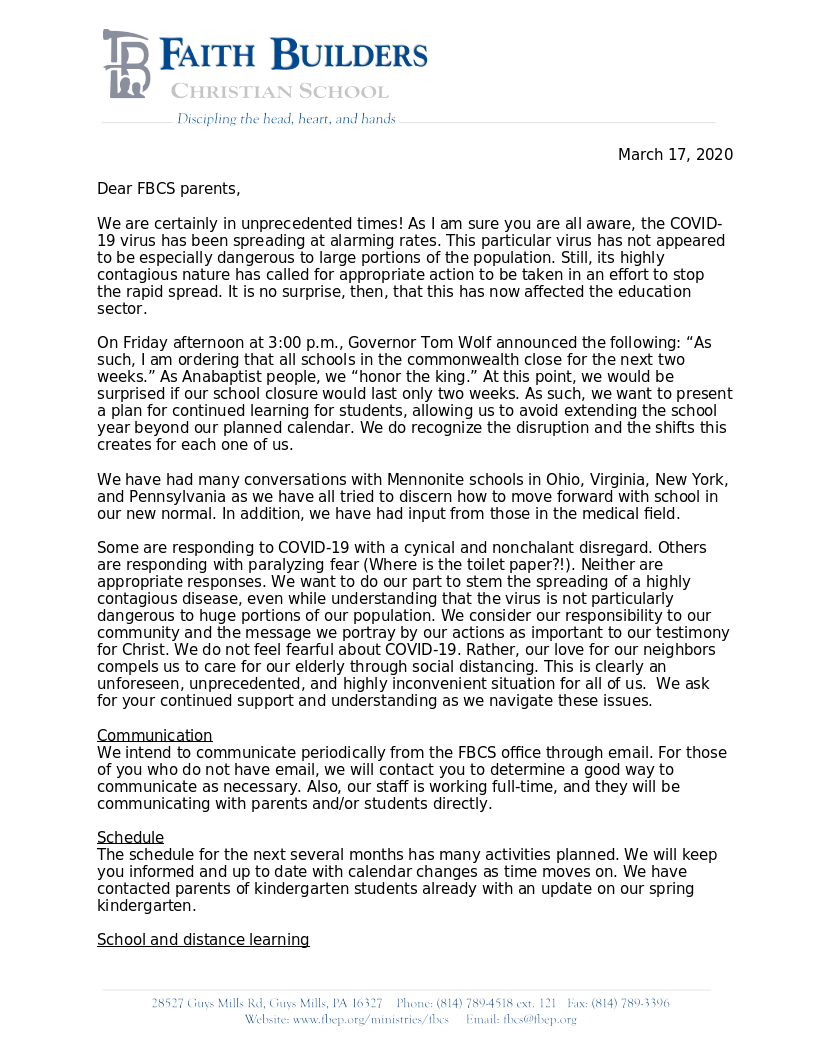
FBCS Letter to Parents Regarding Coronavirus
This is the initial letter Faith Builders Christian School sent to parents. It outlines how the school is planning to support learning at home. Within these parameters, each teacher sent out their own letter to each classroom detailing more specific procedures and plans.
Download the letter or preview it below.
The Board: Style of Governance
This session is part of the series on the structure and function of the board. Your school board is operating your school. Is it doing so effectively? Does it work like a well-oiled machine firing on all cylinders? Board efficiency and effectiveness grows with our understanding and fulfillment of our roles; our sense of mission, vision, and foresight; and will be tested by the various unique situations that will arise and require your direction in your individual schools.
The Principal: Job Description
This session is part of the series on the role of the principal or administrator. A team needs a captain, a work-crew is well-served by a foreman, and a committee functions best with a chairman. Similarly, a principal can be a visionary leader, an organizational director, and a helpful discussion moderator at your school. What should the board task the principal with? What are the dangers of letting him run the show or micromanaging him? How can you as a principal be an inspiration to both, your staff, and your board? We count on you to be the man of the hour for your school!

Effective Boards: Resolving Problems Together
This session is part of the series on the structure and function of the board. Your school board is operating your school. Is it doing so effectively? Does it work like a well-oiled machine firing on all cylinders? Board efficiency and effectiveness grows with our understanding and fulfillment of our roles; our sense of mission, vision, and foresight; and will be tested by the various unique situations that will arise and require your direction in your individual schools.
Ten-Minute Presentations: Hybrid Classroom, Technology, Victims in the Classroom, Finding and Training Teachers
Speakers offer a brief presentation of topics relevant to conservative Anabaptist schools: Individualized/Conventional Hybrid School: What are the pros and cons of a hybrid classroom? How can it be used effectively?When Students Play Victim: What are some underlying issues that might prompt students to claim that being subject to school policies causes them to feel unsafe? Finding and Training Teachers: Identifying, training, and sustaining our ownTechnology and Our Children: Technology
The Principal: Dealing Effectively with Issues
This session is part of the series on the role of the principal or administrator. A team needs a captain, a work-crew is well-served by a foreman, and a committee functions best with a chairman. Similarly, a principal can be a visionary leader, an organizational director, and a helpful discussion moderator at your school. What should the board task the principal with? What are the dangers of letting him run the show or micromanaging him? How can you as a principal be an inspiration to both, yo
The Principal: Proactive Initiatives
This session is part of the series on the role of the principal or administrator. A team needs a captain, a work-crew is well-served by a foreman, and a committee functions best with a chairman. Similarly, a principal can be a visionary leader, an organizational director, and a helpful discussion moderator at your school. What should the board task the principal with? What are the dangers of letting him run the show or micromanaging him? How can you as a principal be an inspiration to both, yo
Encouraging the Construction of Solid Foundations
This session is part of the series on nurturing and training children. Steve encourages parents to guide their children through stages of maturity. It is no secret that Judeo-Christian values have been increasingly under attack by our humanistic society. What is more sobering is how much those ideas have infiltrated our own thinking and affect the way we have been raising our children. From even before conception, when children are now considered optional instead of a God-given responsibility, a
Examining the Elements of Solid Foundations
This session is part of the series on nurturing and training children. Steve offers guidance on training very young children to hearken to their parents and other authorities. It is no secret that Judeo-Christian values have been increasingly under attack by our humanistic society. What is more sobering is how much those ideas have infiltrated our own thinking and affect the way we have been raising our children. From even before conception, when children are now considered optional instead of a