
All Content


Becoming an Effective Teacher: Managing the Demands
Since we care so much about doing everything well we shouldn't try to do everything. Lest we burn out in our efforts to serve students, parents, and the church, Anthony urges us to consider our limitations and find ways to manage the demands on our time and emotional energy.


Trauma: How Can I Teach This Child?
Johnny shows no physical signs of developmental delay, but early trauma has a part to play in the missing pieces of his development. In Part 2, we want to discuss how we as teachers can help trauma children grow in their ability to cope with life and learn all they can in our classrooms. Although not the only ones affected, foster and adopted children likely experienced trauma in their early life.
Dyslexia: Signs, Symptoms, and Solutions
After de-bunking the common myths, this breakout will give an overview of dyslexia including early signs, school-age symptoms, and solutions. We will discuss effective academic interventions as well as appropriate classroom accommodations. This information is valuable for all teachers, particularly those of the lower elementary grades.
Astronomical Adventure
This breakout details a variety of astronomy related activities useful for teachers who wish to encourage students to appreciate and experience Gods handiwork. There will also be a quick sky tour along with a brief discussion of distant starlight in a created universe. Presented from the perspective of an amateur astronomer with 40+ years of considering the heavens.
3 Components for a Successful Reading Class
This breakout will look at three components of teaching reading. First, we will consider a teachers purpose for the reading class. Next, we will address student preparation for an effective reading class. Finally, we will share a list of ideas for active student participation in reading class.

Sensory Therapy at Home

Photo by Tatiana Syrikova from Pexels
When my son turned one, his throttle got stuck on full speed ahead. He moved constantly, took off running on the sidewalk and never looked back, and lunged headlong down playground slides. Wheeee! He loved touching things, the sloppier the better. He made soup on the dining room linoleum when we weren’t looking, cracked eggs onto the piano, emptied the bathtub onto the floor a bowlful at a time, and knocked over objects just to hear them crash. Anything sloppy or squishable or fuzzy was irresistible. He was driven by his senses.
Since then, I’ve met other children like him, children who go hog-wild as their bodies and minds crave more, more, more sensation. You’ll know them by the haggard look in their mother’s eyes. If both of them survive the toddler years, they’ll be just fine.
On the other end of the normal spectrum, which incidentally is wide and forgiving, some children find sensory stimulation overwhelming, and shrink back from intense environments or unmanageable opportunities. You’ll find them plugging their ears a lot (too loud), pronouncing certain foods inedible (too crunchy/ too slimy/ too spicy/ too cheesy), melting into tears over clothing textures (too scratchy/ the tag is pinching me), and objecting to strong smells or loud noises (I can’t breathe/ take it away).
You might call the one side “sensory avoiding,” with the world too vibrant and loud, and the other side “sensory seeking,” where the jolt is never quite enough. We’ve had a variety of sensory issues in our home, but as I said, primarily sensory seeking. We needed to discover a lot of “sensing tools” for curbing attitudes, relieving pressure, bringing peace, and creating fun (mostly so that my houseplants could keep a few leaves, and I could stop scrubbing generous swooshes of maple syrup out of my carpet).
Our sensory seeking children lapped up every idea we had. Along the way, we also found that avoidant children who find particular sensory things deeply disturbing typically find others extremely soothing and pleasant. Only the caregiver, or the child himself, can tell which sensations will be pleasing and which will not, but it never hurts to offer or invite. Forcing, surprising, teasing, or insisting will only defeat the purpose. Childish sensitivities are often tangled up in genuine compulsions and fears.
Here’s our list of simple activities and helpful products to create good sensation for a child who needs it.
- Take him outside as often as possible. Sticks and creeks and grass and mud are God-given sensory tools, nearly always available, low risk, and healthy. Dirty clothes are a small price to pay for hours of happiness.
- Let him take extra baths – relax, play a lot in the water, have fun with bubbles or good toys. It’s a mostly-confined place to splash, and water is incredible.
- Where sitting in one place is essential, such as school, family devotions, or quiet time, add good sensory feelings by allowing him to sit on a balance ball or an inflated balance disc, or with a weighted lap pad.
- Make bedtime more calm and pleasant with a weighted blanket, soft stuffed animals, or a sequined pillow cover.
- Turn on a sprinkler and let him run through it.
- Dig up earthworms to hold.
- Provide a mini trampoline to use up his energy before times of sitting, such as riding in the van or completing his homework. Ten minutes of exercise on a rebounder can help dramatically. Our private school bought one to keep in the first and second grade classroom for their high-energy students.
- Assign him a corner of the garden or flowerbed to make his own. Give him a trowel and some seed packs, and don’t overmanage his methods. (You may need to transplant a few seedlings there while he’s napping, if his seeds made it halfway to China.) Or just provide pots for growing plants in smaller spaces.
- Charm his need to fidget in church with an activities pillow or a DIY quiet book. (Find great tutorials, including no-sew versions, on YouTube.)
- Give him a stress ball, fidget cube, or other small fiddley toy to keep in his pocket.
- When it’s time to calm down, take ten minutes to run your fingers lightly through his hair, or over the bare skin of his face or arms.
- Learn to hold your child snugly, with as much body contact as is comfortable, a warm but not panicked enclosure. This is good for snuggling times as well as for calming a meltdown. Learn how to do joint compressions.
- Do the beach towel wrap: lay a big towel on the floor, have your child lie across the short end, and roll him up tightly like a burrito. It sounds silly but feels amazing, and usually everyone lines up for a turn, amid lots of laughter.
- Keep big fuzzy blankets and soft cushions in your main living spaces.
- Box up anything sensory from the outdoors and bring it inside. Toddlers can play for a whole morning on a towel-covered kitchen floor with a stainless steel bowl full of snow, and a few spoons and scoops. Same with sand, if you’re brave. Sans outdoorsy kinds of weather, you can use a cheap bag of dry rice or beans similarly, for measuring and scooping.
- Let him play with ice cubes.
- Make slime or Play-Doh. Let him help concoct as well as play with them. Homemade versions last longer and feel nicer.
- Sign him up for helping with any messy dinner prep. Mixing meatballs with my hands is one of my least favorite cooking chores, and my son’s favorite.
- Or just bake together – kneading bread dough, shaping homemade tortillas, rolling pie crust, and cutting out cookies. Coach him through making soup. Let him cut all your veggies for dinner, if you can trust him that long with the knife.
- Find all the hands-on crafts you can. Finger paints and modeling clay and bubbles and sidewalk chalk. Put together lots of puzzles.
- Maximize a family pet, something cuddly and soft to stroke. If you’re worried about him being unkind, get something small that can be caged up when he starts getting rough, like a hamster or (shhh) a mouse. Playtime with this pet could be a reward for gentleness with humans at other times of the day.
- Create sniff tests for fun, using spices or baby food jars with the labels removed.
- Provide musical instruments, real or makeshift. Pots and spoons to bang, shakers made with Tupperware and pebbles. Piano lessons and guitar chording.
- Shop for clothes together to reduce battles over the feel of fabric. Honor a child’s texture preferences when you can – the warm and wrapped or the loose and cool. Soft or crisp. Cotton or silky. Or just browse through a fabric store fingering textures, and talking together about what you feel.
- Visit a farm. Cows are great for sensation, calm and stolid and extremely slick at points.
- Print scavenger hunts from the internet, with items to gather or photograph or touch or taste.
- Bury tiny treats like M&M’s in dry pasta, and blindfold your child and have him find and eat them. It’s harder than it sounds.
- Let him take before and after pictures of his room when it’s time to clean up. Seeing the difference helps, and show and tell is fun.
- Offer a wide variety of music, both recorded and live. Play background tunes of diverse styles, from boisterous foreign language to soothing instrumental. Attend concerts and programs.
- Exchange foot massages, back rubs, and relaxed times of hair brushing. My daughters love combing my husband’s hair – running a brush through it to make crazy styles, and spraying all over with water till it’s so soggy it drips.
- Build with wooden blocks.
- Make your outings sensational. The lakeshore, a children’s museum, the playground, a gravel pit.
- Encourage the snipping up of the right kinds of paper (as opposed to the family Bible handed down from Grandma). Gather old magazines and newspapers. Let a preschooler scissors-cut to his heart’s content, showering the floor with snowflakes, but encourage an older child to cut out all the {whatever he finds}: animals, capital letter A’s, blue font, pictures of living things – as hard or easy as you’d like.
This list is just a start, but I hope it gets you thinking. Children who receive the sensory input they need will be far more relaxed: anchored by joy, ready to pay attention, and able to interact with others in meaningful ways.
And their moms (I’ve been there) may look a little less ragged.

Needed: Online tutor for 7th and 8th grade students
We homeschool our children. I'm interested in a solid Christian tutor who could help my seventh and eighth grade girls via the internet. They are doing the Christian Light curriculum. I don’t think they would need help with every subject. Mostly math and language.

To the Experienced Teacher

Photo by Aaron Burden on Unsplash
One of my first-grade art projects involved sprinkling dry tempera paint on wet paper. The children enjoyed the project, but the result was a horrible mess, a frustrated teacher, and likely an annoyed janitor! I declared I would never do that art project again. I was a first-year teacher who had enthusiasm and big ideas, but not much experience or the wisdom that comes with experience.
In 33 years teaching, I have not repeated that art project! I have enjoyed many other art projects and have learned to plan ahead more and think through possible scenarios before proceeding with ideas. The enthusiasm of the beginning teacher is needed in our schools, as well as the wisdom of the experienced teacher. Many articles are written for first-year teachers as they begin school, and that is great. But here I address the experienced teacher beginning a new school year.
- You get a fresh start each fall. At the end of the school year or semester, I sometimes think, “I wish I would have done this better” or “I ran out of time to do that” or maybe “I don’t feel like I accomplished all I wanted to.” We get a new start in the fall! I can work harder at teaching this concept, try this idea for reading, gather more data and apply it, or spend more time preparing lessons.
- Keep out of the ruts. If I’ve always done it that way, it might be time to change procedures. I don’t want to just plod along, but I want to make my teaching interesting for my students and for myself. (There are some ruts that are okay – if I’ve tried different ideas and found one is actually the best, I may continue with it.)
- Add something new. It might be a new lesson, a new story, another motivational activity, or a different game. As in the song, “Make new friends, but keep the old . . .” Keep those favorites and those time-tested activities but add new ideas to keep up your interest and motivation. I might try to add one new idea in each subject in a week.
- Evaluate lessons, teaching ideas, and methods. We don’t need to change just to change but do change if there is something better to do. If it works well, and you like the idea, keep doing it.
- Be open to other ideas. Talk with other teachers. Read teacher blogs, books, and articles.
- Keep learning and growing. I have learned a lot through the years – from colleagues, other first-grade teachers, reading, taking classes, doing webinars, attending seminars, and school professional development.
- Don’t reinvent the wheel. It is good to change things and not always do something “because that’s the way we’ve always done it” but there are times when we don’t need to change something. For a while I thought I should write new lessons each year, until I was advised that I didn’t need to reinvent the wheel. If I have already written a lesson plan for teaching fact families, I don’t need to redo it. I may need to adjust it for a different class and different student needs, but the base of it does not need to be redone.
- Be open to advice. Yes, I’ve taught a number of years, and dealt with many kinds of situations, and have several years of training, but I can still learn from others. I may apply the filters of my experience and my knowledge of first-grade but I can still listen to and accept advice.
- Be careful on giving advice! (Although I guess that is what I’m doing now!) This is something I struggle with, as I feel like I have a lot I’d like to share – not to be bossy but to be helpful. I don’t want to be intimidating to others or seem like I know it all. I do feel like I have a lot of experience and ideas and enjoy sharing. I sometimes feel that is not needed, though, so I’m learning to keep quiet unless asked!
- Enjoy the years of experience. Be thankful that you’ve learned how to handle many kinds of situations. Look at challenges as a way to grow and apply those years of experience.
I enjoy teaching “grand-students” now (children of my former students) and having former students as colleagues. These are more benefits for the long-term teacher.
A mother contacted me and said she had concerns about her child coming to school. We met and she shared her concerns. I said I have a few years of experience and I don’t feel scared about her child’s behavior difficulties. I look forward to having him in class and will be glad to work with him. This will give me an opportunity to apply some of my years of experience!

Needed: Your Input; Filling Your Role at Your Next Meeting
The willingness of your team or committee or board to engage in a meaningful and respectful dialogue will greatly affect the outcome of the meeting.
Remember, the outcome of the meeting is really why you're here. The outcome of the meeting not only affects the people around the table, it affects your school staff, it affects the students, it affects the entire school community, parents, the homes. It affects the church community, it affects future generations. Think of it in that regard is the outcome of this meeting, it's going to have a ripple effect. You should think about that as you engage in meetings.
This is the meat of the meeting where you engage each other. This is the fun part. In the school setting, you are elected to this work, thinking specifically of board meetings, you're elected to this work, and it is your obligation to take it seriously. The Bible parable of the talents comes to mind on this right here. Each of us around the table have been given talents. In the parable, there was talents given out to individuals, one to five talents. Those individuals were called to trade them, and that's our call. We're given talents. We've been elected to the work. We're together to trade our talents in this marketplace of ideas around the table and to generate returns for the kingdom. As we choose to take our responsibility seriously and fully engage in meetings, not for the sake of our own agenda or our own ego, but rather for the sake of the good Master that gave us the talents in the first place.
This is why we're here, at board meetings. We have talents. We've been asked to trade them in this marketplace of ideas. It's for the good Master that we do this, it's not for our own ego, not for our own agenda. Think of it this way. He's looking for a return on his investment. He gave you talents, he wants return.
We're at a meeting, we're ready to engage. What are the rules of engagement at a meeting?
First off, I'd like to say, understand that in meetings we are called to tackle ideas, situations, behaviors possibly, but never people.
We need to find clear and respectful words to communicate exactly how we feel, no beating around the bush, no gaps, hoping that others will understand what I'm thinking. You need to be crisp and clear with your communication.
You need to be honest with your thoughts. That's what makes engagement possible. For some that's more natural than others.
Also be okay to challenge other's ideas. Now, this one's a little tough. You can actually do this in a respectful and godly manner. Remember, you are not assembled to simply agree with each other. That's counterproductive. You're obligated to challenge each other for the good of the cause, and in your case, the cause is the school. You're obligated to challenge each other. You need to do this. This is why you're assembled.
Decision, simply the word "decision" implies the end of deliberation and the beginning of action. Decision means we're done deliberating, we're now going into action mode.
For a fully researched and well discussed and fully supported decision to become reality, there's likely going to be a messy period somewhere along the way where there's conflict. That's just how it is. For a really good decision to be reached, somewhere, as we journey towards that decision, there's going to be a period where it's messy. We don't quite know where to grab ahold of it. Meetings are not always just smooth, structured conversation. There's going to be a messy period. Be okay with a little bit of that mess and that dynamic.
There may be some emotions. Healthy conflict in meetings is a good thing. You should never shy away from healthy, respectful conflict. For conflict to be good and to be possible and to be Christ-like, you need to be completely honest. You can't be holding back because you're afraid of what others think, you have to be completely honest.
You need to be personally vulnerable. You're sometimes going to say that might expose you, you're going to be vulnerable. You need to have low levels of ego, no ego and high levels of humility.
Conflict is a display of passion. Passion leads to good decisions. As Christians, sometimes we struggle with this because we're taught, from young up, not to have conflict. We try and minimize and avoid conflict at all costs. Conflict is different than an argument. If we avoid conflict, this will take us to the passive extreme all the way to the point where all we have left is a social huddle of men that sit together, maybe we drink coffee, and at all costs, we avoid conflict. Good decisions are hard to reach, and the outcomes will be very weak.
There's another dynamic that is much harder to talk about, but I'm going to touch on it a little bit. This dynamic is not limited to school meetings, but it does happen at board meetings. It does happen in the context of Anabaptist meetings. In life we have this hierarchy of leadership and influence. That's good. That's fine. That's what the structure is all about. Yet, in our meetings, we go to lengths to make pretense of group decision. I'm not going to unpack that too far, other than I will say this: if you are at a meeting and you are self-aware enough to know that your voice would carry the day, if you re self-aware enough to know that that's how it is, then the others around you, the others at the meeting are most likely hyper-aware of this. You will need to work extra hard to deflate fear of others sharing their opinion. You're going to have to work extra hard.
When you have a group of men that are just waiting for me to talk, because my opinion is going to rule the decision, that's not a meeting. That's not healthy. Yes, there are meetings where certain voices will hold higher weight. I understand that. I think that's Scriptural, there's nothing wrong with that. However, you don't want to stifle conversation and input from others just because of who you are and because of your trump card. You need to be very aware of this. I've been on both sides of this equation. I speak business setting, I speak school setting, I don't make a good puppet, and I have no interest in making other people puppets.
This is why we have a meeting: we want everybody's input. We have an obligation to do this in a very constructive manner.
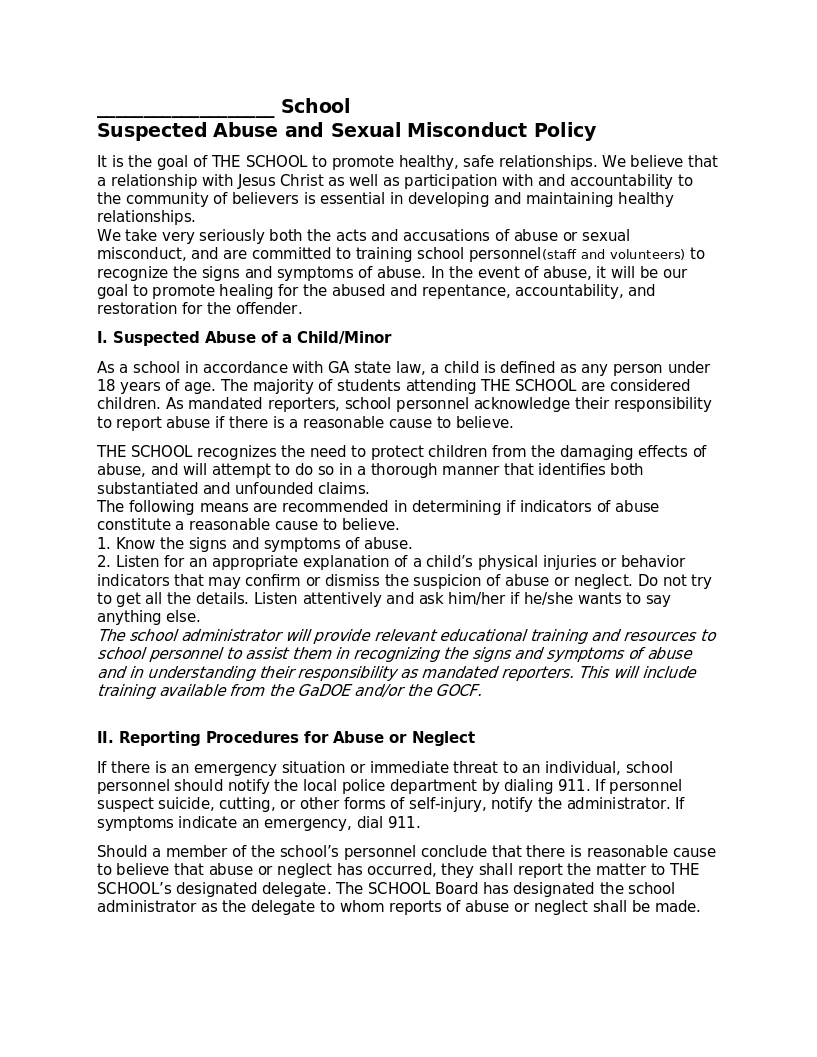
Abuse Prevention and Reporting Policy
How do you guide your staff in avoiding event the appearance of evil? This school policy outlines the parameters for healthy relationships and the reporting expectations when abuse is suspected. Use it as a starting point for your own school's policy.
Download the policy or preview it below.
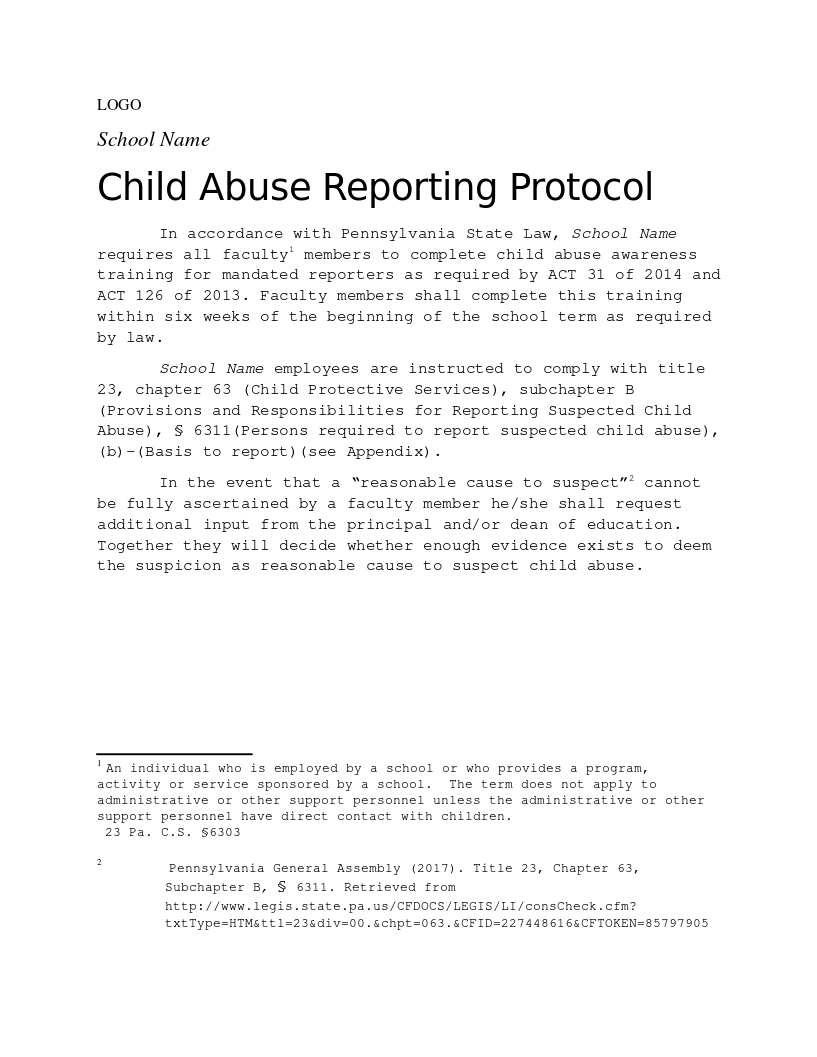
Pennsylvania Child Abuse Awareness School Plan
This document from a private Pennsylvania school outlines expectations for staff training and responses to suspected cases of child abuse, and refers to the appropriate state statutes. Use the plan as a starting point for your own school's policy.
Download the policy or preview it below.

Return
 Image by congerdesign from Pixabay
Today was our first day of kindergarten. In a normal school year, we hold a two-week kindergarten in April. This year in April, the twelve children who were eagerly counting days until they could go to school were sadly disappointed. We made tentative plans to hold kindergarten sometime during the summer. This week it happened. Today we went to school. We were the only class in the building, but we practiced walking in the halls, raising our hands, and writing our names. It felt good.
It was good to be back. Back to the job I enjoy. Back to teaching real students and not sitting on the sideline running after a few stray balls while busy moms do the job I am supposed to be doing. I didn’t realize how good it would feel.
I am enough of a pragmatist to not grieve over the lost opportunities of the last quarter of the past school year, but the feeling of guilt never quite went away. No matter that there was little I could do to change the course of the year, it still haunted me that I wasn’t quite doing my job. I enjoyed staying in bed a little longer in the mornings but knew there were moms who were getting up extra early to have time to fit school lessons into their day. I enjoyed the freedom to pursue other interests but knew there were students losing out on schoolwork because their mothers didn’t have the time, resources, and experience that I had in the classroom. (I knew because the mothers told me so.)
Spring is always an intensely busy time in my life. School activities and life outside of school combine to form a wearying race in a normal year. This year I enjoyed a relaxed pace since the events of the school year were cancelled. I was available to take on extra duties at home. This was a blessing. I should be grateful to God for giving me this respite, not feel guilty because I was blessed with more time while others had less. Still, it haunted me.
And now it is summer. We are still trying to end one year while getting ready to start a new one. The books are finished. They’ve been returned to the school. The report cards are done but still in my desk, waiting to be given out. Slowly we’ve been pulling the last bits of the year together. A graduation happened last week. The school newspaper and annual are being printed. One evening soon we hope to finally have an end-of-term picnic, hand out the last of the awards, certificates, and report cards, and at last put an end to the 2019-2020 term. But we’ve also got the school books for next term piled in the library waiting to be unpacked. Teachers are working on walls, record books, and material for next term. New supply lists are going out. The 2020-2021 term is quickly approaching.
Into this mixed up school summer scene is also added the uncertainty of what school will look like next year. Can we all go every day? Do we have to sit six feet apart? Will we need to wear masks, take temperatures? What about recesses and lunch? What if someone’s sick? There are still a lot of unanswered questions. Ideas and requirements change often.
No matter what form school takes in the next months, one thing is unquestioned. When we can go, it will be good to be back.
