
All Content

January 2022 Progress Report
In the last quarter of 2021, the oversight committee for The Dock identified user experience and site organization as key foci for optimization. Since then, we have taken steps in that direction:
- Moved to premium hosting to handle the complex demands of the site.
- Changed a core component of the WordPress stack to allow for greater flexibility in creating layouts.
- Improved the layout of search results.
- Improved the layout of contributor pages.
Next steps to be taken include improving the search experience, tweaking the home page, and making curated content more visible to users.
We also continue to seek quality submissions from educators! We are in the process of recruiting new bloggers, and are pleased to offer Conversations at The Dock as an interactive space for discussion.

How to Retain Quality Teachers
 Note: The following article, written as an open letter, offers a mix of general principles and specific recommendations for leaders of schools. Not all of the recommendations will apply to all situations and leadership structures, but perhaps they can seed ideas that would apply. The ultimate goal of the piece is to inspire school leaders to cultivate a long-term vision for their school, specifically as it concerns teaching staff.
Dear school board members and administrators,
It’s that time of year again when you’re hoping that all of your teachers will return so that you aren’t beating the bushes trying to find teachers for next year. Here are seven principles and practices, along with some simple suggestions, that will increase the chances of your teachers returning.
1. Communicate regularly with your teachers.Suggestion: Once a week, meet with all the teachers first thing in the morning before school begins to touch base, talk, and pray with them. I know of one school board member who not only meets with his staff once a week but brings them breakfast every time as well.
2. Listen to your teachers.Suggestion: Have a private meeting with two to three school board members and each teacher. It is wise to do this a month or so before you plan to ask them to return. Ask them the following questions:
- Are you happy here?
- What are your favorite parts of this job?
- What are your three greatest challenges?
- How can we help you with these? Assign someone to help and follow up to see that changes are made.
- What would you like to change and why? Within reason, allow them to make positive changes in their classrooms.
Suggestions:
- Give teachers Christmas bonuses, gift cards, meals delivered to school, dinner invitations, etc.
- Have a teacher appreciation banquet and let the students serve the teachers.
- Assign mothers to provide lunch for the teachers once a week. I know of one school whose mothers do this weekly on the mom’s prayer day.
- Encourage parents to bless teachers with coffee, cards and notes of appreciation, cash, gift cards, etc.
Suggestions:
- At the meeting, give them a card with a cash bonus inside. (This is separate from the Christmas bonus.)
- Provide lunch for all the teachers the day you plan to meet.
- Ask them what you as a school board can do better.
- Ask them what they would like changed at school.
I know of a large school whose school board has done this for several years in a row, and most of their teachers return year after year. I know of another school in which the teachers just received an online form to fill out stating their intent for the next year. Several of that school’s teachers did not return. Teachers work hard. Doing little acts of kindness like these do make a huge difference to them.
5. Pay your teachers well.This is always an area of concern, but just read these examples about two schools who are consistently retaining married men teachers with families and experienced women teachers year after year. If it makes this much of a difference, isn’t it worth doing? And, Jesus said, “Do unto others as you would have them do unto you.”
I know of one church whose brothers write down their yearly salary on pieces of paper anonymously once a year around tax time and then collect them in a hat. Then they figure out the average salary and that’s what they pay the teachers. Not the lowest—the average. That’s amazing, and those teachers feel valued. That’s why they stay.
I know of another school that compared the highest salaries of their teachers with the local poverty level. Sadly, their teachers, especially the ones with families, were below the poverty line. So, the school board did something about it. They decided to give the teachers a 20% raise across the board and gave a little extra on top of that for those who had families. The patrons paid the higher tuition rates, the teachers were happy, and most of them are planning on returning next year.
There also once was a school which asked a married man with a baby on the way to teach at their school for two years with no pay. You read that right. Do you think he accepted that? Can you think of any other job in which the boss would ask an employee to do that? Teaching children is super-important, and we need to attract high-quality individuals who are experienced and really care about what they are doing. It should not be viewed as a volunteer position, especially if our goal is to have mature, godly, experienced teachers guiding our children all year long.
Most businesses give their employees a cost of living raise yearly, so at least try to do that. It is discouraging to not get at least a little bit of a raise. Many schools also have sliding scales based on the teacher’s level of education and number of years taught. This is a very fair way to reward teachers for their time, education, and efforts.
6. Help pay for their continuing education.Suggestions:
- Pay for all of the costs for your teachers to attend Teachers Week or Summer Term at Faith Builders.
- Offer to pay for ½ of the tuition costs if they would like to take any college courses for educational purposes.
These are long-term investments in your school. The teachers are investing their time and money; meet them in the middle and let them know that you appreciate their taking the time and money to be a better teacher. If they are going to the effort to learn more about teaching, they obviously enjoy it and will hopefully stay long-term. There is one school I know of that pays for 100% of the college costs for any teacher who wants to get an education degree. In return, the school asks for a five-year commitment from the teacher to teach at their school.
7. Treat your teachers with respect and speak respectfully about the teaching profession.Training the next generation is important, and those who spend most of their time doing it should be respected. Especially, treat older and more experienced teachers with respect. And don’t treat younger, inexperienced teachers like they are doing volunteer service for a year or two. Don’t talk down to them, and don’t act like you expect them to just teach a year or two and then leave. Encourage them to make it a career choice, and treat them as valued, long-term employees.
Also, don’t make jokes or demeaning comments about teachers or their pay. We were once told by a school board member that they had hired a teacher because, “He couldn’t do anything else, so we asked him to teach!” He laughed, and we were appalled. We’d spent a total of fourteen years in universities, and sixteen years working in education. We didn’t think it was funny at all, and we certainly didn’t feel valued by that board member.
These seven principles will do wonders to keep your teachers happy and to keep them teaching in your school. In the long term, everyone wins, especially our most valued commodities: the children in our churches and schools, the church of tomorrow.

Introduction to Diverse Learners: Autism Spectrum Disorder
Perhaps you've heard about Temple Grandin. She was one of the first people to give a voice to or speak about what it's like to have autism. In 1991 was the first time that autism was labeled or identified as its own category in special education. And in the last twenty or thirty years, we have learned so much about autism.
The Continuum
And today each of the different disabilities that are similar to autism are kind of all put together in something called Autism Spectrum Disorders. And in Autism Spectrum Disorders, it's a spectrum, which means that there is a continuum of ability levels within this spectrum. In the autism spectrum, on one end, you have something known as high functioning autism. And in the middle, you might have something moderate autism, and then severe or profound autism on this side.
The autism spectrum could look something like this. And on one side, like, when you have high functioning autism, there's just a little bit of weakness with communication skills, and then that communication, the ability to communicate well with others gradually gets worse as you go down the spectrum.
So the autism spectrum could be thought about in just a single line like this. But autism, the spectrum could also be thought about more like this, where we have all the different components of an individual, and so their IQ, their social-emotional interaction, communication, motor skills, fine motor, and sensory—all these different components fall on the spectrum. And so a child could (like as far as their IQ) they could have a severe low IQ, or they could be gifted and have a high IQ. In the area of social emotional interaction, a child with autism could be more in the aloof category, but they could also on the other end of the spectrum then, a child autism could be active, very involved. We just have some of those may be social tendencies that may seem a little bit unique or different than what we would typically expect.
Generalizations
Author Lynda Young, in her book Hope for Families of Children on the Autism Spectrum, states, "If you've met one child on the spectrum, you've met one child on the spectrum. They're all different." And I think it's important for us to keep that in mind.
Every child with autism is different, and there are still some general things that in general these individuals struggle with. This would be things like difficulty reading social cues and making eye contact when they're talking with someone. Also, a child with autism might struggle with repetitive behaviors, things like hand flapping or eye twitching. But sometimes a child with autism doesn't have that at all. And so, again, there's these different things that all fit into the autism spectrum category, but you won't always see them.
Another thing that a child of autism can often struggle with is sensory overload, or they will just like something that sounds that I don't even hear. They will hear these tapping or these sounds that can be very overwhelming. And listed in the description is a link for a video that shows what it can be like for a child that is struggling with sensory overload, like just when they go out into public, what are all these things that might be coming at them that I would never think about? Or in the classroom even, if there's a little noise of something buzzing that could sound like an obnoxious noise to a child that's struggling with the sensory piece of things.
Children with autism also often have very intense interests and something specific, like maybe in outer space or a specific part of math. They can just have these intense interests that really can be a strength of theirs. Their ability to remember lots of information and share it. Those are just some general things that we can think about when we are working with a child with autism.
Applied Behavior Analysis
When a child has been diagnosed with autism, one of the methods of therapy that is very common (it's very accepted by professionals today) is something called ABA or Applied Behavior Analysis. And this is like the systematic method where the professionals would teach skills to individuals with autism. They kind of pick specific behaviors or skills that they want to learn and systematically train the child to learn how to do these behaviors.
And there's a book that I found really helpful. It's called A Parent's Guide to Autism. So it's for parents, but I found it very helpful for teachers as well. By Ron Sanderson. And this would go into a lot of details explaining what this ABA therapy is all about and how it works. But I think for teachers, it's helpful to understand how they analyze behaviors. I think that understanding a little bit about that is helpful for us as we're working with these (maybe perhaps) challenging behaviors in our classroom.
So what happens when... Or the first step when we're looking at these challenging behaviors is kind of to analyze them and to ask ourselves, "So when is this challenging behavior happening? Is there something that is setting this child off that's making this behavior occur?"
It's called the predictor or an antecedent. It's what comes right before the behavior. So, for example, if a student has angry outburst, we might say, "Well, he is showing anger." Well, the question I would ask is, "When is this happening? Is it happening in a certain place, at a certain time when he's encountering a certain challenge?” So what they will do is they will look at what comes right before this behavior and then think about, well, what is the result or what is the consequence of this behavior?
Reasons for Challenging Behavior
And there are many different reasons that a child could be exhibiting any kind of challenging behavior. Maybe they tear up their math paper when they don't want to do it, or maybe they're being unkind to their peers. And so sometimes, let's just say for example, a student tears up his assignment and throws it on the floor. And this happens repeatedly. And then he is sent to the office or sent to talk to the principal; that's the consequence or the result of this behavior. And it turns out that this child continues to do this behavior so that he can avoid this difficult thing that he's encountering in his work. And so what happens is when he is sent out of the room to become more stable and ready to learn again, he actually is getting what he or is actually reinforcing his behavior. And so what these therapists are doing is saying, "Well, what reinforcements could we give instead that would modify this behavior so that it will improve and or lessen?" A child... There could be many different reasons for a behavior. So a child with autism might be doing their repetitive emotions as a way to calm themselves down so that you might see it happen when they're getting really uptight about something or really nervous or anxious. You might see that those behaviors show up more often then. Sometimes a child will exhibit a certain behavior because they're trying to get something, because they're trying to get attention or they need to stimulate themselves. In this therapy they're really analyzing behavior. And I think that that's something that we can think about as teachers too. What's leading up to this behavior, what's the consequence of it, and how can we shift this to help things improve?
There are other approaches that we can have when working with a child with autism. So there's many different things we could try. You could try teaching social stories, using social stories to teach them. How should we be behaving in this particular setting? I think we can teach students coping methods and ways to work with their differences, and it's who they are. And it's not something that we have to necessarily change or get rid of. It's something we need to use in a way that can work in the environment of the classroom or in life. Students can learn how to cope with the challenges that they are facing. In the classroom I do think that it's important that I think our task as a teacher of a child with autism is to cultivate a classroom environment where they can thrive. And for a child with autism, things like having a fixed schedule where there's a lot of routine, we know what's going to happen. There are not surprises in our day. That helps to bring stability to their lives.
Also, I think it's important that our classroom environment isn't too overstimulating. And so if you think about all the things that they have to take in the world, it just looks different than it might to me. And I think we need to be careful that we don't have too much going on in our classrooms, too many distractions or things that can overstimulate. And this is kind of in general, with disabilities, but I really see that students emulate their teachers. The way the teacher acts toward a child with a difference or a learning disability, they mimic that, and the way that I talk to a child with autism, they will do the same. And so I really think that it's important as teachers that we're modeling this love and acceptance and all of these pieces that play into how we want our students to interact with each other.
Those that specialize in the field of autism have many resources that can be of help to you and the families that you serve. I will link below in this video some other resources, some additional books, some other websites that could be a good place to start when you are thinking about looking more into autism spectrum disorders.


Hope
 Photo by Натали Хмельницкая on Unsplash
“A thrill of hope, the weary world rejoices, for yonder breaks a new and glorious light!” (Placide Cappeau)
It really feels like a weary world, with many hard things in our school family, troubles in the world, COVID, death, illness, cancer, and more. We had a paper chain in my class to count down the days until Christmas, and each link had something to do, a song to sing, or some activity. One day the link said, “Do you know someone who might be sad at Christmastime? Is there anything you might do?”
We talked about hard things and sad times and what we can do for people going through these times. The children said we could pray for them, we could make cards, or we could give a gift. Jason said, “But we still have hope.” I was blessed by his response, and have been thinking about hope. Jason knows about hard times. He has been telling us about a family friend who had a brain tumor and recently died.
Recently I’ve been to viewings three Thursdays in a row—for a school janitor, a colleague’s mother, and then the father and husband of two of our teachers. A couple school grandparents also died recently. In October, one of my students fell in the gym and was taken to the ER and admitted to the hospital with a concussion. This was scary for all of us, as she was not responding well at first.
I had to talk with my class about the death of the teacher’s father. (I first said he passed away, and then realized I needed to use a different term. One of the children later told me she used to think passed away meant you were driving and you passed something.) I related this to something they would know about—the death of a pet. One of the children had just told me her kitten had died. We talked about being sad, and that it’s okay to be sad. We sorrow, but not as those who have no hope (1 Thessalonians 4:13). There is that word hope again! We are sad because we miss them. I talked to the children before they had art class, thinking that art would be a comforting time for them.
I’ve realized it’s important for the children to DO something to help in handling these hard things. We made cards for the girl with the concussion. We made cards for the teacher whose father died. We talked about appropriate things to write, and it was good for the children to think through that. We pray for people in difficult situations. I was blessed with the children’s listing of people we should pray for, and of how they remember that. Jason prayed for them in his lunch prayer. I prayed for one of the families in the morning of the funeral, but in my end-of-day prayer, I didn’t think of it. As soon as I said, “Amen,” one of the children said, “You forgot to pray for Miss Lynn!”
Some other things that help us deal with the hard things are writing or drawing, doing journaling, reading books, Bible verses, doing a Bible lesson on heaven or having a lesson on hope (I’m working on that one!)
I have been meditating on the importance of praise, even in the hard times, so we are singing a song of praise each morning with our devotions. I told the class today that they can choose the praise songs. The choice for today was “Joy to the World” so we praised God to start our day.
Book Review: The Happy Teacher Habits - 11 Habits of the Happiest, Most Effective Teachers on Earth
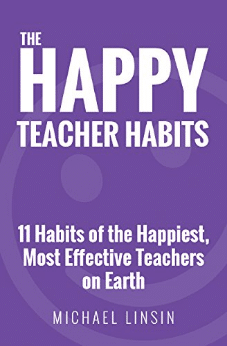
I’ve been a fan of Michael Linsin for a few years now. I began with reading his information on classroom management which is fantastic, but more recently I’ve been intrigued with his writing on how to function well both in and out of the classroom, which is the topic of this inspiring book.
It is a quick read at only 127 pages, and it is an easy read, full of interesting stories that he weaves into each chapter. It has excellent advice for us teachers. Here is a short synopsis of each of the eleven habits of happy teachers according to Mr. Linsin.
- Narrow down your activities and commitments. Focus on the 20% of things that really matter to you and let the rest go. The other 80% doesn’t matter that much, and it’s taking up your precious time.
- Learn to say “no.” If we’re going to try to streamline our lives so that we can be more productive and function better in the classroom, we’ve got to learn to say “no.” If we can learn to do this, we will have more time and be able to focus on the most important things that we choose to spend time on.
- Clean up and declutter your classroom. Clutter is distracting and energy-draining. Get rid of what you can, store and tidy up the rest. You’ll love it and so will your students.
- Inspire your students to do well in their work by knowing your content well and by teaching it well. Present challenges, cheer them on, expect them to work hard, but don’t offer any external rewards. Teach them to value working diligently and to recognize and enjoy good work when they achieve it.
- Improvise! Know your content so well that you are an expert in your field. Then when you are teaching, you can improvise. You will be able to relax, be yourself, add relative information as needed, tell stories, and inspire your students with your knowledge in your content area.
- Tell stories. You should have many of these from your personal life, teaching experiences, and reading. Think of stories that relate to what you are teaching and use these stories to pull your students into whatever you are teaching on any given day. Linsin breaks this down into three nuggets: 1) Find the lesson objective. 2) Figure out how you can make this objective relative or interesting to your students. 3) Then tell a story that will help your students relate to or understand the objective better. This will draw them into your lesson and help them make a connection between real life (your story) and the objective in the lesson.
- Envision. Take a few minutes each morning to do a mental run-through of your day and to quickly go through your lessons. This is especially helpful if you are able to picture yourself responding to student misbehavior in a pre-planned way according to your, or your school’s discipline policy.
- Shift the responsibility of your students’ successes onto their shoulders. It’s their responsibility, not yours. Allow them to “wrestle” with a difficult math problem or with rewriting an essay. Inspire them with great lessons, give them good examples, but then give them the time to work through the hard stuff and let them achieve on their own.
- “Sway” your students to enjoy having you as a teacher. Be consistently pleasant. If you are nice to your students, they will want to be nice back to you. This doesn’t mean that you don’t enforce your rules; it just means that you kindly and politely tell them the consequences of their misbehavior and enforce them. The second part of this is trust. Always do what you say you will do so that your students will trust you.
Interestingly enough, part of this is being a dynamic teacher in front of the class but being a little aloof outside of class. He stresses that teachers should not ever try to be “cool” or buddies with their students. It’s the opposite: teachers should be reverenced and respected and being kind and trusted (and a little aloof) is a great way to achieve this status.
- Listen. In staff meetings and in the staff lounge, listen more than you talk. This way people won’t get irritated with you, and when you do speak, they will listen more intently. Listen to your students. If you listen more, you will understand them better, and that will make you a more effective teacher.
- Work hard. Being a great teacher doesn’t just happen. You have to work hard to make it happen. This means knowing your content, memorizing your classroom management policies and enforcing them, and trying to always be working at something so that your goal to become a better teacher will be realized. You’ve got to work hard to make it happen.
This book can be ordered online on Amazon. At Lipsin’s website, you can find many other interesting books and articles on teaching and classroom management. I cannot recommend one hundred percent of everything he writes, but much of it is positive and I have found it to be very helpful.

- 261Page 70