
All Content
Challenges and Opportunities of a Smaller School
Small schools have a unique set of challenges, such as lack of facilities or staff. However, these issues can also be opportunities for the school. In this breakout, the speaker discusses some of these challenges and opportunities, then gives time for audience questions and ideas.
Accommodating Traumatized Children in the Classroom
Children scarred by trauma require extra time and energy. How should schools respond to these students? Can we be flexible enough in our methods and expectations to accommodate them? How can school boards help bear the load to keep teachers from burning out? Courtesy CASBI.
My Charge
“A charge to keep I have… to serve the present age, my calling to fulfill. O may it all my powers engage to do my Master’s will.” (Charles Wesley)
Who am I working for? If I’m working for God I should be doing my best to work diligently and to my full capacity, and I don’t need accolades from others. It’s for God. Therefore, if I’m working long hours and giving my time, and supporting others, I can think of that as serving, and not look for others to thank me or say that I’m doing a good job. This is my ministry and my calling. In I Samuel 30:6 David encouraged himself in the Lord and found strength in the Lord: “David strengthened himself in the Lord his God.” I can do the same.
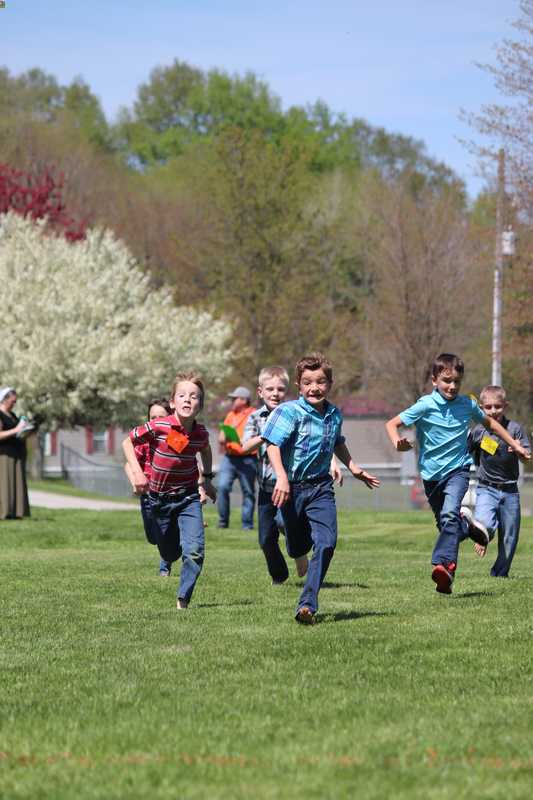
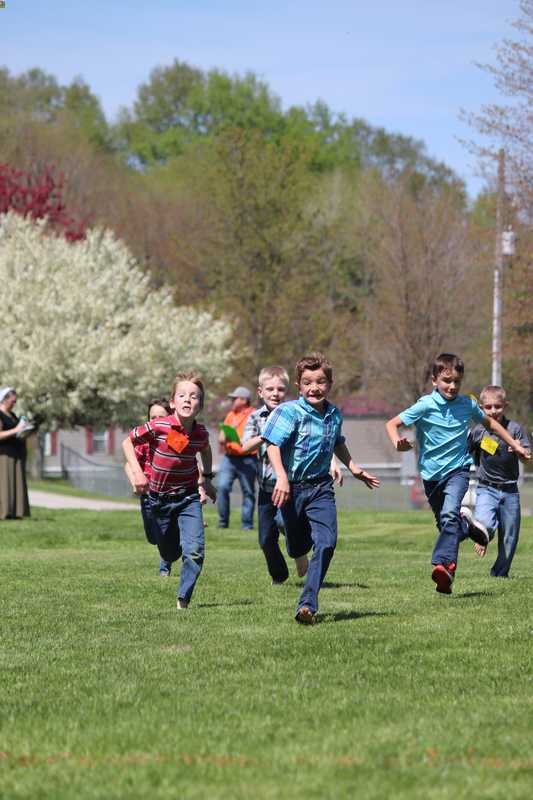
As we approach the end of the school year, we think about finishing well, wanting to keep going strong, and crossing that finish line. Many of us will have Track and Field Days and this provides a picture of our school year. If we’re running in a race, we aren’t going to slow down as we near the finish line. We want to keep going strong until we cross over that line. Maybe we will even speed up as we see that finish line approaching.
I will use today for an example. On Thursday we have PE in the morning, so my reading block is broken up. I need to have spelling and writing classes in the afternoon. By the time we got to writing class at 1:45, I was tired and really didn’t feel like being enthusiastic about writing a key word outline. I was tempted to say, “Let’s play a game!” but I kept going strong and we did writing, and had a good class.
We have end-of-the-year assessments this week, and I feel nervous about this, as it seems like my students are starting to check out. I want them to keep going strong, do their best, and perform well on the assessments. Today we talked about this in devotions. When you are running a race, do you want to say, “Oh, I see the finish line? I’ll just start walking now.” No! You may even speed up when you see that finish line.
We talked about going strong until the end of first grade – not giving up but doing even better than we had been. We compared this to the Christian life, also. We want to keep going strong, following Jesus, clear until the end of our lives. I think of 2 Timothy 4:7, “I have finished the race, I have kept the faith.”
We made blue ribbons to help us remember all of this. (We had a blue paper circle and put a gold notary sticker on that. We attached a strip of blue paper with a ‘v’ cut out of the bottom. Last, we wrote with Sharpie, “Finish well. #1”) We are wearing the ribbons or keeping them on our desks where we can be reminded to “Keep going strong” and “Finish well!”
As the teacher, I want to keep going strong, keeping my charge, serving my students and their families, and fulfill my calling to teach this class.
Understanding Reading
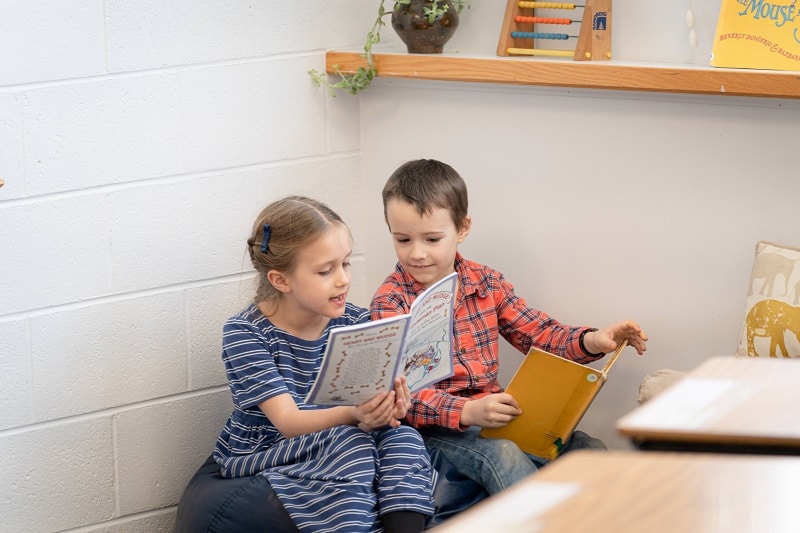
“I read it, but I don’t remember any of it!” the student exclaimed. And I understood. Although I am an avid reader, how many times have I found my eyes skimming over the page while my mind is elsewhere? For pleasure reading, this may not matter, but in the educational setting, what a student reads needs to stay in his mind and be understood.
Educator Cris Tovani says that students need to know and understand why they are reading so that they can determine what is important, what they need to remember, and what strategies they should use to comprehend the content. Otherwise, they are just reading words and will think everything is important. In his book I Read It, But I Don’t Get It, Tovani gives the following “access tools” teachers can use to help students organize and synthesize their thoughts as they read.
The first tool is thinking aloud. Most teachers have learned to participate silently during student reading, even reacting to what the student may be reading aloud. The teacher can extend this mental thinking to verbal thinking, telling the students what is going on in the teacher’s mind to help the students learn how to comprehend text.
To do this, you as the teacher can choose a short piece of text: the first page of a story or a difficult section of a textbook. If possible, the text should be projected on a screen and each student receive a paper copy. Then you read the text out loud, stopping often to share your thoughts. Point to the words in the text that trigger your thinking. Don’t be afraid to do this without practicing—your hesitancy will mimic how your students feel. Choose what to model based on the content. For a mystery, you might infer what will happen next. For science or social studies, ask questions. Connect information from one concept to the next for math, and give background history for literature or history.
A second access tool is to mark the text. If the student is using a personal workbook, the marking can be done directly in the book; if the student is using a shared textbook, the marking can be done on sticky notes and placed in the text. You as the teacher can direct the student to mark the text with notes and highlighting. Not only does this process helps students pay attention and not daydream, it helps them remember what they read.
Depending on the age of the students, you can suggest different codes. A younger student might just write a one-word topic of a paragraph on a sticky note or even draw a picture of the topic and put it to the side of the page. An intermediate student might write a sentence telling the main idea of a section and put it at the top of the page. Older students can highlight important information and develop a code of symbols to insert, such as BK beside something that is background knowledge, ? beside text that they don’t understand, or MI beside a sentence that explains the main idea. Different colors of highlighters can also be used to code different categories of material. And again, you as the teacher may want to model this for the students first, ideally by projecting text and marking it on a whiteboard. Not only does this engage the student while reading, it also provides an easy way to review material for a test.
So the next time a student—or even you the teacher—says “I don’t remember what I read,” try one of these tools. You may be surprised at how engaged your students become with the reading, even the most reluctant of readers.
(Source: Tovani, Cris. (2000). I Read It, But I Don’t Get It. Stenhouse Publishers.)
A Snapshot of an Average Day
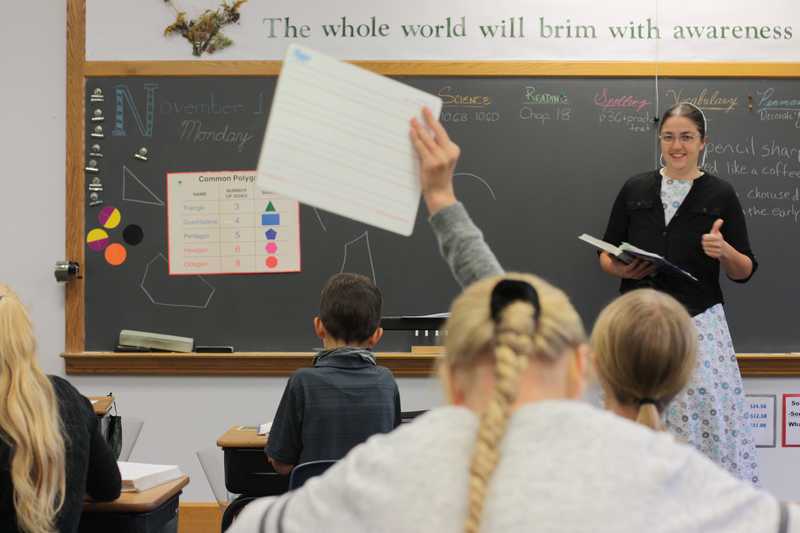
I recently returned from a choir tour on which I had the privilege of visiting four other schools, talking with the teachers, and gleaning ideas. Something that has always intrigued me is how teachers spend their days. Here is a snapshot of my teaching day, and a few things I do or have that help to keep my classroom running smoothly and effectively. Perhaps one or two of these ideas, many of which I’ve picked up along the years from other teachers, can help make your day run more smoothly as well.
Prayer, devotions, and coffee. Whatever your routine is that works well for you, do it. If you need a big breakfast, make sure you have time for that. Sing and pray before you walk into your classroom. Our mental and physical state have a lot to do with how we will function during the school day.Have a great schedule. Mine is always a work in progress. Last week we moved penmanship to later in the day so that the younger students could get their reading done, and this week we switched our daily journal writing to just before lunch as a treat for getting all of our morning subjects finished and handed in. I have found that having math, English, spelling, penmanship, vocabulary, Bible, and reading classes done before lunch (if possible) works best for me. The afternoon, when brains and bodies are more fatigued, is when we have our science, history, physical education, music, and art classes. Find what works best for you and your students and do it. Keep tweaking your schedule to keep it optimal.Keep students motivated with encouraging words and frequent prodding to get their work done (with good grades) and handed in quickly. I require mine to hand in all of their “morning subject” work before lunch so that we can finish any fix-ups during lunch. (I grade papers during lunch and during every spare second I can find.)Math first. With the exception of first grade reading class (which usually has 2-3 sections to it), getting math done first thing in the morning works well because students’ brains are more alert and not yet fatigued.Organize! I keep all my teacher’s books close at hand where I can easily grab them off my desk. I keep sticky notes on every page so I don’t waste time flipping through the pages. I keep my spiral bound books open to whatever page we’re on.Baskets close at hand. I have a basket with all my flash cards, clocks, protractors, counting blocks, etc. right by my teaching table so that I can easily reach over and grab what I need.Sticky notes are great. Sticky notes are great. Sticky notes are great. Every day I have a sticky note that I write on.Today’s sticky note reads:
- Research field trip to Niagara Falls (We read about waterfalls in our Lewis and Clark history book.)
- Get division 5 flash cards for grade 3
- Find picture of Challenger explosion (We are studying rockets and space in science.)
- 1st grade math – schedule to finish book?
- Get the Endurance book from library
Later in the day, I will never remember these thoughts that I have while I’m teaching, but if I write them down, I will. So, I quickly jot them down, and when school is out, I can research or find these things.
Eat lunch, talk, and laugh with the students. I have found that spending this time with my students does much to shape the culture in my classroom. We also just enjoy each other’s company, and having lunch together builds camaraderie and esprit de corps.Science right after lunch. This used to be my least favorite subject, but since we’ve begun using science sketch books, it’s one of my favorites. I like to have science class right after lunch and right before physical education class because very often, when we’re outside, we will find something that we just studied in science class, or something related to science because we are outside and make a concerted effort to look for interesting things in God’s creation.Physical Education class: variety, variety, variety. We enjoy having a different activity every day. We play basketball, tennis, golf, four-square, yard games, and go on lots of nature walks. I usually plan this out and only occasionally let the students choose the day’s activity.Afternoon classes: history, music, Spanish, and art. The end of the day is usually the hardest. The end of the day should be the time for the most enjoyable subjects, if possible. This time of day we have our history, Spanish, music, and art classes.When I was in school, I remember sitting in the classroom staring at the clock at the end of the day, half asleep, with a teacher droning on and on while I was completely tuned out, and I absolutely loved school. Instead of having my students dragging at the end of the day and staring at the clock, I am usually telling them, “Okay, I dismissed you five minutes ago. Let’s put the paintbrushes down. You can leave now.” That’s because we’re doing the most fun subjects of the day.
After school, I quickly grade any remaining fix-ups or straggling papers and put them on my students’ desks. I return every paper (with the exception of research papers) by lunch the same day, or the very next day so students can get immediate feedback and learn from what they got wrong.Clean up. Next, I tidy up the classroom a bit, and then I go to my sticky note list and try to get as much done as I can before it’s time to start dinner.So, there’s a snapshot of an average day for me. While it does change a bit based on the number of students and grades I am teaching, it basically stays the same as it works for me. I hope there are one or two tips you can glean for yourself!

Teachers Needed
•1st & 2nd grade teacher• 3rd &4 grade teacher• Male teacher to assist teaching older studentsShenandoah school is a growing school with opportunity for more growth pending on sufficient staff. Several families in the community have interest in sending their children to a Christian school! Housing is provided!
Bible Memory Tools
The Word of God is living, powerful, and precious. Because of this, it is of inestimable value to have God’s Word become deeply ingrained in the hearts and minds of our children from a very young age. But while we may all agree on its importance, robust and meaningful Bible memorization can be difficult to achieve.
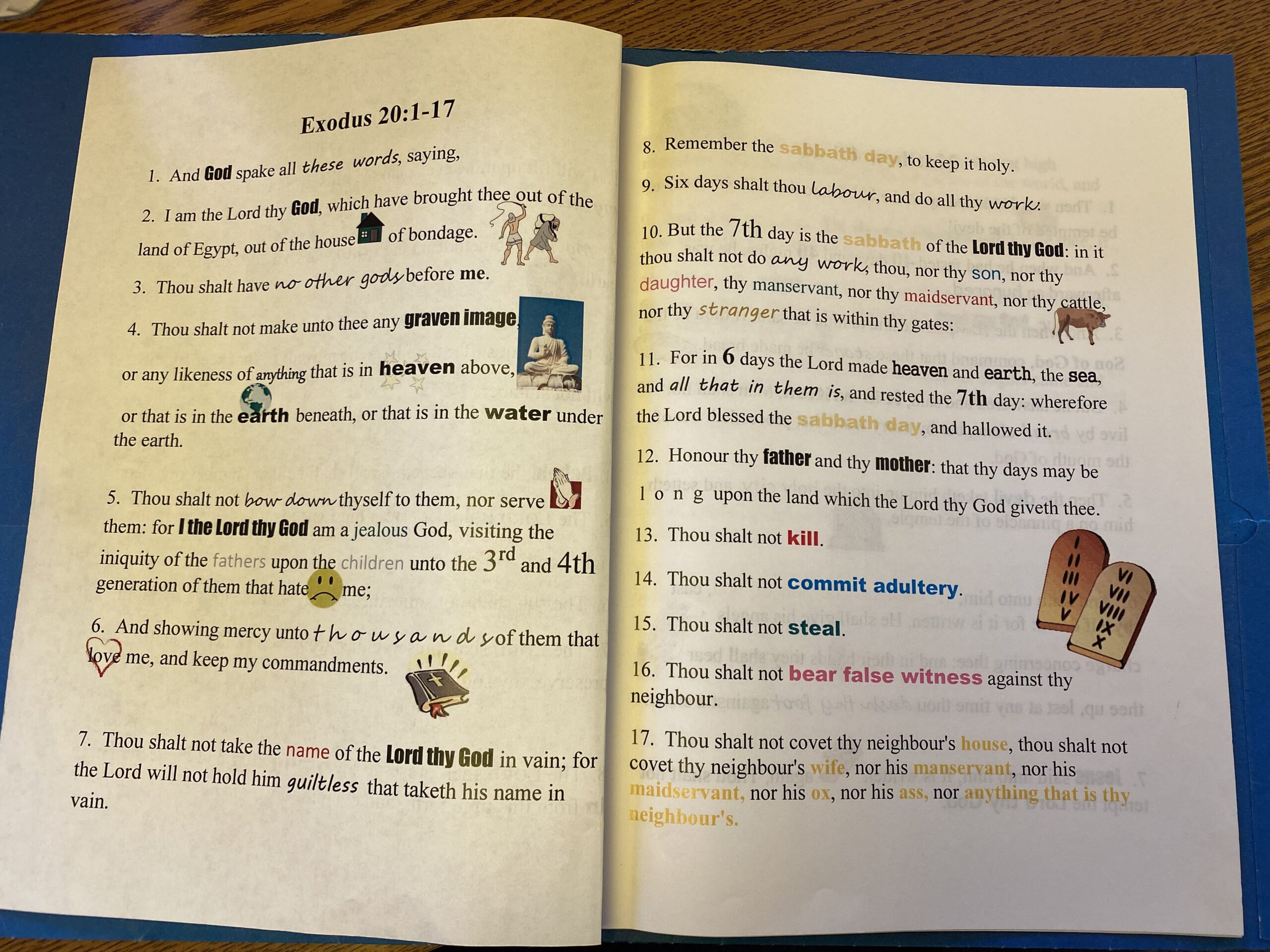
Some of you know all too well the excruciating, time-stealing frustration of listening to students try to recite their Bible Memory to you when they really don’t know it. Over the years, I have learned to implement various practices that have resulted in most of my third graders being able to recite their Bible Memory quickly with few or no mistakes. First of all, at the beginning of the year I print out the year’s memory passages and put them in a binder folder for each of the students to use throughout the year. To aid the visual learners, I include clip art and use various colors and fonts for the text (see photos below).
Our school has a prescribed list of Bible passages that students learn each year, and most passages we learn in third grade are ten to fifteen verses long. I split the passages into sections of two to four verses, depending on verse length, and we learn a section per week. After we have learned each section, we go back and review the whole passage.
The students are expected to recite the week’s verses to me each Wednesday. I usually have them do this individually while the class is completing their handwriting practice, but they also have the option of saying their Bible Memory to me in the morning before school begins or at break time. This is especially helpful for students who don’t like to be put on the spot and would rather not have the whole class listen when they are saying Bible Memory.
We practice Bible Memory for several minutes each day at the end of Bible class. On Thursday morning, I introduce the next week’s verses, and we discuss the meaning of the passage, particularly the difficult words. Throughout the week, we review these words and their definitions, as well as the general meaning of the passage. Then we read the verses aloud together, using good expression and voice inflection. Especially for the kinesthetic learners (those who learn best by action and movement), we add motions. I do not think it is irreverent to make these fun and sometimes quirky. If we do not believe that the Bible is a dry and boring book, then I don’t know why we would teach it in a dry and boring way.
Saying Bible Memory with all the expressions and motions can be a great way to get students up and moving in between classes throughout the day. Besides the concentrated practice time in Bible class, we practice our verses two to three times a day by standing and saying the verses together. Sometimes I have the students take out their folders and read the verses. Often, I will simply say one phrase at a time and have them repeat it after me.
Occasionally, I have my students read the passage by having each person take turns to read one word at a time as we go around the room. This is a good exercise in focus and following along, and it forces them to pay careful attention to each word. Most children enjoy the challenge of trying to do this quickly without getting mixed up.
I encourage the parents to have their child practice saying the week’s Bible Memory passage to them the day before they need to say it at school. If a child often has trouble saying Bible Memory, I ask the parents to help them study more at home.
I pray that the verses we learn in school will take deep root in the hearts of my students and will bear fruit throughout their lives. Providing our children with tools for memorizing Scripture is an important gift we give to them. Let’s work to do it well!

It’s May! Summer is Coming!
 Photo by corina ardeleanu on Unsplash
While I do love teaching and enjoy my job greatly, it is stressful being responsible for little humans all day, and one of the perks of being a teacher is having the summer “off.” (In many ways, it’s not really “off,” because we usually find ourselves preparing, planning, and participating in teacher enrichment types of activities.)
So, May is here and summer is coming. What will you do with your time off? Here are several options and suggestions for ways you can spend those precious three months you’ve got coming up soon.
Rest and relax. We are responsible for our students about seven hours a day, and that can be stressful even if we really enjoy what we do. If you’ve ever been a secretary, cashier, or builder, you know the difference. Take a few days or a week to just relax and spend time doing things you love to do but don’t always have time for during the school year.Set some educational goals for next year. I look for the area I’m weakest in and work on that. One year it was teaching science, another year it was art, and this year I think it’s going to be organization. Read books, research and get ideas, ask other teachers questions, and work on improving that area of need.Plan some teacher enrichment activities. This is always one of my favorites. I plan to go to seminars, camps, museums. I usually try to travel to at least one new place. I want to have more knowledge and experience next year than I did this year. I want to have more interesting stories to tell my students, and I want to model for them what it’s like to be a lifelong learner.At the beginning of August (or earlier if you’re ready and in the mood), go into your classroom and gather any new books you’ll be using. Plan to take them home where you can look them over at your leisure. Sit at your teacher’s desk for a while and look around, visualizing where you might move desks, furniture, or a bookshelf.Gather materials. Go through the science book and gather everything you will need for every experiment and put it in a bin to take to your classroom later. I also try to find brain games, interesting books and puzzles, or science or history items to add to my classroom.Plan and prep. About two weeks before school starts, I like to make sure I have my ducks in a row. I double-check all the books and tests and make sure I have everything I need. I like to figure out how many pages I would need to cover in a day in order to finish the books by the end of the year. I’m not a “book finisher,” and I will gladly stop, slow down, or back up if my students are not comprehending what I’m teaching them, but I have found that usually we can indeed finish our books on time if we stay on track and focused all year round, and don’t get sidetracked with all kinds of bunny trails and waste time in class.The summer months fly by, but if we have a plan, set some goals, and use our time wisely, we can make the most of them. We can feel relaxed, refreshed, organized, and ready to go in August if we spend our summer months well. Happy summer!
- 261Page 67