
All Content

Pickens Christian School seeking lower grades teacher
We are currently looking for an individual to help teach at our local church school. We are a small school consisting of around 12 students from grades 1-8. We usually split the group into two groups and have one teacher facilitate the lower grades and one teacher the upper grades. We are currently looking for someone interested in teaching the lower grades. We use the Abeka video curriculum for our students. The teachers set up daily schedules and make sure students are doing their daily work. They also help with extra curricular activities. We are looking for someone who is willing to invest their time into the lives of young individuals and help them grow. We are a small Mennonite community and enjoy a close knit community. We would love to share more information with you. We do provide a salary for our teachers and housing for those that need. Feel free to contact me for more information. Thanks for your consideration.Dervin Seibel864-624-3390

Three Writing Games
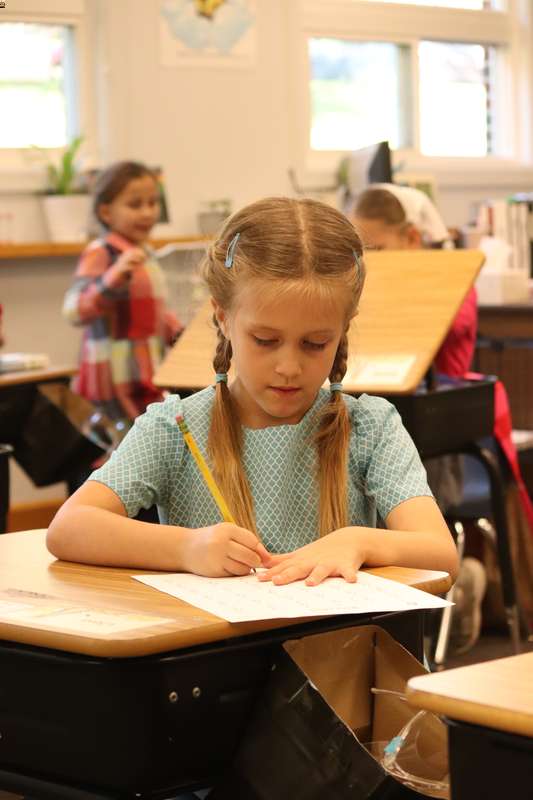
Looking for a fun activity to stretch your students’ imaginations? In search of an easy substitute for your regular lesson on a day you aren’t feeling well or are just stretched too thin to prepare everything in time? Interested in a random new game that your students will love?
If so, these writing games may be just what you’re looking for. Not only is writing an essential skill and learning tool, it can also be a wonderful way to tickle your students’ imaginations while providing a fun learning activity. These three writing games have been favorites for my students over the years.
Popcorn Writing
Materials needed:
- Piece of paper for each student
- Timer
- A way to randomly select each student one by one (for example, writing their names on slips of paper and picking them out of a dish)
- Sentence starter (optional—see below)
In this game, each student will write a story. Students may start writing about anything; I have found it often works best to give them a sentence starter to get them going. A few sentence starter ideas are as follows:
- It was a perfect day for a soccer game, so no one expected anything to go wrong.
- I gasped as I peered through my binoculars.
- It all started when I poured orange juice on my breakfast cereal.
- Paul couldn’t believe what was standing in front of him.
- I was doing my homework when I heard a loud crash coming from downstairs.
- The day I got my pet cat was also the day the trouble began.
- It sounded like a trumpet, and it was coming from outside.
As the students are writing, the teacher should start a timer for a set increment of time (45 seconds works well). When the timer rings, the teacher will randomly select a student. That student should say the word they just wrote on their paper. Every other student then needs to use that particular word in their own story within the next 45 seconds when the timer will ring again.
So, for example, if Student A is selected and they just wrote the word “fountain,” then every other student must somehow include the word fountain as they keep writing their own story. After another 45 seconds passes and the timer beeps again, repeat the process with another student. Perhaps student B has just written the word “rhinoceros.” Now every other student needs to find a way to make a rhinoceros show up in their story. Encourage students to be creative in this; perhaps they will simply describe something as being “as big as a rhinoceros.”
If a student has just written a boring word, like “the,” “an,” “and,” “when,” etc., I will let them say the second-last word they wrote. This makes the game more interesting and fun.
You may continue this activity for as long as time allows or until every student has been chosen at least once. Whenever you decide to wrap things up, give the students a minute or two to complete their story and make it feel finished in some way.
Don’t forget to give students a chance to share their stories with each other! Students absolutely love getting to hear how their peers used the same words in a totally different way, and they enjoy the random, somewhat crazy nature of the stories they end up with. This activity is a great way to promote flexible, creative thinking.
Picture Book Cover-Up
Materials needed:
- A picture book for each student (must be a story that is unfamiliar to the student)
- Small pieces of opaque paper (construction paper works well)
- Adhesive putty (or some other non-permanent, non-damaging adhesive)
Disclaimer: This game involves some preparation beforehand, and that can be somewhat time-consuming. However, teachers of older students could have their fast finishers help them with this part of the process in the day(s) leading up to doing the activity.
Prepare the picture books by covering all of the words with slips of paper. Paper can be cut to the appropriate size and attached to the book page using a non-permanent adhesive. Each book should have all of the words concealed, with the pictures still visible.
Each student will then receive a picture book. They should look at the pictures and come up with a story that would make sense with the images they see. Students can write their stories on top of the paper that is covering the original words.
It is great fun to have these books available for students to read and enjoy each other’s writing! When finished, you can have each student pull off the papers in the book they “wrote,” and have them take a few minutes to read what the original story was about. This activity is a fun way to exercise story-writing skills in a low-pressure way.
Sandwich Story
Materials needed:
- Sandwich story handout for each student
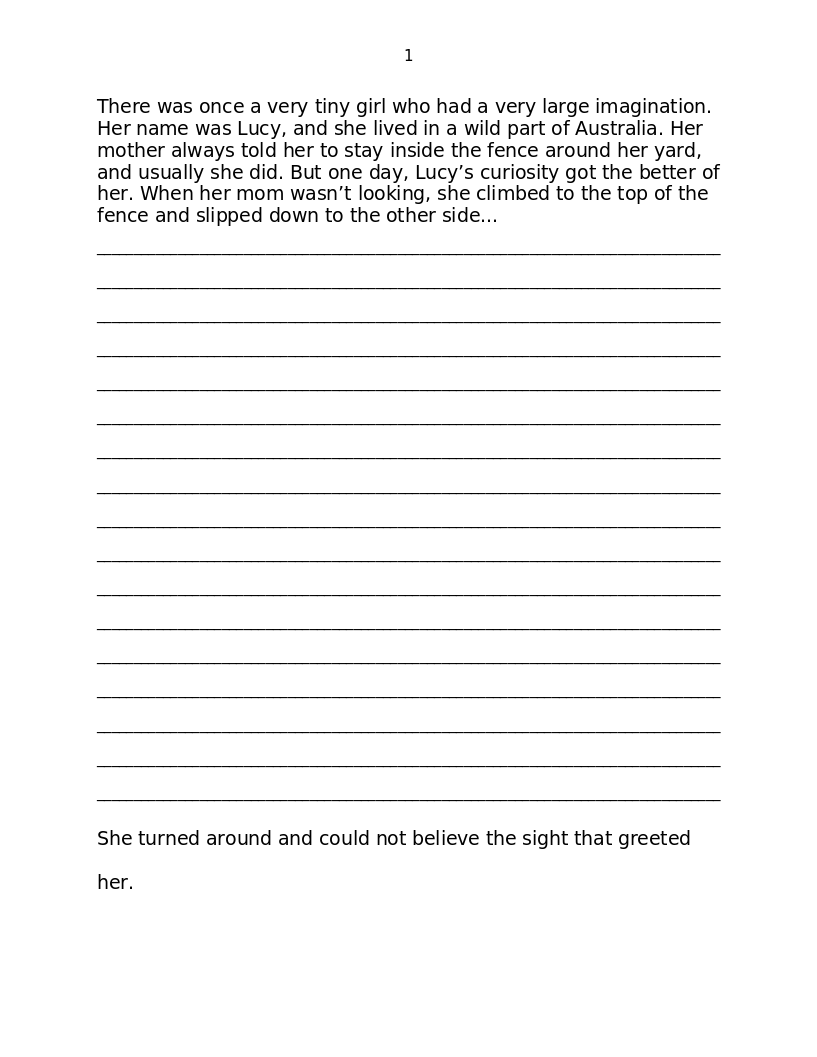
To understand this activity, picture a story written out on a piece of paper. Now, imagine that a giant eraser has completely removed whole chunks of the story, leaving only sporadic sentences behind. The first few sentences are there, but the next two paragraphs have been erased. Then there is another sentence, followed by a few more erased paragraphs, and so on, until you arrive at the last sentence of the story.
Now, imagine that your students are going to work together to fill in the missing spaces between the sentences that have been left behind on the page. Each student will fill in one blank space, “sandwiching” their writing between the existing sentences and creating a flow from one given sentence to the next. Their goal is to write something that makes sense and keeps the story going. At the end, the entire story will be filled in by the collaborative efforts of individual students writing their own little parts.
In reality, each student is given a sheet of paper with one sentence at the top of the page and one sentence at the bottom. These handouts should align with each other so that Student A’s last sentence is Student B’s first sentence, and Student B’s last sentence is Student C’s first sentence, and so on. That way each child is filling in one part of the story, picking up where the student before left off. These “sandwiches” can then be combined to make a cohesive whole.
One of the fun elements of this game is that each student will fill in their part of the story without knowing what the other students are writing. This makes the final product unpredictable and usually pretty funny.
Below, you will find pre-made handouts that you can use for this activity. Alternatively, you can always make your own by creating your own sequence of sentences. You will notice the handouts are labelled according to how many parts they have. Obviously, the size of your class will determine which handout you will find the most useful. I have always used this activity with larger classes (12 students or more), so I have simply made two or three sets of the same handouts. So, if you have 13 students, you could use the 6-part handout and the 7-part handout. In the end, this will create two different stories for you and your students to enjoy.
Once all the parts of the story have been written, put them together in order and read them aloud! The collaborative nature of this activity makes it so fun for students—there’s something enthralling about having their writing be part of a bigger whole.
Writing games are the perfect way to spice up your next writing class or to pull out of your back pocket for a sluggish day in the middle of winter. Games like these are so much more than games—they allow your students to imagine, create, and thrive in new ways.
Link to Sandwich Story Handouts: https://thedockforlearning.org/contributions/sandwich-story-handouts/

Cultivating Curiosity in Students
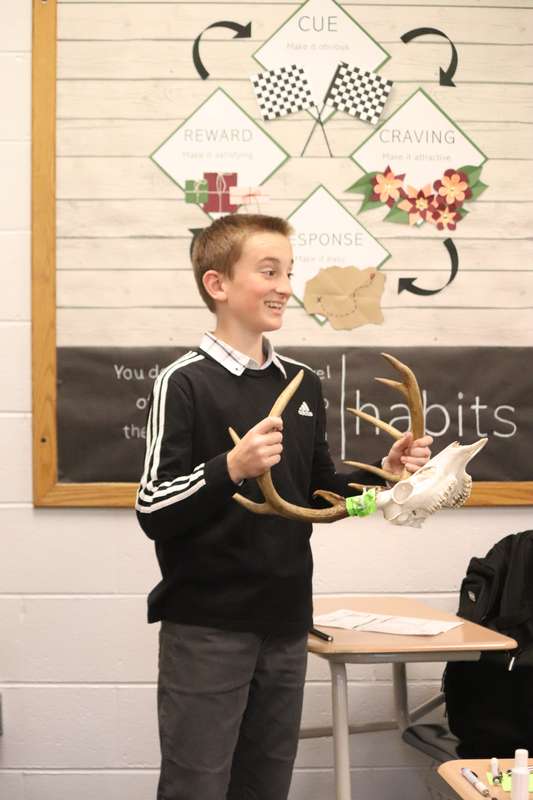
One of the most exciting tasks we teachers can pursue is cultivating curiosity in our students. When our students are curious, they are usually engaged in what they are learning, enjoying themselves, and eager to discover more interesting tidbits. A classroom is rarely boring if students are curious. While cultivating curiosity in students isn’t that difficult, it does take some effort. Here are a few suggestions that have been helpful to me.
Model curiosity yourself.
Ooh and aah over the fact that a bird can glide forward for twenty-three feet while only going down in altitude one foot. Look up words in the dictionary. Make statements to arouse curiosity such as, “This art project has the neatest effect. Just wait until we get to finish it tomorrow!” or “For our business letter writing assignment today, we are going to write a real letter and send it. You will hopefully get a letter back.” Curiosity is contagious.
Do as many additional activities in the core subjects as you possibly can.
These are usually included in the curriculum, but too often teachers are busy, these take too much extra work, and projects don’t get done. Assign the speeches in English class. Make the pie chart posters in math class. Do every experiment in the science book. Find cultural folk art projects or eat foods from other cultures in history. The changes you will see in your students’ interest and attitudes are well worth the effort on your part.
Go overboard with exposure.
Expose your students to as many different edifying concepts, facts, buildings, art projects, stories, and field trips as you can. This isn’t stuff that they will be tested over. It is just interesting information, activities, true stories, experiences you’ve had, items, or just crazy ideas. My latest idea has been that I’m dreaming of taking my junior high students to hike the Grand Canyon rim to rim. While it’s kind of a joke, it gets us thinking, and dreaming, and curious about the process and the possibilities.
Keep their hands and minds busy.
Focus on completing the classwork on time with good grades, but also provide a myriad of different activities for them to do when their work is completed. This is not only often a good motivation to finish classwork, but also a delightful way to encourage curiosity. Can they figure out how to solve the new puzzle or brain game? Have they read that new amazing book and seen the beautiful photographs or paintings in it? Having art supplies and a weekly project available is another good way to keep students’ hands productively engaged and busy.
Arrange classes carefully.
All work and no play makes Jack a dull boy. How would we feel if we had to sit at a desk and write most of the day? I love to write, but I wouldn’t want to sit in a hard chair at a desk for hours on end to write. Classes and hard work, including math problems, writing assignments, and answering history and science review questions should be interspersed with activities which give students a physical and mental break. I try to give my students a schedule that has a more difficult and focused class following a lighter one that includes more group discussion and/or activity. Example: math, piano practice, reading, Bible with group discussion, English, recess. Doing this helps prevent boredom–the exact opposite of curiosity.
Feed their interests.
First of all, you should present many different concepts and activities to be curious about. Students will choose the ones that particularly interest them and ask about them. That’s when I like to dig up books, art supplies, science experiments, or whatever it is to feed whatever has sparked their interest. Usually this happens naturally because they’re noticing what I’m presenting to them, but sometimes this is assigned, as in the case of a research paper. Give them super interesting topics and perhaps have them do some preliminary work (sketches, a project, etc.) to help spark their interests in their chosen topics.
Surprise them.
Donuts on a cold winter morning, the announcement of an upcoming field trip, and a new history and/or art project do wonders for cultivating curiosity. If students are surprised with a few things like this, they will have a new outlook on school. Keep it up, and you’ll have them hooked, wondering what you will surprise them with next. Note: Students should never expect these. Talk to them often about being grateful and have a good attitude.
Avoid negativity in any shape or form.
This includes countdowns to how many days of school are left, eye rolling, heavy sighs, and any negative comments made by students. Meet these with a big smile and a positive comment. One of my favorites is “We GET to do this!” Thank God daily during morning prayer time for the privilege to have a Christian school, to be in a nice warm building, and to have interesting learning opportunities.
Curious students are interested in learning and approach school with enthusiasm. The effort it takes is well worth the results produced.
Modeling curiosity yourself, exposing students to different concepts and activities, keeping students busy, having a varied schedule, feeding students’ interests, and surprising them are all viable ways that teachers can cultivate curiosity in students.
Teachers and tutors wanted
Faith Mennonite High School is actively searching for teaching staff. We have a full-time and a part-time opening. We are looking for staff that could teach in the following areas: high school science, math, computer programming, art and spanish.We are also looking for help with learning support and tutoring.please contact principal@FaithHighSchool.org for more information.
The Poetry of Robert Frost
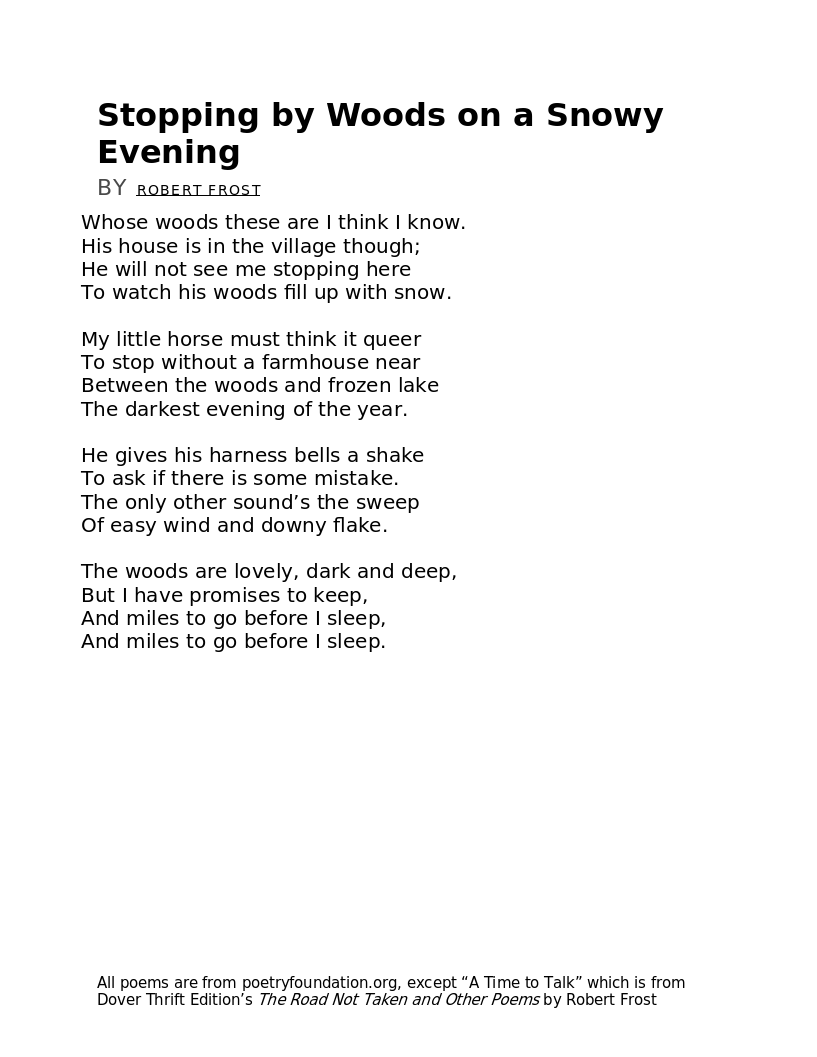
A selection of poems by Robert Frost followed by a worksheet for reflection, analysis, and response.
From the contributor: In CLE's Literature II (Unit 6, Lesson 6), we study Robert Frost's poem "The Tuft of Flowers." After discussing it and completing the lesson exercises in class, I assign the attached file to give a richer introduction to my favourite poet. Students read some more of Frost's poems, which are easy to understand, and write a response essay at the end (p. 7). My goal is to have them observe his topics (frequently rural and old-fashioned), themes (relationships, nostalgia, and values), mood (reflective and whimsical).
From Learning to Read to Reading to Learn

A first-grade teacher in a classroom somewhere in the world is approaching the middle of February. Her beginning students are nearing the end of Learning to Read and will be soon graduating to their “big” readers. If this teacher has never taught first grade before she may find herself in for a jolt. If this teacher has some experience with teaching students to read, she may be groaning inside at the approaching difficulties. And then there are those teachers who’ve made this transition enough times to have learned how to smooth out the bumpy road ahead.
This post is specifically for teachers using Christian Light’s Learning to Read and then the first-grade reader, I Wonder. First graders who are sailing through the last lessons of Learning to Read soon find themselves flummoxed by their new reading course and their teachers may also be despairing. But it doesn’t have to be that way! Over the years I’ve discovered certain strategies that make it easier to bridge from one program to the next.
First, it is helpful to understand that the two reading programs developed independently of each other. The initial writing of the Reading to Learn series was not an attempt to continue Learning to Read but to provide instruction in reading enjoyment and reading comprehension for the rest of the school term. One idea behind the series was to provide interesting stories rather than the stilted story-form necessary in keeping with skills and words already learned as in Learning to Read. The original writer of I Wonder did not attempt to dovetail the two programs.
While this idea was a good one, it has created a problem in knowing how to mesh the two programs. The Sunrise second editions of Learning to Read, Language Arts 100, and Reading to Learn 100 are one committee’s attempt to do a better job of this. However, it is not a perfect attempt. The following ideas are ones I use to eliminate stress for myself and my students.
Before the Transition
- By the end of Learning to Read, first graders should be able to independently read the stories and answer the story questions in their lesson with little help from the teacher. In my classroom, we discuss the new words, talk about the pictures, ask a few leading questions and then everyone reads the story silently and answers the questions. We then read the story orally—often chorally. If students are struggling to do this independently at the end of Learning to Read they are not yet ready for I Wonder. If one child is struggling while the rest are ready to move on, the teacher will need to provide extra support for that child. If most of the class is not independent, spend more time working on problem areas before launching into I Wonder.
- Language Arts 100 (Sunrise Second Edition) was developed to provide further phonics instruction needed for the material in I Wonder. If students are not using this or are not following the pacing of Language Arts, the teacher will need to provide instruction for those missing phonics skills.
Easing into the Transition
The type and format of exercises and amount of print encountered in the Reading to Learn 100 workbooks is different from Learning to Read. The stories are also much longer. Even a very independent reader can find this difficult. Though I previously stressed that students be independent readers, I start off doing much of the Reading to Learn 100 work as a class.
- In introducing the new words, do not only rely on the lists given in the workbooks. Write them on the board to read and discuss. Or, write each word on an index card and put its pronunciation on a separate card. Let the students match the words and pronunciations. Play word games with them. Make sentences with the words. During class time, have them find the words they need to use for the given exercises in the workbook. Using tactile cards is easier for many students than finding the words in their workbooks.
- There may be other unfamiliar words such as names and places in the text. Take time to introduce those words also. (In one story, a character’s name is Toby. If left to themselves, my students will always call him “Tobby”.)
- Just learning to navigate pages of mostly text can be a struggle for some students. For the beginning lessons, do the work together as a class. I prefer to have everyone read the instructions and exercises chorally (together). Next, I have them mark most answers themselves, and then give their answers aloud.
- It is recommended that each story is read twice. Ideally the students read it themselves the first day and oral reading is on the second day. (And I am a firm believer that oral reading class is not usually done as a cold read.) However, at the beginning of I Wonder the story length is daunting for most students. I often compromise by reading part of the story to them and having them finish the last page or two, either on their own or chorally. As students gain more confidence and ability, I ask more independence from them. On day two of the reading lesson, each child takes a turn reading orally.
- Each story has a Bible verse that corresponds with it. I list the verses on a poster for each unit. Each day we recite all the unit verses paying close attention to the one for that story. By the end of the unit most students know all the verses from memory. We also orally match verses with meanings—a workbook exercise that can be difficult for some students.
- I can usually discontinue doing the work as a class by the end of the first LightUnit. However, some years we are still doing most of the work together until the end of the second unit. By the end of the year, it is surprising how much more independent they have become.
If you are a first-grade teacher using Christian Light materials, I hope these tips will help ease some of the frustration of transitioning between Learning to Read and Reading to Learn. It takes some time but if your students are average students, you will find one day that they are very capable of handling the material. If any of you have found other tips and strategies helpful, please add them to the comments below. We can all learn together!

Effectively Accommodating Varying Student Ability
Within any group of students there will be diverse talents and aptitudes. Is it appropriate to modify systems of scope and sequence to accommodate varying student ability? If a student fails in one subject, must he repeat the entire grade? Should advanced students be given special opportunities that challenge him? What is the main objective in making these decisions; the system of the school, or the good of the individual student?
Is There Not a Cause?
What good is school? Why does your community need a school? After many decades, conducting our own schools has becomecommonplace. What are the contributions of schools to our church life in 2022? If we more fully understood the value of our schools, might our thoughts and actions change?
Nurturing a Child's Sense of Wonder and Beauty Through Art
Over the past half century, popular children’s books have deteriorated into tasteless plots and cartoonish illustrations. This is an insult to the God-given intelligence and sensitivity that children are naturally born with. How does excellent children’s literature and art deepen a child’s understanding, empathy, and imagination?
Nurturing a Child's Sense of Wonder and Beauty Through Literature
Over the past half century, popular children’s books have deteriorated into tasteless plots and cartoonish illustrations. This is an insult to the God-given intelligence and sensitivity that children are naturally born with. How does excellent children’s literature and art deepen a child’s understanding, empathy, and imagination?
Tech at School: Pros and Cons (Panel Discussion)
As we all know, technology continues to change our world. Can tech be suitably utilized in our schools? Are we equipping students for its appropriate use? How might tech help or hinder the functions of our classrooms? Come to this roundtable discussion to hear comments on questions like these.Moderator: James MartinPanelists: Lyndon Hartman, Jonathan Miller, Verle Troyer, Philip Kauffman
Shouting for the Battle
Many of the early Christian private schools experienced legal difficulty to secure the freedom to operate. This topic will review one of those stories, and note how the visionaries of that time “shouted for the battle”. Today, do we stir ourselves to value and work for the school as much as they did? Do we enthusiastically “shout” for our schools today?
- 261Page 51