
All Content

Healthy Boundaries—Rewarding Relationships
Boundaries are essential to healthy relationships, but how should we go about establishing them? What qualities are necessary for rewarding relationships?Jonathan calls us to humility, open communication, trust, and transparency as we exemplify Christ-like behavior in our relationships.
A Vessel Unto Honor
The master teacher seeks vessels of honor for his kingdom. In light of that, what character qualities should teachers embody?Kenneth Kreider emphasizes the importance of humility, discipline, and dedication in teaching, urging us to be vessels of honor in our work, standing on the foundation of truth.

Grading with Rubrics in the English Classroom

When English teachers get together, the topic of grading will come up—often with complaints about the time grading takes and the difficulty of grading essays fairly. While part of that is just the nature of the job, essay grading can be made simpler with the effective use of a well-written rubric.
A rubric is a list of characteristics desired in a final assignment, with different points assigned for each level of achievement. An analytical rubric displays in a grid-like formation that matches a description of student achievement to different levels, such as exceptional, good, satisfactory, and poor, or to different numbers of points, such as 5, 4, 3, 2, 1 (see below).
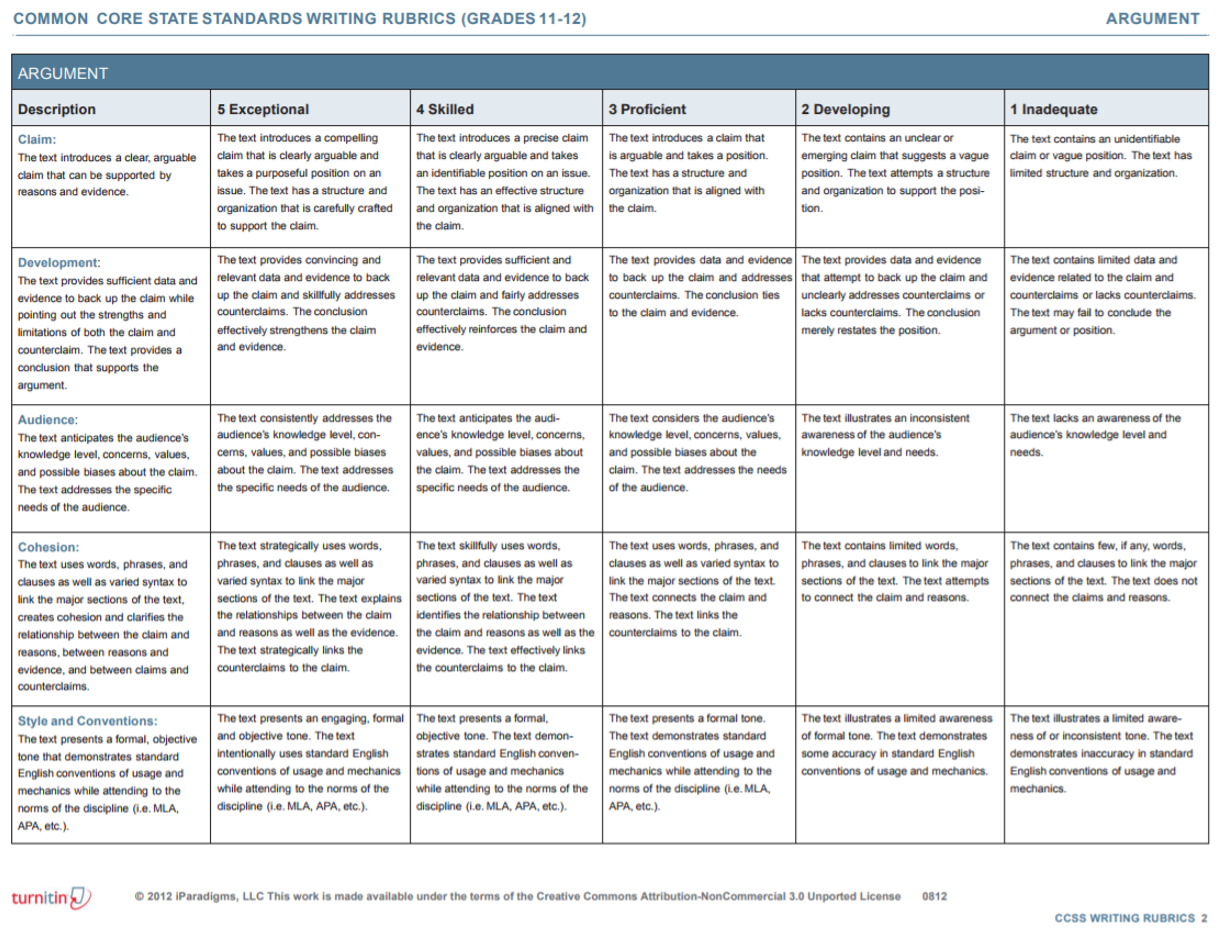
(Note that while this rubric comes from the sometimes-debated Common Core, it provides a good starting place and can be adapted, as described later in this blog post.)
A holistic rubric describes the desired outcome for each characteristic, and the grader attaches a point amount to the characteristic (Fuglei 1).
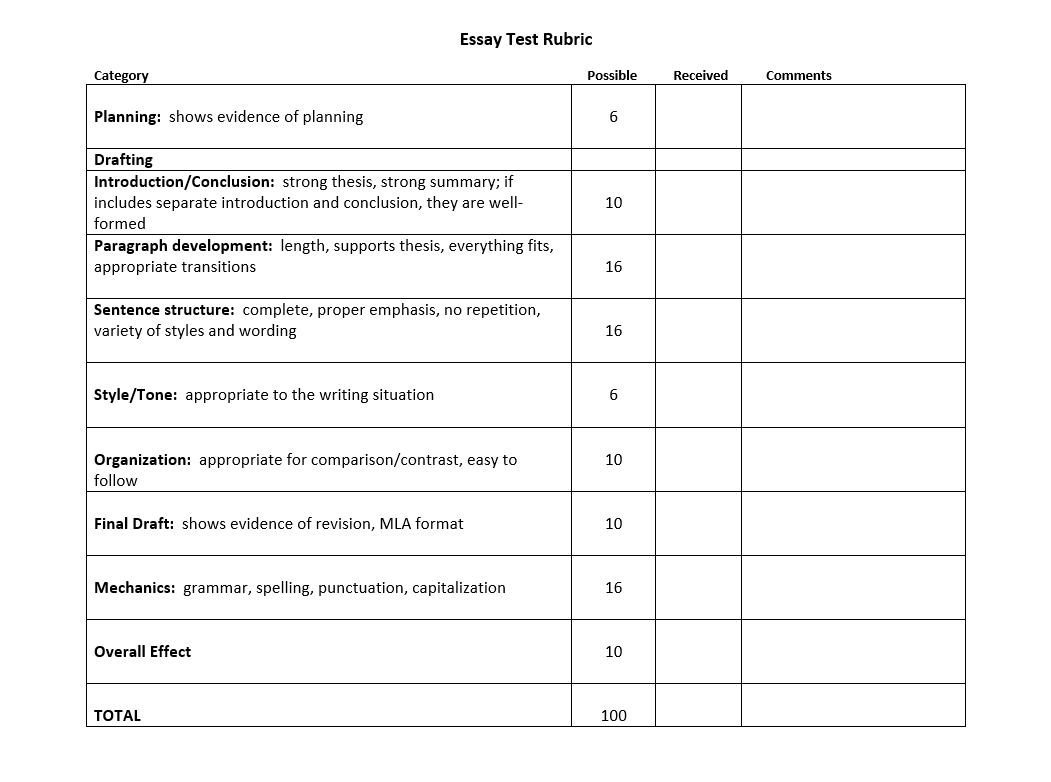
While some critics argue that rubrics stifle the student’s creativity and limit helpful feedback, most English teachers agree that rubrics allow the most objective grading for essays. Used as a teaching tool during the writing process, the rubric allows the writer to see the needed characteristics before turning a paper in. The teacher can explain each attribute on the rubric as a writing lesson. Then used as an assessment tool, the grader can look specifically for the required specifications when checking the final draft. The key, then, is to create a fair and easily used rubric that still provides feedback for the student. Here are some tips.
- Don’t start from scratch when creating a rubric. Most writing curricula include grading rubrics. If not, they can be purchased or even found for free online or in teaching resource books.
- Modify already existing rubrics to meet your student’s needs. If there is a specific writing characteristic that you are emphasizing, be sure it is included on the rubric. Or if you know your class needs help in a certain area, include it as a goal on the rubric.
- Individually tailor rubrics to students. By leaving points for one category open, each student can set an individual goal (or the teacher can set it) to work on for a specific assignment. I often build upon a previous rubric, using a student’s lowest category to set the individual goal on the next rubric.
- Leave room on the rubric for comments. Rather than just assigning points, tell the student why that amount of points was assigned. While comments can also be written on the paper itself, it often helps to have them all together on one page.
- Keep rubrics as a portfolio of writing progress throughout the year. The student can use each rubric as a guideline for the next paper. At the end of the school year, the cumulative rubrics show the progress made.
- Keep a rubric to a one-page length. Longer rubrics are cumbersome both for the writer and the grader. A shorter rubric provides focus.
- Make the point value for each category equivalent to the importance of the category. If the teacher is focusing on mechanics, that should be a larger proportion of the total points. Or if the main goal is organization, that should be the largest category. I always do my rubrics out of 100 points to make it easy for students to see their grades.
- Use wording that matches the wording in the assignment. For example, if the teacher describes mechanics as “grammar, spelling, and punctuation,” that is how it should be worded on the rubric.
- Use the rubric throughout the writing process. Go over the rubrics with students at the beginning of the writing assignment. As each lesson is completed, remind students of what part of the rubric they are working on. During the revision and proofreading process, have students work through the rubric one category at a time.
Works Cited
“Common Core State Standards Writing Rubric.” 2014. https://www.csun.edu/sites/default/files
/Common%20Core%20Rubrics_Gr11-12_turn_it_in_0.pdf. Accessed 10 Feb. 2024.
Fuglei, Monica. “Rubric’s Cue: What’s the Best Way To Grade Essays?” Resilient Educator, 12
Nov. 2014. https://resilienteducator.com/classroom-resources/essay-grading-
rubrics/#:~:text=Because%20a%20rubric%20identifies%20pertinent,criteria%20in%20the%20 writing%20assignment. Accessed 10 Feb. 2024.
Photo by Afif Ramdhasuma on Unsplash.

Pedagogical Moments: Metaphor

In the land beside the sea, the Great Teacher taught the multitudes. In His teaching he used stories, he asked questions and demonstrated with objects. He was also a Master of metaphor or comparison.
He said, “Men do not light a candle and put it under a cover, but on a candlestick and it sheds light to all the house. Likewise, let your light shine before men that they may glorify your Father in Heaven.”
He warned, “Beware of false prophets who come in sheep’s clothing but really are ravening wolves.”
He exhorted, “Those who hear my teachings and follow them are like a house built on a rock.”
He entreated, “The kingdom of heaven is like a treasure hid in a field. It is like a merchant seeking for good pearls and it is like a net thrown into the sea and filled.”
He stated, “I am the good shepherd. I am the true vine. I am the bread of life. I am the living water. I am the way, the truth, and the life.”
He taught, “A sower went forth to sow. And as he sowed some seed fell by the wayside, some seed in stony places, some among thorns, and some on good ground.”
Metaphor simplifies
A good teacher learns to use metaphor or comparisons to simplify concepts and lessons. Metaphors are comparisons of a new idea with something already understood. Metaphors recall the experiences of the known and place them upon the new concept. Metaphors also help facts and concepts be retrieved from the brain.
Metaphors give us mental pictures that make connections what cannot be readily put into words. I remember a co-teacher once describing her students as a team of spirited horses. When the teacher had control of the reins, good things were accomplished. But the team was always at the point of wanting to take off on their own and the teacher needed a steady hand on the reins. This mental picture expressed much in a less critical manner than a bold statement would have.
Metaphors are especially helpful in teaching young children who do not yet have the language capacity to express themselves fully. If you listen to young children, you will find them creating their own metaphors when they don’t know how to explain what they need.
Examples of metaphor
Metaphors give us hooks to hang things on for easier retrieval. Many memory aids are a type of metaphor. Understanding that the silent “e” a the end of a word gives the main vowel the long sound (all abstract ideas) is more readily remembered with the idea of Mr. E having a long arm that reaches over the neighboring consonant and taps the vowel, reminding it to say, “__”. Young students enjoy the visual image and the metaphor sticks in their brains.
A common kindergarten or first grade penmanship metaphor is comparing the various penmanship lines to a house: basement, floor, ceiling, roof. Placement of the letters is reinforced by the metaphor. Students enjoy stomping through the floor to the basement when they write g, j, p, q, or y. Lower-case f is so tall that he must bend his head because he can’t stick it out the roof.
A classroom management metaphor could be a basketball game. There are rules to follow. The players (students) must know and understand the rules. The coach (teacher) explains and demonstrates how the game is played. The players practice until they can execute the rules. The referee (teacher) calls the infractions as they see them.
Young students walking down the hall as a line of little ducks or as quietly as a mouse is much more fun and interesting than simply walking in a straight line and not talking.
An imaginative teacher will find metaphors in their everyday lessons to help students understand, remember, and learn. Students can also learn to find metaphors to aid their learning.
The Great Teacher taught with authority and not as the leading teachers of His day. He made use of stories and metaphors. He asked probing questions and illustrated his teachings with objects. Those listening to Him recognized the truth He taught and were amazed. Some acknowledged Him and some turned away. The choice was theirs, but this Master Teacher made His truth plain by the way He taught.
Photo by Henri Guérin on Unsplash.

Paradox in the Classroom: What to Do?

Consider the following scenarios:
- A student struggles to remain in his seat throughout the day and, as a result, is falling behind in his work. In order to help him catch up with the class, you consider keeping the child back from recess or another break in order to work on his missing assignments. At the same time, you know that this student would greatly benefit from the chance to release some energy.
- In an effort to stay on track with your curriculum requirements, your class is working on several rigorous projects in the same week. Several days into the work, you begin to notice that your students are looking tired and losing their motivation. You begin to wonder how you might give your students a boost to help them finish their projects well. However, you know that time is limited, and the projects should ideally be finished by Friday afternoon.
- You are teaching a lesson you have taught many times before in years past, and it has always gone well. Today, however, it feels to you as if your words are falling on deaf ears and the concept does not seem to be connecting. In the moment, you consider your lesson plan in light of the remaining time and wonder what you should do. You feel responsible to teach your curriculum well, but at the same time, you know finishing your plan ‘as-is’ would be a waste of time.
If you look closely, you will notice a common theme present in these examples. In each situation, a teacher is finding himself in a position where a decision needs to be made between two equally valid options: completing assignments vs. enjoying a break; rigorous learning vs. boosting classroom joy; sticking with your plan vs. embracing spontaneity. As you think about your own teaching experiences, you can likely think of other examples of paradox—statements or scenarios that are as contradictory as they are complementary.
It is true that students must be held accountable to finish their work, yet many of the students who struggle in this area are also those who would benefit the most from a break. Rigorous activities are the essence of academic excellence, but what would our classrooms be like without an equal dose of joy? It takes a high-level of control on the teacher’s part to execute a lesson plan without veering too far off-topic, but it may require an even higher level of skill to be able to go off-script in a way that would benefit the class.
One of the definitive aspects of a paradox is that the tension persists over time. In other words, the pressure we feel to choose between two seemingly contradictory needs will still be at work in our classrooms tomorrow, next week, and even next school year. In fact, if you take the time to drill down into nearly any ongoing problem you face in your classroom, you may find that it is deeply rooted in one of many common paradoxes: today vs. tomorrow; work vs. home; ends vs. means; and warmth vs. firmness.
For teachers, the question is this: How do we respond to a paradox in a way that benefits our students and enhances their learning? As we think about the paradoxes at work in our classrooms, there are a number of helpful things to keep in mind:
- Consider your situation in light of a balance beam - or any other narrow object that might beckon children to see how far they can walk before falling off. Successfully maneuvering such an obstacle requires frequent shifts of one’s weight to the left and right based on the needs of the moment. At times, one might have only a split second to adjust. Navigating paradoxes in the classroom can be very similar. Give yourself permission to oscillate between the opposing sides of a paradox as the situation requires (Smith & Lewis, 2022). Some of the greatest mistakes we can make in our teaching occur as a result of either knowingly or unknowingly avoiding one side of a paradox.
- Find a win-win through considering a compromise. For example, perhaps you have tried maintaining a strict boundary around bringing work home to complete after school, but the tension between your teacher identity and other responsibilities has left you feeling discouraged as these duties pull you in opposite directions. Instead of feeling disappointed, consider ways that you can accomplish your school tasks and still meet other obligations. Perhaps finding a quiet hour early on Saturday morning with a freshly-brewed cup of coffee to invest in school work will leave you feeling less pressure throughout the week without causing any major disruptions in your typical weekend plans. Satisfying responses to a paradox can often be found by those who are willing to consider an unconventional, outside-of-the-box solution (Smith & Lewis, 2022).
- We are not alone. Many people have passed this way before and have struggled with the same tensions in their teaching. Remember: paradoxes are persistent by nature! Use this to your advantage by learning how others who have gone before you have been able to find a path forward through the contradictory demands of the classroom.
- Consider how Jesus, the Master Teacher, dealt with paradox in His ‘classroom’. He went beyond simple acknowledgement to fully incorporating paradoxical statements into His teaching to give His audience a greater vision of the Kingdom. Consider teachings such as “For whoever desires to save his life will lose it, but whoever loses his life for My sake and the gospel’s will save it” (Mark 8:35, NKJV) or “...but whoever desires to become great among you shall be your servant” (Mark 10:43, NKJV). Furthermore, He did not share these statements as mere enigmatic words or philosophical sentiment; He lived them out as an example for us.
Your classroom paradoxes await you. How will you respond?
References
Smith, W., & Lewis, M. (2022). Both/And Thinking: Embracing Creative Tensions to Solve Your Toughest Problems. Harvard Business Review Press.

How Much Commitment Does It Take to Be a Teacher?
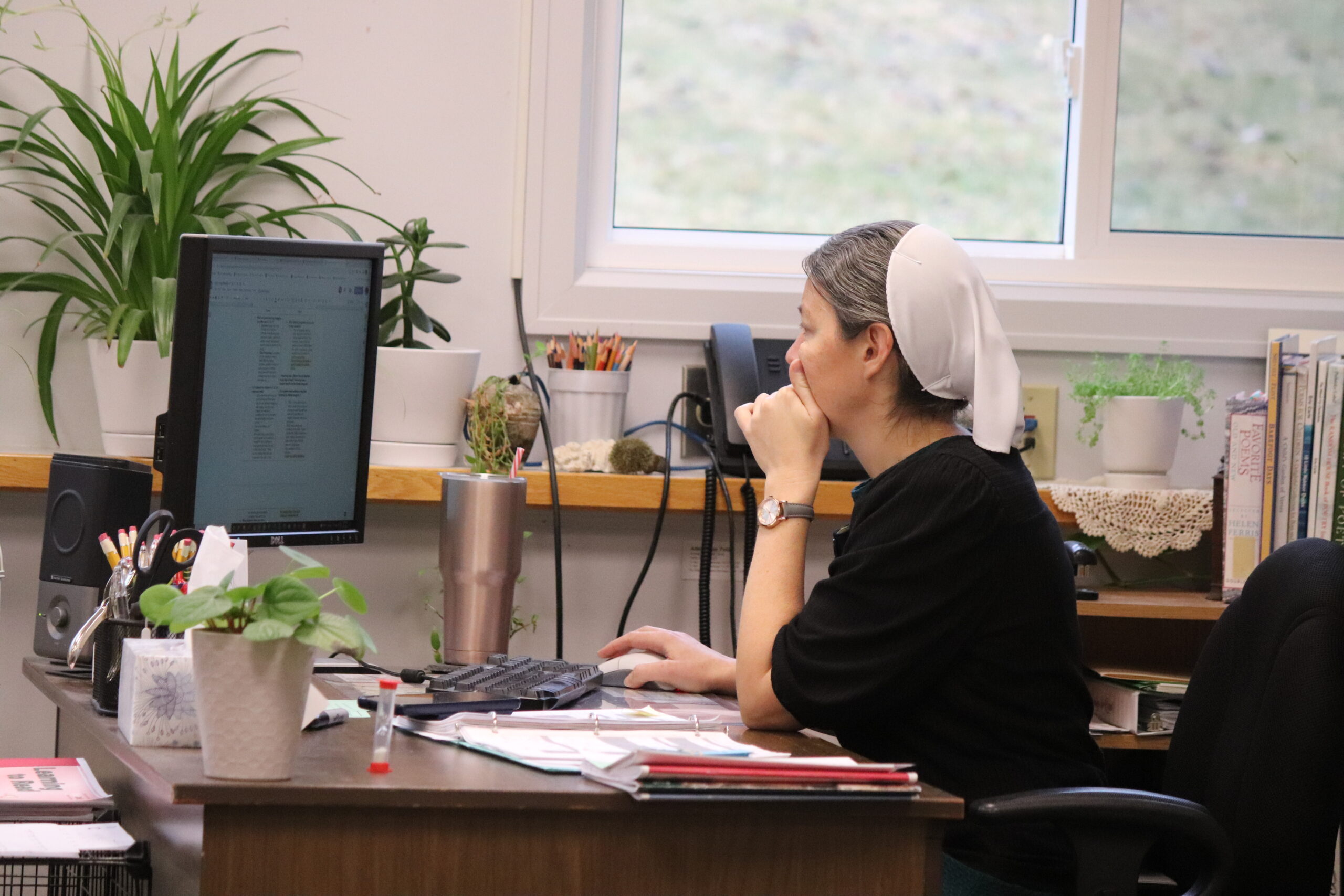
Two former students of mine asked me to fill out a survey for papers they are writing about becoming teachers in the future. The questions were thought-provoking, and I thought the answers might resonate with others and hopefully be encouraging, so here they are.
How much time do you spend on school-related activities each week?
I try not to track it, but it's around 45-50 hours a week.
How does your job affect your mental health and social life?
Teaching is usually a very uplifting and exciting thing to do, and one that I enjoy greatly, so in that aspect, most of the results of teaching on my personal life are highly positive. It does take a lot of time, so I have to work at prioritizing my family—trying to come home fairly early (hopefully after all my papers are graded), and only working on school stuff at home if everyone is out of the house or napping. At times it can be stressful, like when a parent or administrator has "concerns." This would negatively affect my mental health, but these incidents are usually very rare and short-lived.
How much commitment will it take to be a teacher?
To do it well, I would say it takes a lot of commitment. That doesn't necessarily mean a lot of time though, if you've got your ducks in a row. Each year it gets easier as you've often taught the same material before, and you've got more experience in how to handle various situations.
The commitment, I believe, comes in the form of classroom management and knowing the content well. If teachers haven't previously studied fairly extensively in their content area, they are going to have to be committed to putting some time into studying, or they won't be nearly as effective in the classroom. The classroom management aspect is probably the most trying for a teacher. To do that well, one has to be committed to having a classroom management plan and sticking to it.
What are the ministry opportunities? What place does your faith take in the workplace?
Great question! Since I have a degree in my field, I could go down the street to any public school and make about four times the amount of money that I'm making now. But, I believe in Christian education. I am a firm believer in Anabaptist doctrine, and in an Anabaptist school, we get to discuss this every day in Bible class or whenever else it comes up.
I also believe in giving back to the community of which I am a part, and in which my family and I have been so richly blessed.
In addition, I believe that eight-year-olds are not missionaries. I do not believe in sending young children out to be "salt and light" when they don't completely understand doctrine, or a whole lot else for that matter. For this reason, I believe that they need to be nurtured, instructed, and taught in a doctrine-rich setting such as that provided by Anabaptist schools. Then, when they are older and more mature in their faith, they can go out and be missionaries. Someone needs to teach them while they are young. I feel that this is my mission field for now, although I realize that God uses different people’s talents in different ways. This is just where I feel led to be right now.
What are the two biggest life lessons teaching has taught you?
I've learned a lot and am still figuring some things out, but the two most impacting aspects have been the following:
- to be kind to everyone as much as possible, and
- to love my content matter, the process of teaching, and my students.
Will your teaching job be replaced by technology?
NEVER. Having a real teacher in the same room with the students cannot compare to any other option in my opinion. Although it can work (hello, Covid!) long-distance learning is an out-distanced second place to in-person learning in my opinion.
Would you recommend this job?
Absolutely—if it's a good fit for someone. He or she should have a love for learning and a love for students. It is hard work preparing lessons, teaching, managing the classroom, and grading papers. But it's also one of the most rewarding jobs anyone could ever have.
Not only is teaching rewarding, exciting, and fulfilling, but because teaching involves imparting knowledge, encouraging, and working with humans, I believe it is one of the most worthwhile ways a person could invest his time.
When I look back on my past work, I don't have a grand structure I built, a large bank account, or a well-managed store or business. But, I do get to look back on the lives of students whom I have taught and have hopefully had a positive impact upon. That's gold—way more important than buildings, money, or a well-managed, successful business.
What natural abilities or interests are needed for this career?
A teacher needs to have the ability to learn well and study hard. Mastery of content area is muy importante. A teacher should also love learning and humans—and be able to diagram sentences or work complex algebra problems on the board while observing that note being passed or those two girls talking in the back.
What is the wage for this job?
The average teacher salary in the state of Pennsylvania is $67,000. I've made anywhere from $12,000 to $37,000 a year, with a Bachelor of Arts degree in Communications, plus two additional years spent in college becoming certified to teach secondary English. That's pretty pathetic pay for Christian schools. But I still believe in what I'm doing, even if I'm not making a lot of money. (See answer to the ministry opportunity question.)
I do desperately wish that things were different, and that teachers were valued monetarily as much as mini barn builders and construction workers. We are certainly responsible for more important material (little humans!).
I will add that this is the biggest downside to the job, as well as the most important reason that gifted teachers, especially qualified men, are not more interested in spending their time in the classroom. That is a shame.
Are there a lot of job opportunities for teachers?
Absolutely. Because it's hard work and involves juggling content area, students, parents, administration, paperwork, and more, there are not a lot of qualified teachers, nor enough of us willing to take on such an important task. It's also difficult because one has to prepare lessons beforehand, teach all day, and then grade papers after school. Most people just do their work and go home. Teachers have way more to do. But the rewards we reap are greater and have eternal value. That makes it worth it from my perspective anyway.
Blessings as you prepare and study to become a teacher.
Mrs. Swanson
Teachers are Mentors
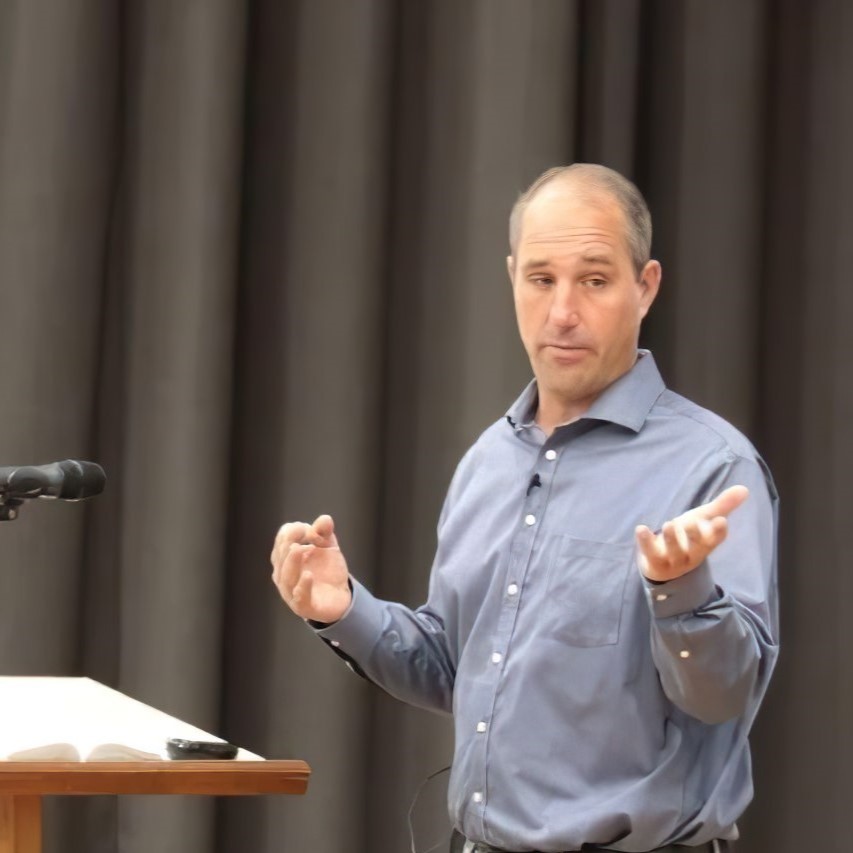
I would invite you as we think about "Teachers are Mentors" to turn in your songbooks to number 585. We have a very common song. The words of this song, I think, are very meaningful in this talk. It's the song "Follow the Path of Jesus." And if you think about it, this is what Jesus did with his twelve disciples. He simply invited them to walk with him for three years, and then he said, "Now go and preach. Baptize and teach in all places." That is what we are called to do as teachers is to impact lives as Jesus did.
What is a mentor? I think mentoring is taking your life experience and giving it away for free. What cost you blood, sweat, and tears, agony, sleepless nights, and lots of years of experience, and you just offer that to a younger person for free.
Sometimes you see positive outcomes for your investment and sacrifice, and sometimes you don't. I think mentoring in a Christian school setting is more like this. It's a miracle in which a special relation, a relational bond, is formed between two people, one with more experience than the other. Because of this special bond comprised of deep trust, admiration and relationship, God molds and changes their lives forever. I would suggest that he changes and molds both of their lives in a better way.
Sometimes this relationship is intentional, and sometimes it isn't intentional. It just happens. Here's the scary part. Sometimes the mentor isn't even aware of the relationship. Now don't let that paralyze you this morning. I would say to you, cling to the hand of Jesus. Follow him day and night, and you'll do alright.
I suggest to you that there are three A's of mentoring, if this is helpful. It's gonna take active listening, and you listen and listen and listen. And I think you are earning the right, then to say a few sentences at the end.
It means availability. Availability is a big thing, and it's not gonna suit your schedule. It's it's not gonna happen when it really works well for you.
You're going to need to analyze their issue. I often send a quiet prayer up to God and say, "I have no idea what to say. Give me words. Give me words for this person because they they're seeking direction. They wanna know what I think. I wanna know what you think." And you're going to need to be kind, and you're going to need to be truthful.
Think about mentors and what mentors do. Mentors give second chances. Mentors allow for mistakes. Good mentors actually expect mistakes. I like to see mentors who are so close to the situation that when the young man drops the ball, they actually catch it before it hits the floor. They don't let the thing go splat. But you can't always do that. But good mentors are going to realize that they're gonna be let down.
I would suggest that mentors take risks on inexperience. They, in fact, risk their own reputation sometimes. They risk mature relationships for the sake of the inexperienced and that relationship.
It doesn't always go smoothly. Mentees. I'm not really familiar or comfortable with that term, but the person being mentored sometimes fails. And even more sadly, the mentor fails sometimes. I have failed as a mentor. I have let people down that were depending on me. Both ways. So many times I forget how many chances it took for me, how many risks others took on me, how many chances they took.
You know, sometimes you teach and you interact, and these people move out of your lives. And and here is a little push encouragement for that experienced teacher that you had a relationship with this person, but now they're grown up and maybe they have a big truck and, you know, a gun rack in the back and stuff like that, and they seem really tough. Don't hesitate to seek them out and talk to them, because you still mean more to them than you will ever know. And you still, with a few words, can light their path and direct their way. Even if they're going a wrong way, reach out to them.
Baidon was about thirteen or fourteen when he came to grade five at our school. And since our school only went to grade six, he was there for two years, and I would see him at school. And he started coming to our church, and he was there for Sunday school. And often on Sundays, he would just stay at our house for lunch, and he'd be there in the afternoon and sometimes go to church with us in the evening, and that that was pretty much the extent of our relationship. He became a Christian at our church and joined instruction class. And as the pastor, I took him through instruction class.
And then one day he came to instruction class, and he was really troubled. And he wanted to talk to me. And he said, "I have a problem. You see, my mom became a Christian."
She was a single mom, and she was raising her two youngest boys, Baidon and his younger brother. Their dad who walked out on their family years before, and his mom had become a Christian at one of the other evangelical churches in town.
And he said, "My problem is that my mom wants me to go to church with her. I don't know if I did the right thing."
I said, "Baidon, you go to church with your mom. They use the Bible over there too. If you want to learn from God, you can learn from God there. You don't have to come to my church."
And so he did. He went to church with his mom, and our school didn't go any further. He went to another school for a while and then dropped out. I heard he was driving truck, and I I saw him once in a while in our town.
And years went by. And then one night, I got a call late at night from an unregistered number. But I took it, and I heard, "Stephan. Is that you, Stephan?"
I said, "Yeah. Who's this?"
He said, "I'm Baidon.
Like, "Okay, Baidon? Are you alright?"
He's like, "No. I'm not okay. I just backed over a little girl and killed her."
And I said, "Baidon, where are you?"
And he told me. I said, "I'll be right there."
"You need to understand that in Guatemala, if you kill someone with your vehicle, you're about as guilty of their death as if you take a gun and shoot them. So Baidon was in big trouble.
And I was there with him when the police came and when the lawyer came. And sitting there, I thought, you know, I had no idea how much our relationship meant to him. But I was the one he called when he was in trouble. And I would encourage you when you get that call, be there for them. They need you. I think there are a lot of flowers out there waiting for the end of August or the beginning of September to blossom under your caring, sympathetic influence.

Teaching Resources for Children with Down Syndrome

The following is adapted from an email response by an educator and mother of a child with Down syndrome.
Fortunately, there are many wonderful resources today for teaching children with Down syndrome. Some of them are specifically developed with Down syndrome in mind. Others are intended for use with a wider spectrum of abilities.
I have listed below some of the resources that I used with our own son who has Down syndrome. He is now 16 and is a delight to our family as he reads everything in sight, learns to manage money, and works in our family business. He surprises us everyday with his capabilities, whether it is learning to drive the golf cart or calling 911 with his new phone (twice in one day with thinly-veiled excuses!!!).
Disclaimer: If you use the below methods and they work, I am not responsible for anyone else using number skills to call the ambulance unnecessarily.
Nevertheless, here are some suggestions.
Whole Child Reading is a good quick read that includes many of the successful methods I used with our son. It also explains the reasons behind the methods.
The two books below about how to teach reading and math are excellent; however, they may not be in print anymore. It looks as if you may still be able to get them from Amazon, and you might also still be able to find used copies. What I found invaluable was the introduction to the reading book which explained how to teach to inspire confidence and how to differentiate between teaching and testing. It also has an excellent chapter about the learning process. It gives good advice with specific examples such as the danger of labeling a child as stubborn when, instead, the problem may be that the material has not been broken down into small enough steps to ensure success.
Teaching Reading to Children with Down Syndrome
Teaching Math to People with Down Syndrome
DSE is a very good evidence-based resource. I used some of their printed resources/kits in teaching our son. They use the same method as the above books, but they have physical bundles with guides that are very useful.
I don't like using too many computer or tablet resources, but one that was helpful to our son was Starfall. It incorporated enjoyable learning without too many distractions, and the screen was simple and uncluttered. A subscription for one year is also quite inexpensive and could be used as support for whatever curriculum you choose.
Mercy for Marthas is a blog with plenty of information about education for children with Down syndrome. It has many helpful ideas as well as links to other resources. Even though it is a homeschool resource, the one-on-one methods will be useful in a school setting as well, especially if the child is being tutored.
Positive Discipline for Children with Special Needs is a good book for meeting the unique discipline challenges of children with special needs. Because of cognitive differences, children with Down syndrome often don't make good connections between their behaviors and punishment. This confusion for why they are being punished can really destroy/delay advancements in behavior and academics. Spanking is particularly ineffective because many of our children with Down syndrome don't process pain in the same way other people do. This book provides other ways of providing kind yet firm guidelines that work much better than traditional methods for children who are developmentally delayed.
I wish you the best as you serve our Down syndrome community by learning how to serve one precious child.
Photo by Pavol Štugel on Unsplash.

Senior Trip Policy

This policy from Osceola Christian School outlines the purpose of the senior trip Washington DC. Use as a model for drafting a similar policy or to generate ideas for a trip to DC.
Osceola Christian School
High School Graduates – Washington DC Trip
Summary
As part of the graduation process, OCS makes possible a well-thought-out highly educational trip to Washington DC to visit the Holocaust Museum, Bible Museum, Tomb of the Unknown Soldier, Eternal Flame, Capitol Hill, White House, and Arlington National Cemetery. The unique combination of visiting the Holocaust museum and Bible Museum alongside a visit to the USA Capitol provides a fertile environment to share the history of “The Skeleton in the Closet” on how the Anabaptists were hoodwinked into not seeing what was actually going on and actually participating in Hitler’s scheme to eradicate the Jews.
This trip provides a deep dive into how the political machine of our country operates with a field trip guide who can clearly articulate to the students the two Kingdom concepts and the doctrine of non-resistance, a core doctrine of the conservative Anabaptist people.
This trip also provides opportunity to educate our students on the history of this nation including the good, bad and ugly truths usually left unsaid.
The desired outcome is for our students to have an eye-opening experience that helps them appreciate our Christian Anabaptist heritage and gives them tools to think critically about the opportunities and threats we face in today's political climate of what it means to be 21st-century Kingdom builders.
Qualification
A student is qualified to go on the DC trip if he/she has successfully earned a diploma or if student has completed a custom graduation plan as prescribed by the admin team.
Trip details
- This trip usually takes place soon after school lets out during summer vacation.
- This trip is usually Monday through Saturday
- Parents are encouraged to engage their students in raising the funds for the trip.
- The total cost for the trip can vary from year to year depending on air fare prices and cost of renting an apartment for the week in Washington DC (estimated cost $1000-1200).
- Each year OCS appoints a Washington Trip sub-committee from the board and staff members to oversee the trip. The committee may delegate the actual planning and going on the trip to trusted brothers in the church who would like to participate.
- For continuity there will be overlap from one year to the next of the tour guide to ensure each tour guide has been properly trained.
- The sub-committee will meet with prospective parents of graduates at the scheduled OCS School meeting to give the parents an orientation and help them prepare for the trip well in advance.
- Students will be required to read at least two books and watch one video prior to the trip.
It is the vision of OCS to make this a signature part of graduating from our school and something students look forward to throughout their high school experience.
Photo by Louis Velazquez on Unsplash.
- 261Page 38