
All Content

Effective School Boards: 3. Making Thoughtful Changes to Policy
How do we decide if a change in policy is needed? What factors influence the need and the outcome of the change? Who makes the decision to change or not to change the policies that are in place? This topic will explore some questions that school boards need to answer to make good decisions.
Devotional & Maintaining Servanthood While Administrating
Devotional: Joel MartinMaintaining Servanthood While Administrating: John GerberAt first thought, it may seem like administration and servanthood are opposites. After all, is it not the administrator’s responsibility to rule the servants? But we see from the perfect example of Jesus and from the examples of the other leaders that and effective administrator is first a servant. How do we serve and lead at the same time?
Effective School Boards: 1. Leading Productive Meetings
Effective meetings, whether in businesses, schools, or organizations, are an important part of developing and communicating direction, ensuring the efforts of the organization are aligned and purposeful. This is also true within the context of Christian schools. Private Christian school boards are often a diverse mix of skills and experience levels. How can we effectively harness this group to enhance the running of a Christian School?
Evaluating the Effects of Digital Media
Disorders - Finding the Balance
What is a disorder? How many are there? And what shall we do about them? “If the school board would just understand how serious this disorder really is…”. “If the parents could just see how they are spoiling their child…” How can we find our way together down the center of this misunderstanding prone, and disorderly path?
Assisting Without Competing
In the path of life, do you find yourself walking alongside a man with leadership responsibilities outside of the home such as school and church? Do you wonder how you can be a support and help him to excel in these responsibilities rather than being a drag or competing with what he is called to do? In 1 Peter 3 our attention is drawn to Sarah as a worthy example. Can we draw some valuable lessons, negative and positive, from her life and others?
Maintaining Our Vision Through Curriculum Choices
Curriculum stands at the core of our Christian schools. A lot of work has been done in the last 50 years to provide Biblical curriculum options for us. This is an ongoing work. May our boards and principals use much wisdom and discretion in choosing the best for our schools. Are there ways we should supplement our curriculum to more completely meet the needs of our students?

The Gift of Neurodivergence

We have likely all had an experience in our lives in which we see a child misbehaving in a grocery store or a doctor’s office. The embarrassed parent quickly says something like, “I’m sorry they cannot help it—they have ADHD”. Or maybe they say something like. “They have autism and cannot control their emotions.” I’m also sure most of us have had similar thoughts about these diagnoses being excuses for poor parenting. Because of the way in which our society has latched on to the labels in such situations, some people have reacted and believe that these things are made up entirely and simply not real. So, are these diagnoses actually real? Or are they psychiatric terms used to medicate children into submission? To fully understand these conditions, we must step back and understand exactly what is happening in the human brain of neurodivergent people.
What is Neurodivergence?
Neurodivergence is a sociological classification for a variety of medical conditions in which the brain does not process information in the same way as a neurotypical person or a person without these conditions. These conditions are evidenced by differences in mental function, learning styles, sensory processing, communication styles, and behaviors. Some of the conditions that are considered neurodivergent are Autism Spectrum Disorder, ADHD, Tourette’s syndrome, and Dyslexia. Dyslexia has long been recognized in our Anabaptist settings because of the impact that it has on learning and reading. Conditions such as Autism and ADHD however have not been as widely recognized or accepted within our Anabaptist setting because of some of the over-diagnosing that has happened in this country. We have to understand that some people have similarities to these diagnoses but are not necessarily neurodivergent. When diagnosing neurodivergent conditions, health care provider search for patterns of thought processes and behaviors that correlate with these conditions and not individual symptoms.
While there is evidence that these diagnoses have been over-diagnosed in some settings, there is also evidence that they do exist as well. There is not only diagnostic and behavioral data but MRI brain imaging and postmortem studies that have shown structural differences in people with these diagnoses. Alvarez-Jimenez et. al. (2019) noted that in people with autism spectrum disorder, there were changes noted both at the cellular level such as neuron size changes as well as changes more globally such as differences in the thickness of gray and white matter in people diagnosed with ASD. There have also been studies to show similar changes in the brains of those with ADHD and other neurodivergent diagnoses. There is evidence specifically in ADHD of a deficit of a neurochemical called dopamine.
While there are classifications for things like these disorders, it is important to recognize that each of these neurodivergent individuals will present in various ways. Each is a unique individual, and no two people will be exactly the same. This is likely one reason why it is difficult to understand or to grasp because there is not a clear delineation of symptoms or manifestations of any of these diagnoses. Whereas, many medical diagnoses present at least in similar ways, mental health diagnoses have been known to present in many different ways. Many mental health conditions are viewed on a spectrum or range of symptoms for this very reason.
God Created Neurodivergence
We have identified that there is evidence that these neurodivergent conditions are real, albeit possibly over diagnosed. So how then do we view them when they surface in our Anabaptist communities? The first thing that I believe is that God has created each person, and they are unique and loved. The second thing that I believe is that God has a plan for each of our lives. He has created us with the gifts and abilities to fulfill that calling that he has given to us. We speak often about spiritual gifts and how each person contributes within the church. We also understand that we do not expect the person who cannot carry a tune to be our primary song leader. This would be very demoralizing to that person. In the same way, not accepting the gifts and limitations of those with neurodivergence would also be demoralizing. I believe that we must accept them as God has created people with neurodivergent conditions for His glory. Just as we would with all of our brothers and sisters, we must call each other to personal, emotional, and spiritual growth regardless of how we process information. Knowledge and understanding of these neurodivergent conditions, however, may help us to be more successful in our encouragement.
Neurodivergence is a Gift
Much of our knowledge of these conditions has been focused over the years on many negative facets. These negatives are a very big part of the life of those with neurodivergent diagnoses. Those diagnosed with dyslexia have an incredibly difficult time learning to read. One person that suffered with this condition told me once that it was like looking at your book in a mirror. Another person told me that their dyslexia manifested as chunks missing from words and so they had to try to guess sometimes what the word is with only part of the word present. They said that more would be missing if they were more tired, stressed, or had a headache. This made things like documentation in their work very challenging. Autism can manifest as non-verbal children or children that are very sensitive to neurostimulations such as noise, light, or activity. People diagnosed with ADHD can often be impulsive, or hyperactive. Sometimes, people with ADHD will completely space out or not hear what is happening around them. They will often be disorganized and forget important tasks or appointments. People with Tourette’s syndrome often have tics or will say things in the middle of their sentences that is sometimes very inappropriate.
While these challenges are real, there is a whole other side to these challenges. The other side is the gifts that God has granted people who are challenged with neurodivergent brain processes. For example, those with autism spectrum disorders are known to have incredible concentration. They are tuned into fine details and have been known to have incredible memories. Those with dyslexia, while they may struggle to read, they are incredible visual thinkers. They are also known to have very high 3D imaging in their mind. They are extremely creative in artistic and have strong mechanical skills. Those with ADHD are often extremely creative. They can hyperfocus on complex tasks and complete them in record time. They have an energy and passion. Those that have Tourette’s syndrome have incredible observation skills and cognitive control. Because of these attributes they are usually highly empathic individuals.
God has created each person, whether neurotypical or neurodivergent a unique individual that he is calling to Himself. He has created them to be a part of and contribute to His Kingdom. While, it may look different for each person based on their individual needs, people with neurodivergent brains can be a huge asset to the local church. Our church is currently in a building project. No one has ever asked me to complete excavating or to lead out on a framing frolic. These simply are not things that I would be very good at because I have not learned them, or I am not gifted in them. However, there are other things that I have been asked to be part of because they are more closely related to things in which I have been gifted. So with neurodivergent folks, there are many things that they can do well. Their role and input may not look the same as everyone else in our churches. However, we need to ensure that they feel the same love and acceptance as those that are neurotypical.
Raising a Neurodivergent Child
While all parents have had situations in which a child has left them embarrassed in a store or at church, there is a clear difference between the behaviors of someone with one of these challenges. There are things that happen that are not socially acceptable in our society and churches at times. While these social norms are important, we must consider why they are being broken and look more holistically at how to address them.
Raising children has its own challenges. Each child brings a unique personality to the family that adds color and joy to the family. Our four children all have very distinct differences and yet our family would not be the same without each one. However, the needs of those with neurodivergent minds is different than those that are more neurotypical. This will also be true in our churches and schools as well.
One of the first things that is needed with these types of challenges is clear structure and boundaries. Often, a child with ADHD will intentionally push a boundary if it isn’t clearly defined to see exactly where the line is. This is not always done as an act of rebellion or defiance, but these children find freedom in clear structured boundaries. Some children with ADHD will do things to make their parents or teachers upset. They push them to the point of frustration because it gives them a certain dopamine rush when this happens. Unfortunately, it can also be very emotionally damaging to them as well as they are often very sensitive to the frustration that they create.
Another thing that is common in people with these types of challenges is overstimulation. This can come in many ways. Sometimes we find that too many evenings away or late nights causes increased behaviors and challenges. Loud environments such as gatherings or banquets can cause someone with neurotypical challenges to become overwhelmed. While this does not excuse poor behavior, it is helpful to understand this when correcting the behavior.
This sounds like it would be very challenging, and it certainly can be. It takes a lot of energy to keep up each day with children that have been gifted with a neurodivergent condition. It can be emotionally draining to try to understand what is happening in their minds and to be empathetic and yet set expectations that are realistic and Godly. However, it is also exhausting to have a neurodivergent mind and to keep up with the different way in which the brain works and the constant neurostimulation that others do not have.
For those parenting a neurodivergent child, the work you are doing is not in vain. There are times which I wonder if we are making an impact. However, it is true that, while it can be challenging to be consistent, this is the most impactful thing that one can do with a neurodivergent child. Consistent structure at home. Consistent boundaries and rules. Consistent discipline if the structure or boundaries are broken. While these things will not seem impactful at first, over time, we can see evidence that these things bring a sense of calmness and peace even in the midst of chaos. A neurodivergent person will feel security deep within themselves from this consistent environment in ways that they cannot explain. Seeing a neurodivergent child start to understand and recognize their need to decrease stimulation or practice emotional regulation is rewarding because these are life skills that will assist them throughout their lives.
Finally, and most importantly, prayer and connection with God are extremely important. In order to properly keep our composure and focus, we must be connected to the one that created each of these special people. While it may be hard to find that time alone with God in a house full of busy children, it is imperative to stay grounded so that we can stay consistent and structured. This connection with God will help us remain calm and composed on the days in which things get a little more chaotic. It will also give us a grateful heart for the gifts that people with these challenges bring each day.
Conclusion
One of the most impactful things that someone told us once was, “Imagine the impact that they can have in God’s Kingdom once they learn to harness all that energy”. This was one of the most encouraging things that we could possibly have heard. It is documented that those with ADHD receive 200% more negative feedback in their childhood. So, to hear someone optimistically speaking truth and life was very refreshing to our weary hearts at that time. God can use those with these conditions to build His Church and His Kingdom.
Whether you are a person with a neurodivergent diagnosis and wonder what is wrong or if you are a parent or teacher that is struggling to know how to relate to your child; you can know that God said that they are fearfully and wonderfully made. God has a plan to use each person in His Kingdom if they will submit to his Word. There is a great opportunity for neurodivergent individuals to impact the world through these gifts and abilities that God has given to them. Neurodivergent conditions truly are gifts that bless many if we accept and cherish those with these gifts and provide the environments that they need to develop and thrive.
References
Alvarez‐Jimenez, C., Múnera‐Garzón, N., Zuluaga, M. A., Velasco, N. F., & Romero, E. (2019). Autism spectrum disorder characterization in children by capturing local‐regional brain changes in MRI. Medical Physics, 47(1), 119–131. https://doi.org/10.1002/mp.13901

Turn on the Lights!

Ohhh, what a dark and dreary morning. It’s foggy and misting, and not conducive to a cheerful attitude for this teacher! As I drove to school this morning, I first felt rather downhearted with this weather and the dark morning. Then I remembered a recent devotional on Jesus being the light and thanked Him for that. I continued thinking about Jesus the Light, and light in general, and considered what I could do with my class today to motivate them (and me!) on this gray day.
We will start with having devotions about Jesus, the Light of the World (see below). We might put the blinds clear up. We could light candles or use battery-operated candles to get some extra brightness in our room. I have a set of 24 little flashlights that we really enjoy using, so we will use them today to spotlight words in our reading, make shadows, read stories by flashlight, play a version of tag, or explore light for science.
I can add some surprises to the day, such as setting the timer throughout the day for random amounts of time, and whenever it rings we stop what we are doing and read a story. We could tell stories or jokes. I can add some extra brain breaks. The children could get a stuffed animal to “help” them with their lessons. We might take a break from the written work and play a learning game.
On these gray days, we can do some extra singing. Perhaps wearing brighter colors would cheer us up. We should think of something to look forward to.
This gloomy day ended up being a happy day inside!
The next day. It is another dark and dreary morning. It doesn’t bother me as much as I think ahead to the plans for the day. We have Book Day. I am amused with my “costume”—I'm dressing as “the old lady who swallowed a fly,” and I’m looking forward to finding out what my students have come up with for the day.
Jesus, the Light of the World Devotional Activity (adapted from Christmas Do-votionals, Warner Press)
- Turn off the lights and light a candle.
- Discuss the light and how it shines. Where are your eyes drawn? To that flame! It happens to me every time. I try to look at the class as I’m talking, but my eyes continue to turn to the flame. We want to turn our eyes to Jesus, the light of the world!
- Read John 8:12, John 9:5, and John 1:5.
- Discuss how the light chases away the darkness. This could be demonstrated with a flashlight. Relate this to Jesus “chasing away” the darkness of sin.
Photo by Rich Smith on Unsplash.

Am I a Teacher? Or Am I Just Pretending?
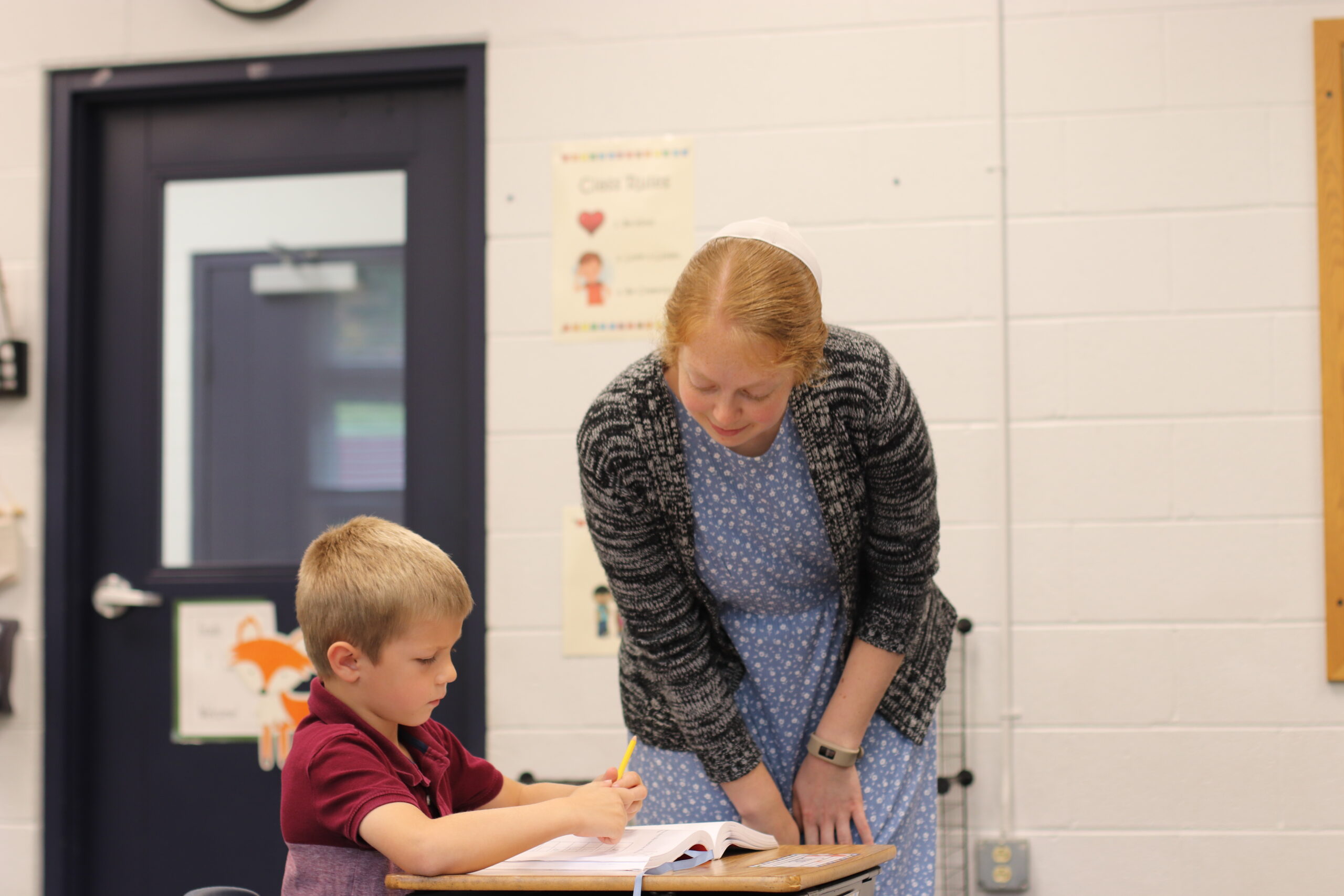
A beginning teacher, the first weeks of school, and a common question, “Do you feel like a teacher?” How does one answer that? What does being a teacher feel like? Is it showing up every morning, presenting lessons effectively, racing through math flash cards, listening to long-winded stories, admiring the hole left by the missing tooth, settling recess squabbles, bandaiding scratches, cleaning up spilled lunches, and checking workbook pages? Does feeling like a teacher feel like brain exhaustion by the end of the day? Is it a shared camaraderie between fellow teachers? Does one feel more like a teacher when the lightbulb goes on in a student’s eyes or when one is stifling frustration with the child who is hopelessly confused? Is the teacher feel developed by sticky candy gifts, moments of student growth, and apology notes? Can one feel like a teacher when things haven’t gone well; when a student continues to show disrespect; when the concept of long division still hasn’t stuck after six weeks; when recesses are a series of arguments; when spring is a long way off?
I’ve taught long enough to teach the second generation of six-year-olds to read. But sometimes I still wonder, “Am I really a teacher? What does it mean to really be a teacher? What should being a teacher feel like?” Some days and some years I do feel like a successful teacher. And other days and other years, I wonder if I am really the one for the job. I sit in teacher meetings and listen to others share wisdom and experience and wonder if I am at all qualified. Some days, I listen to an idea from a beginning teacher and wonder why I never thought of that before. After all, I’ve done this long enough that everyone thinks I’m a pro. But what if I’m not.
I have an idea that every teacher at times wonders if they are merely pretending to be a teacher. Any time one starts to compare themselves to others, we start to doubt our own abilities. Beginning teachers look at those with more experience and become discouraged with all they don’t know or get accomplished. Older teachers, too, can compare themselves to fellow teachers—or even to previous years of their own—and wonder why things don’t go as smoothly as they’d like.
Part of being a teacher is the fact that we show up every day. We continue to learn new methods, explore new ideas, and expand our horizons. But part of the teacher life is also recognizing that the struggle through hazy math concepts, reading challenges, and recess disagreements is the real part of teaching. Being there, every day, not giving up is what makes one a teacher; not the accomplishments and accolades.
So, to the younger teachers, keep going. Every day you show up with a prayer in your heart and a smile on your face you are gaining experience. You are a teacher.
To the experienced teacher who’s been teaching for a few years, keep going. On those days you feel eclipsed by the newer, younger, more exciting co-teacher; by the ideas presented at teacher workshops; by the “experienced” voices of others; by successes of others where you struggled—you are gaining experience. You are the teacher God created you to be. Yes, keep growing. Yes, check your heart and your motives. Yes, give heed to constructive criticism but unless you are called elsewhere; keep going. Be heartened by the fact that at some point each of us wonders whether we are teachers or imposters.

Confronting the Woke Mentality in our Schools
How does wokeism influence conservative Anabaptist schools? Gerald Miller highlights the need for Christian schools to promote a kingdom-oriented vision and encourages teaching scripture as the roadmap for students to bring the kingdom of God wherever they are.
Structure and Purpose of Kindergarten
Lyndon discusses the benefits of early education, assessing readiness for first grade, and the role of kindergarten in teaching discipline. The discussion highlights the need for clear communication between parents, teachers, and school boards, as well as the impact of a positive school culture.
- 261Page 36