
All Content


The Basket of Flowers Book and Study Guide
Here is the novel The Basket of Flowers by Christoph von Schmid (not under copyright) and questions to answer for the novel. This novel promotes honesty, faith, and perseverance (among other values).
This novel was originally written in German, so German speakers should look for this novel as Das Blumenkörbchen.
For more freely downloadable books and study guides, visit Edward's website.

Preventing the Summer Slide

It’s summer vacation! Yay! Let’s sleep in till noon, watch videos, and hang out on the living room couch.
Or not.
Researchers, educators, and parents are becoming increasingly concerned about what they call the “summer slide,” and they’re not talking about the local water park. Many children experience a learning regression over the summer months, slipping backward significantly in reading, math, and memorization. Worse, the slide can be cumulative, lowering a child’s performance each successive year. It’s not only a problem for first graders; studies suggest that older children lose even more than the little ones do.
Without frequent exercise and practice, any learned skill will slip. Yet we all love the concept of recess: a well-earned break from the daily grind. What is the solution? Keep the learning going all summer long – but make it fun.
Let’s start by getting children out of the house and into community life. This may seem counter-intuitive, as many parents have been waiting for this chance at relaxed living and free labor. (Or maybe that’s just me.) But what fun, educational experiences can we have together as a family? We can
- Take a daytrip to visit great-grandma over the state line
- Sign up for a hike
- Join a free herb planting seminar at a community garden
- Attend an orchestra concert at a neighboring college
- Stop by a maple farm or a friend’s horse barn
- Volunteer with a clean-up crew
Websites like Macaroni Kid locate organized activities and group them by region, so you can find your own town and access a daily list of what’s happening nearby.
Engross your children in good books. Reading just four to six books over the summer can make the difference in maintaining your child’s reading comprehension level. Many libraries offer summer reading programs, with fun prizes and incentives. (While ours consists mostly of cheap toys, there are also certificates for treats or meals at local restaurants – and hey, my children are reading.) Read together. Read often. Read aloud – even after they can read it themselves. Rent audio books. Find books across a wide range: light-hearted picture books, chapter books an older sibling can read aloud, and informational books on any topic from lunar exploration to backyard bugs. You may find the surprise gifts of science, history, and world awareness creeping into what you thought was your summer literacy program. They’re tricky like that. And the more the merrier!For the development of a healthy child, use technology sparingly and intentionally – as a tool, not a toy. Digital gaming doesn’t build much in a child’s mind and body. But websites like Education.com or Xtramath.com give children a chance to use a computer (fun! fun!) to develop or maintain real-life skills like grammar and subtraction. Some authors such as Dr. Seuss, Jan Brett, and Eric Carle have websites for children’s education. With parental guidance, scientific websites like National Geographic and Smithsonian can be great tools for learning about nature, discovery, and invention. Take a virtual field trip to the Hershey Factory or Mount Everest (more listed in this article). Or try Chess.com for an occasional battle of wits.
At home, plan ahead to get children engaged in home life. Challenge from the get-go their easygoing assumption that summer equals low expectations. There’s nothing wrong with some relaxing – they’ve earned it! But then get them moving, and use this chance to teach responsibility and teamwork.
- Hang those chore lists on the fridge.
- Teach a new skill like bread baking or wood refinishing.
- Divvy out household, yard work, and animal care assignments. (It’s great math practice. If Johnny folds five items of laundry and Suzie folds three, who will fold the other three hundred and sixty-nine?)
- On a rainy day, skip the screen time and pull out paper and pencils so they can write letters to their cousins in Lancaster County.
- On a sunny day, shoo them down to the creek, or lead them on a long walk with a bird book.
- Let your children plan and prepare one meal a week: following recipes, doubling the dessert quantities (math again!), and washing dishes.
- While you buy groceries, give them a calculator to tally prices.
You notice I am sharing all these sparkling ideas at the beginning of the summer. Feel free to check back with me at the end and see how it went. Managing children’s education requires significant time and energy, when it would be a whole lot simpler to let them loaf.
But think of it this way: if you’re like me, you’ve outsourced this aspect of parenting all winter. Someone else, God bless them, has been growing your children’s I.Q.s and skill sets. Now is your chance to participate. You may find you learn as much as your pupils do, and have just as much fun.
What summer slide?
Resources:
https://www.brookings.edu/research/summer-learning-loss-what-is-it-and-what-can-we-do-about-it/https://mentalfloss.com/article/579224/kids-whose-parents-read-aloud-to-them-understand-a-million-more-words
Spelling the Song: Learning to Sight-Sing with Familiar Hymns
(Singing) “Follow the path of Jesus, walk where his footsteps lead…”
The way I learned to sight-sing was to take a familiar tune and try to sing the notes to it.
After verse three, let's sing the melody in the notes.
Like, mi mi fa so so fa mi re do do re mi mi re-re (Ode to Joy). When you do that with songs that you know, pretty soon, you don't have to be looking at the book to know what notes you're singing. That's what worked for me to learn to sight-sing.
Sing the melody. Look this time and next time through we'll see if we can do it without looking.
(Singing) “Do do re mi so mi do, re re re re so mi, do do re mi so mi do…”
Take a familiar tune—and often I would do what we did this morning, where I would let them go ahead and look at the soprano line as they're singing and then try to do it without looking.
Most of the students here would recognize the shapes and the syllables. Our congregation is really strong on shaped notes. Now, we do have a fair amount of people who play the piano and a few stringed instruments, not a lot but some. Obviously, they work more with round notes. Some of our older people, especially if they’re familiar with the piano, will stick with round notes. But by and large, in our school singing and our congregational singing, we rely heavily on shaped notes.
I remember when I was younger, I would, sometimes, be working with my brother on the carpenter crew and I would be blaring away like this, and he’d get irritated at me and he would sing it. Except he’d just insert random notes in it. I told my students that, and of course, they got a kick out of that.
And so, we don't do it every morning, but a lot of the time, we'll sing a song and then we'll sing the melody and the notes. I'm hoping that it works for them like it did for me.

Cultivating Conversations
 In a world of fragmented relationships, conservative Anabaptists have the potential to be increasingly known for their gracious communication and hospitality. They will provide winsome, humble voices of clarity and discernment in a culture snowed under with the ambiguity and ungodly philosophies of social and broadcast media. Life-giving conversations will characterize their churches, schools and homes. Empathetic listeners and gracious counselors will outnumber the lonely and hurting. Iron will sharpen iron and truth will be spoken in love.
This potential cannot be realized without communities of committed Christ-followers who have experienced the rich blessings of God and the clear leading of the Holy Spirit. Only within such communities can compelling, life-giving conversations be fostered. We desire and pray for this, and will also act. Presenting a gracious message that brings others to Jesus requires both speaking and listening skills. Developing these in our children and youth ought to be a focus in our communities.
This article will explore two foundational ideas behind the development of speaking and listening skills: the importance of practice and the deepening of thought processes that comes from practicing well. In addition, practical suggestions will be given for developing and cultivating speaking and listening skills in our homes and schools.
Successful Communication is Not Only for the Gifted
Speaking and listening skills are developed through practice. But perhaps we undermine this idea with some common expressions focusing on talent rather than practice. How often have you heard: “He’s such a gifted speaker?” Have you ever heard somebody ask: “How did he become such an articulate and effective speaker?”
We tend to approach conversations in similar ways. We assume that good conversationalists and discussion leaders have obtained some mysterious gifting enjoyed only by a privileged few. At a youthful and impressionable stage in my life, I remember hearing an outstanding conversation on a volatile topic. I can still picture the setting and participants. In this discussion, the proverbial elephants in the room were addressed and slain. The potential landmines were disarmed as issues were discussed and clarified. This gave space for opposing viewpoints to be heard. Why was this conversation working in places where others had failed? I remember noticing several things about those leading the discussion: their outstanding verbal abilities, their humility, and the clarity they brought to the topics at hand.
I was at first awestruck at the apparent scholarly thoughtfulness of the participants. They had seemingly attained a verbal adeptness inaccessible to the ordinary human. I longed to gain the mysterious skills they possessed. I wanted to contribute to similar discussions—ones that would allow us all to break through our clouded preconceptions and see the issues more clearly. I wanted the capacity to broach, listen to, and discuss difficult topics without causing rifts in relationships.
As I continued to listen to these discussions, I began to realize that what was happening was not rocket science. The most effective phrases and ideas consisted of simple one and two- syllable words. What was unusual was the humility and clarity that these words cultivated. “I think I hear you saying (summary of what was said). Did I hear you correctly?” “I’m not sure if I understood what you were saying about x. Could you talk more about that?” “I agree with what you said about x. What would you say about y?”
These discussion skills were, after all, attainable. These words could be practiced and learned. I could use these words and phrases to frame my questions and ideas. Even my young students could learn and practice foundational skills that would enable them someday to effectively use these kinds of language skills to cultivate wholesome interactions in the church.
We are no strangers to the need for practicing skills. Onlookers are consistently amazed at the cooking, homemaking and sewing skills of Mennonite women and the skilled labor of Mennonite men. It is not that we are genetically predisposed to these tasks. We have had thousands of hours of practice at these skills from an early age. The same type of diligence is necessary to cultivate good speaking and listening skills.
We ought to care about practicing speaking and listening skills in the same way that we care about practicing homemaking and craftsmanship. Learning to speak with clarity will sharpen the thinking of the day laborer as well as the practiced, seasoned speaker. But the sharpening is in the practice. Listeners and speakers not only gain clarity and grace through practice; they also have opportunity to strengthen and deepen their thought processes.
Deepening Thinking through Speaking and Listening
This is perhaps most evident when we interact with young children whose thought processes are developing rapidly. An experienced teacher advised me to expand thinking skills by using good questions to encourage and develop language skills. Prompting the child is a more effective way of building memory than simply supplying the vocabulary term that the child is struggling to retrieve. Giving the child a few words to begin a sentence is better than impatiently interrupting their stumbling words. Children gain deeper understandings of the topic under discussion as they practice putting words together in a coherent way.
 As children talk about what they are learning, they not only benefit from practicing their speaking and listening skills, they also deepen and strengthen their thinking on that topic. An instructor at Faith Builders purposefully develops as a thinker by applying this strategy to the books he reads. After reading a book, he finds a willing audience and retells the main points of what he has read. Three retellings are enough to fix the new ideas and most powerful stories in his mind.
As children retell stories to each other, they gain more than new information. As they hear other students talk, they see what they missed. As they hear themselves talk, they evaluate their own ideas in a more accurate way. Perhaps this is what Winnie-the-Pooh was thinking when he said, “When you are a Bear of Very Little Brain, and you Think of Things, you find sometimes that a Thing which seemed very Thingish inside you is quite different when it gets out into the open and has other people looking at it.”
Practice Begins at Home
We begin to practice speaking and listening skills at home. The way we speak to the babies and toddlers in our homes powerfully influences their language development and their lifelong learning potential. Children who are verbally adept tend to have parents who kept up a flow of conversation in the early days of their life. This conversation flows naturally through the course of the child’s
day, from diaper changes to shopping trips to the bedtime story. University of Kansas researchers Betty Hart and Todd R. Risley published a report on this phenomena called “The Early Catastrophe: The 30 Million Word Gap by Age 3.” Prior research showed that children of high-income families consistently outperform children of low-income families, with the gap being the widest between professional families and welfare families. This was not news to the educational community. What educators found puzzling was why they could not arrow the achievement gap by providing impoverished children with he same educational opportunities hat other children had. They also found that a stable and loving environment was not the core issue in the achievement gap. Even if they came from solid families, children from low income homes came to school with significant learning disadvantages.
The surprising result of this study was that by the age of 3, children from high income families had been exposed to thirty million more words than children from low income families. These findings highlight the key role of conversation in the homes. High income parents tend to converse more, use complex sentence structures, speak with precise vocabulary (vs. baby talk and slang), support children with positive words and affirmation, and read regularly to their children. What these parents offer their children can be offered regardless of income
The Questions We Ask
The kinds of questions parents ask heir children also develop their communication abilities. Professor Monisha Pasupathi, in her lecture series “How We Learn,” describes two common parental responses to a child’s storytelling. 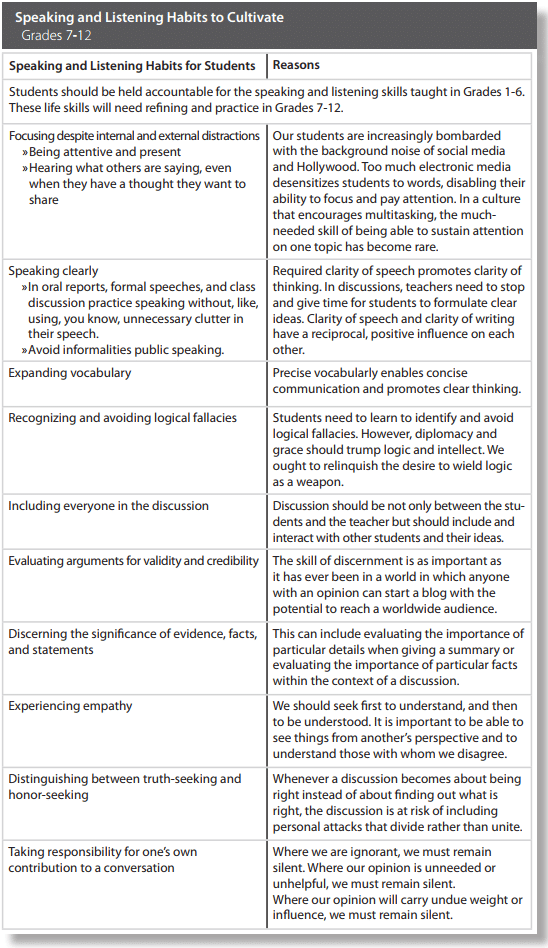 When a child retells he story of an event during the day, some parents give little time for their child’s story. They focus on getting the facts and do not ask for their child’s perspective or feelings on the event. This approach is called the repetitive approach. Children who experience the repetitive approach learn limited communication skills.
Other parents patiently listen to their child’s stories while asking probing questions to encourage their child to give more details. In response to their parents’ support and interest, children tell more vivid, accurate and detailed stories. Parents who ask their children to elaborate on their stories in this way are using the elaborative approach. By school age, these children have acquired outstanding verbal skills that powerfully impact both their speaking and writing. Pasupathi speculates that these children not only have attained better verbal summarization skills, they also have gained reflection skills that help them to learn from their life experiences.
Pasaphuthi points out that storytelling skills, like other communication skills, are gained through time and practice. Stories are best told in the natural flow of shared work and play. I believe that conservative Anabaptist parents are uniquely positioned to help their children gain elaborative storytelling skills. Stay-at-home moms have more opportunities to strengthen their child’s storytelling because of the amount of time they spend together. Families sitting around the supper table provide an appreciative audience for children to practice their storytelling skills.
Speaking and Listening at School
As children reach the age of formal schooling, teachers sometimes assume that their students will gain the necessary speaking and listening skills as they do their daily assignments. But teachers ought to be thinking constantly about how to craft class discussions, ask questions, and teach students to communicate. After all, school 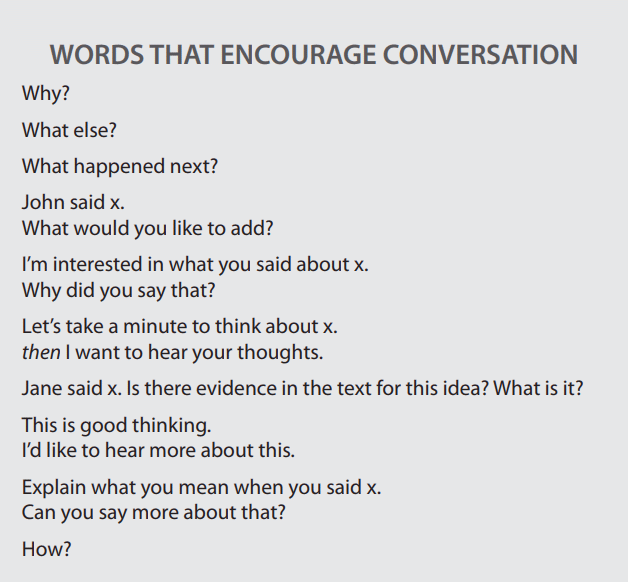 is where, for the first time, children hear divergent ideas, decide when to insert their thoughts, and practice expressing their opinions clearly and compellingly to a group of peers.
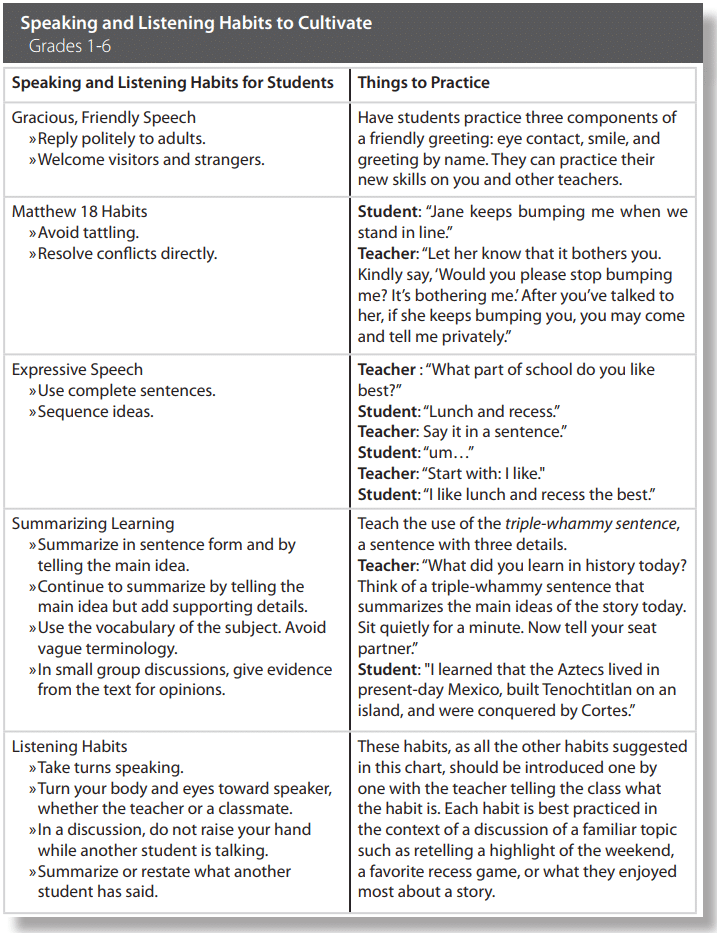
The preceding charts outline areas in which schools could assess and strengthen teaching practices. Many of these techniques could also be used in the home. Students who practice these skills are on the path to contributing to their churches and communities with effective and gracious communication skills.
Our Anabaptist communities offer havens of peace and wholesomeness in the clamor of 24-hour news cycles, social media, and driven lifestyles. Our traditional family values and practices portray a vision of belongingness to those jaded by the broken realities around them. As followers of Jesus we possess a compelling message to share with others. May we prepare the next generation to communicate effectively with grace, humility and clarity.
Works Cited
Keene, Ellen Olliver. Talk About Understanding: Rethinking Classroom Talk to Enhance Comprehension. Portsmouth, New Hampshire: Heinemann, 2015.
Hart, Betty and Todd R. Risley. The Early Catastrophe: The 30 Million Word Gap by Age 3.
Pasaputhi, Monisha. How We Learn. Chantilly, Virginia. The Teaching Company, 2015. Video.This article originally appeared in a Faith Builders newsletter. Download more free resources at FBEP.org.
Early Summer Work
It is no secret that one of the best perks of a teaching career is summer break. At the end of a school year, it is always tempting to heave a big sigh of relief, throw the mess into drawers, and get started with summer plans. It’s tempting, in other words, to quit thinking about school as soon as the last report cards are issued, and not think about school again until the new year is about to begin. Instead, we should see summer vacation as a prime opportunity to prepare for success in the next year. The sooner we start after the end of the school year, the better will be our preparation. My early summer work falls into three categories.
Reviewing. While the old school year is still fresh in my memory, I like to review the highlights and lowlights of the year. What improved in my classroom over previous years? Where did we go backward? What teaching strategies worked? What didn’t work? Where should I have put more energy? Where should I put less energy? What are the major academic and non-academic needs of my students? These questions, and others, help me to focus my attention on the changes that will lead to the greatest improvements next year.Brainstorming. Early summer is the best time to dream big. For example, I recently discovered a podcast called “A History of the World in 100 Objects,” and wondered, what if I could teach a science course that way? Perhaps I could try “Physical Science in __ Objects.” What would be the ideal number of objects? Which objects would have the highest payoff? How would I engage the students? What would they learn? How would I assess their learning? Now that school is out, I have time to dream of what could be.These big dreams are unlikely to come to full fruition—let’s face it, I’m not going to write a science course from scratch—but that’s the point. Early in the summer, I am not under pressure to figure out the minutiae of implementation. However, the ideas I generate while brainstorming can shape how I actually teach my courses. I might not do a full science course this way, but what if I could do one section? Baby steps toward improvement are easier when I dream of massive improvements first.
Planning. High ideals almost never happen without specific plans. I have found that I do not get guest instructors or go on field trips unless I plan them well in advance. Additionally, if I know before the school year starts what sorts of projects I will be doing, I have the time to shop around and get the right supplies at good prices. No late-night runs to town to get mirrors because I just thought of a great project to teach optics.Planning ahead is the best key to success that I know of. To that end, my goal is that, before I go on summer break, I will have at least a rough draft of the schedule for all my courses for the next year. This means going through the texts, deciding how long I think each section will take, and putting it into a calendar. Then, when I come back from break and start preparing in earnest, I’ve already done the hardest work. I will need to reject some ideas and hone others, but the early summer work will mean that my late summer work is easier and of higher quality that it would have been otherwise.
Summer break is good. Rest, refreshment, a change of pace—all of these are good things, and we should enjoy them. I find that I enjoy them even more if I delay starting the break by a few days and do the hard work to set myself up for success the following year.
Freedom Quilts, Cotton Gins: Invite Historical Understanding with Hands-On Activities
I try to come up with as many hands-on activities as I can. I don't do this every single unit, but I try at the end of a chapter to have some activity like this that we do hands-on. That's my goal. We're studying slavery right now, and I made this years ago before I had children, but it wouldn't be hard to make one. You could even make one out of construction paper, but this is an underground railroad quilt, and every year one of my students, at least, picked this topic for their research paper, but this is really interesting. This was a secret code that the slaves would use to know when they were going to escape.
For instance, this one is monkey wrench. It meant get your tools ready. This one is wagon wheel, it meant load everything secretly in the wagon. This is bear paw and it meant to go through the woods where the bears would go—don't go on the road. This next one is crossroads. It was where to meet somebody or something. This is log cabin, and they were supposed to go to the log cabin. Usually, there was a signal like two or three candles lit in the window. That was the safe one. This is bow tie and it meant once they got to the cabin, they were supposed to dress up, get out of their slave clothes and wear formal clothes. This is flying geese meant to go north. This is drunkard's path. It meant to take a crooked path through the woods. This one is a north star or some kind of star to follow the North Star. This one is tumbling blocks, keep going, tumble quickly so you don't get caught.
Again, just to hang that up on the wall where we're studying slavery, something to look at that makes more sense and to think that they would've, in secret, hung these out the window and, “Look, okay, this one, there's the churn dash we better load our stuff up.”
We were studying the colonial period, and we made little yarn dolls. The guys made boy yarn—they had legs—the boys made boy yarn dolls and the girls make girl yarn dolls.
We made these little pouches; before they would've had pockets, they would have had little leather pouches.
For one, we had studied South America last year, and what do you do for South America? Well, I don't know, what do you do? I thought they could make a map and the easy thing would be get a white poster board, and mark all the countries and make a map. I said, “You have to make some kind of a map of South America.” But I love to put crazy parameters on them. “But,” I said, “you can't use a poster—you can’t just put a poster board in and put the map on it. You have to do something interesting.” Some of them glued coffee beans and little oranges and bananas, and they actually use those for, like, the texture on their map. Some of them made hysterical cartoons like the guy crashing into South America thinking that they'd hit India or whatever. They had cartoons on them. There were several different ideas I gave them.
I always present to my students—I feel like they're young, they don't have a broad range of experience. If I just said, “You have to make a map,” I'd probably get a bunch of little pieces of paper with a map. I try to let them think big and I trie to give them is many crazy ideas as I could.
Again, I picked up—it was a string art of a ship—and I just happened to glance over at that and say, “Oh you could do string art,” and I got two of these that were just beautiful and they're even color coded. Green is Brazil and whatever. Then actually one student got so excited he made one of the whole United States.
We just got through with the Industrial Revolution. We actually got cotton. I make them like touch the poky thing on the cotton. It hurts. It's very sharp, and then I actually make my students—I give them a blob of cotton—and they have to sit there and pull the seeds out. If you've ever done that—like, here's the seed, and so you have to pull it and pull it and pull it.
Then you get this little bitty seed out of there. Can you imagine before the cotton gin, and you had to sit there, the slaves had to sit there by hand and pull these out. Then when I show them the picture of the cotton gin and say, “By cranking that handle, one person could get done fifty times the amount of work rather than us sitting her pulling out this little cottonseed.” Again, you can get cotton online or if you know somebody who lives in the South. We used to pick this up on the side of the road when I lived in Texas.
Then we're talking about the Industrial Revolution: You had to get all the cotton and then usually—I don't have enough time, but I'll demonstrate how to card. After they get all the seeds out of it, they card it, and this isn't carding very well, but they'll get these little Rolos they call them. Then they get a spinning thing and they spin it, which we can't really demonstrate. Then we get yarn. We have this yarn and then some of my students—I've done this a couple of times—I've said, “Hey guys, who has extra two by fours lying around their shop,” and a bunch of the boys raise their hands, and I say I need 30 of these. All it is is the two by four.
I just get yarn. I went to the Goodwill and got a big bag of yarn for a couple of dollars. Again, I go through shopping and I just look for stuff like that and I buy it. Then we just took one color yarn and wrapped it around the two by four. One year I ordered little plastic needles, but this year I just went to the art room and got a popsicle stick and taped it on there. I tell them, “Once you’ve woven your wool, then you have to weave this.” And you have to go over and under and over and under and over and under. They sit there and do this for twenty minutes, and they have this much done. I say, “Can you imagine making your own clothes? All you're trying to do is make a bookmark.”
What if you had to sheer your own sheep, grow your own cotton, pick the seeds out, make the Rolos, make all the yarn, and then sit here and do that. Could you make three yards of fabric for a dress? All of a sudden, the Industrial Revolution makes a lot more sense.
I actually had them make bookmarks. This was last year, but we were doing the Industrial Revolution as well. I actually had them—they all had to finish a bookmark for a grade because I wanted them to know how hard it was to sit there and weave on a loom. I got all these beautiful bookmarks. Some of them use different kinds of thread. That's just something that they can touch and realize, “It must have been really hard back then. No wonder the sewing machines were so fabulous.”
This year, I had them go back—I have on my fish tank back there a treadwheel stand, and I had them for their homework… go back there and punch the treadwheel three times and make the flywheel go round. Can you imagine how much faster that would've been than sitting there doing this by hand? Anything that we can think of like that.
I am working on a list of ideas, so if anybody's interested, they can contact somebody from Faith Builders and I'm compiling a list of all these different activities.

Tech on a Budget: Serving the School as Efficiently as Possible
- If at all possible, make sure you have a network.
- Management, internet filtering (if applicable) student access, etc. is almost always easier if it is on a network.
- Exemptions to this would be if you have only a 2-3 licenses of certain software—even then, though, I highly recommend using a network with active directory set up!
- Make friends with someone in your community who is techy!
- This can be former students or interested business partners.
- A lot of times these individuals will actually love the responsibility of your network, and will be willing to invest time and expertise that you don't have in to setting it up!
- The right individual might also be a source for students who are looking for more advanced computer classes.
- Buy enterprise grade wherever possible!
- Many times a used enterprise-grade device is better than consumer grade.
- l have bought 4 year old lease return computers that have run for another 4-5 years in the school, with my cost of ownership around $40-50CDN/unit per year.
- Don't be afraid to have 1 or 2 spare machines around that you can swap in and out easily enough.
- Don't be afraid of used! Are their any local businesses or banks that you could connect with to be on their list for donations of their end of life devices?
- If you are setting up a lab, try to get all the same make and model number.
- Look at purchasing a license to some sort of imaging software that will let you easily rebuild a computer in minutes, rather than the hours it takes to manage individual machines. This software can run you $15-25 per unit but the time saved in labor will more than repay for itself.
- See if your church can get registered with an organization like Techsoup.org. If you are a church school, and your church can be properly registered, you will qualify for significant savings on software from organizations like Microsoft, etc.
- At the least, if you can register with Microsoft as an organization, you can get bulk pricing also at a significant savings.
- Before buying any software from any company, always check to see if they offer non-profit or educational pricing.
- Most tasks that we give our students in school are not hardware intensive—take a hard look at using a virtual desktop solution like Ncomputing. Modules are available on eBay for $30-50/pc and all you need to do is supply the monitor.
- If you have a network, you can filter your internet at point of entry. This is much easier then having to manage individual workstations. That is always time consuming.
- l enjoy tech things, but I am not a truly techy person...so double check my suggestions

Thank You, Teachers

For the hours of energy poured into your students over the past nine months–thank you.
For waking up every morning ready to face a new day with people you didn’t create, to teach content you didn’t choose, and to deal with challenges you didn’t foresee–thank you.
For uncounted lesson plans, flashcards, speed drills, phonics sheets, number charts, math formulas, foundational basics, ground rule rubrics, over and over and over again–thank you.
For the lovely classrooms, beautiful bulletin boards, creative ideas for prizes and incentives, poetry appreciation, art lessons, bird watching–thank you.
For looking beyond academics to matters like character and wholeness and the heart–thank you.
For investing in young people, growing our community’s strength, building the church–thank you.
For bearing with questionable lunch manners, for wiping up disgusting substances, for working with people in training, who have not yet mastered some of life’s nuances like which buttons ought to be closed and where to put wadded tissues and what topics are not discussed in polite society–thank you.
For challenging the keen students, tutoring the slow, correcting the naughty, coaching the defiant, meeting the reluctant halfway–thank you.
For setting standards of acceptable behavior, and sticking to them–thank you.
For caring when children injured themselves, fought with their friends, hid tears, went hungry, and lost ground relationally, academically, spiritually–thank you.
For working respectfully with parents who took last-minute trips, who kept a child home when he should have attended and sent him when he should have stayed home, and who contacted you (or not) with varying levels of tact (or not) about their weighty concerns and irrational fears–thank you.
For demonstrating a living picture of Jesus, for modeling Christian virtue, for admitting need, for asking forgiveness after mistakes, for showing what the path to holiness looks like, and for walking it while initiates watched–thank you.
For teaching when you were sick, or struggling, or bone tired, and for waking up the next morning and doing it all again–thank you.
For the hours of energy poured into your students over the past nine months–thank you!

Junior High Teacher
Established Christian School has an opening in the 7-8th grade level. Total enrollment approximately 60 students, 8 in the 7-8th grade room. Classroom style instruction. Beautiful campus setting.Experience delightful environment, living in the Central Valley of California.Please contact Norm Beeghley - naj1966@juno.com for additional details

We Love a Challenge: Promoting Staff Development
Who trains your teachers? Is it experience? Which is ultimately the students, really. Or are they skilled trusted mentors? Far too many of our teachers experience the sink-or-swim idea.
Just don't dump them into your classroom without any expectations, without getting to know you and the people in your classroom, and then all their training will be by student experience. Boots on the ground is a way to gain proficiency, but it's a slow way, and it's often a burnout way, too.
Many of us are involved in trades or occupations. We benefit from apprenticeships and mentor/mentee arrangements. Whether farmers or shopkeepers or builders, we find it helpful to attend trade shows and informational meetings and seminars, or whatever, to keep up with things, or to stay on the cutting edge. I suppose we'd have a lot less teacher burnout, or quit-out, if they also had similar opportunities to keep up with things, or to stay on the cutting edge of their profession.
Is your teacher development program intentional or haphazard? Give them an opportunity to develop their skills. It is to their advantage and to your school's advantage as well for the longterm. Not only for this next term, but for possibly for the long term.
The earlier you can secure your teachers for the following year, the more time you're going to have to develop their skills and talents and to discern what their interest are and shore up the subjects maybe that they're weak in.
References and interviews if you don't know the teacher very well. That is one way of actually developing your staff: by you getting to know them. If you don't know them very well, be sure you have plenty of good references from qualified sources. Then interview the teacher, too, if you don't know her or him very well.
Then advance training and development would be another way that we can help develop staff for this fall: Hope Teachers Institute—I think it's week-long, right? Christian Light Teacher Training; Western Fellowship Teachers Institute; Faith Builders Teachers Week. Then other more intensive preparation would be things like hire them in advance so that they can attend the summer term at Faith Builders. Teacher apprenticing term at Faith Builders, that would be like a two-year course. Take enrichment courses in a local community college, or online courses or computer courses.
There was a young man—I was really impressed when, after he was hired and after he was interviewed by the other school—I was really impressed how diligently he began to prepare for that assignment. He knew that his weakness would be English and so he bought an English handbook, he studied English literature. He went all out to shore himself up on English because he knew that's where his weakness would be. You want to take that kind of ambition and build on it and give them the courses and the resources that can work.
Assign a mentor to young or beginning teachers. Young or beginning teachers need a mentor. You need to have someone assigned with them. Give them a daily phone call or a weekly phone call, whatever the need is. Work with them for a day every week. Just mentor them through.
Developing present staff: Staff meetings: Staff meetings can be enrichment times and this is something that I just enjoyed very much. One of the best memories I have of staff meetings from when I was principal and teaching was reading through a book as a staff. We'd read a book, maybe a chapter a week. Each one of us would read a chapter a week. Or maybe we'd read it as a devotional, kind of, for our staff meeting and then we discuss it. The Master Teacher, for example, Rod and Staff's Master Teacher, and other books that you can read for staff development and developing skills.
Staff meetings can also be a great time to discuss methodology and "How do you handle this?" and "What would you recommend for my student here?" Iron sharpens iron. You just blend together and work as a team. You will all develop together.
Develop a culture in your school that teachers really want to be critiqued. They really want to be evaluated. There are forms. There are ways that you can do this. This should come, though, from an experienced teacher, someone that has experience in that area, or maybe from outside the school if your school doesn't have an experienced teacher that can provide that.
Don't forget to affirm and appreciate, as well as show out the areas of weakness that they need to improve on. Affirmation and approval, appreciation, go a long ways in developing teaching skill.
Schedule three to five days per term for in-service training. I'm suggesting that you actually build this into your calendar: Southeastern Educator Seminar in Hartwell, Georgia is every February; the Virginia School Institute; Texas Teacher Conference is a new and growing one; CLE Workshops are in October and November—that's a traveling workshop of experienced educators going around. Then you have CMTI, Conservative Mennonite Teachers Institute, usually held in September, one in the East and one in the West, except West doesn't come that far west, really.
Visit other schools as well. That can be an enriching time. Some schools go as far as actually swapping teachers for a day. I'm not sure that it'd recommend that one, but that is what a few schools that I know have done. Visiting other schools is a way to sharpen your iron, sharpen the teacher's iron.
There are some schools that kind of take the attitude that, "Well, you know, we can't afford to take off so much," you know? But I'm saying if you really are concerned about developing your teachers and giving them enough respite time, that they can actually develop skills and refresh and revive, that means... Some of these workshops and some of these meetings like this are essentially revival meetings. It's teacher revival meetings is what they are. It gives them a boost in their energy and brings them back with lots of ideas and they're brimming over.
Then the summer development opportunities. Teachers teach best out of freshness. The best teachers are learning teachers. If you do pay your teachers during the summer, then you do, I think, also have a little right to also specify what kinds of things they should be doing. You can ask them to take classes. For example, they might have to go to Summer Term at Faith Builders. They might have to attend a week of teacher training somewhere again just as alumni. Go back and do it again and take it over. Or maybe do required reading with book reports. We're going to require things like that. Research projects with term papers, for example, Menno Simons' view on education.
Travel study: This is something that I'm kind of excited about. I see more and more teachers doing this during the summer. They're being paid right on during the summer, but it's structured in such a way with an agreement with the school board that it's going to work for the school's benefit. Some of their teachers would go to work in refugee camps for the summer, over in Greece, or something like that. They'd write articles about it when they come back. Their classrooms are better for it because they have a broader experience now and they can teach social studies like never before.
Provide stimulating periodicals and resources: the Christian School Builder by Rod and Staff; the Blackboard Bulletin by Pathway, LightLines, which is a free publication from Christian Light. ACSI has periodicals if your school is a member of ACSI, Association of Christian Schools International. If your school is a member of that, you can get their periodicals free. There's more. There will be lots more that you can get, so keep good reading materials in front of them, including articles that you cut out of the Wall Street Journal, or whatever you're reading, that might be helpful or stimulating for their development.
Human beings, men especially, are up to challenges. We like to be challenged. We like to develop our skills, alright? That's inherent in anybody that is thinking sanely, I think, as far as teaching is concerned.
Good Morning, Sunshine!

Life change comes through establishing and working proper routines.
As a 20-year-old, I walked into work one day with my drowsiness very apparent. My co worker knew that I was going to be teaching the following year. Part way through the morning, as I was operating my forklift, my coworker told me, “You can operate a forklift half asleep, but you can’t teach half asleep.” This admonition stuck with me for the rest of my life, but it took awhile for this to make any difference in my mornings.
That fall I started working as a brand new school assistant. Each day had its schedule, but also included unexpected challenges. These challenges were compounded by my inability to say, “NO,” when asked to do some new responsibility. After my first year, I was doing way more than I was capable of and had no way of knowing what I ought to be doing. I was completely overwhelmed. I needed a life change and it came in the form of a morning routine.
My morning routine journey began with learning about the importance and accessibility of a morning routine, and the value of prioritizing responsibilities. I loved the lemon language Cynthia uses for talking about my most important tasks. So I took about 30 minutes to create this template and fill it in. Then came the work of staying accountable with it. I shared it with my fellow male staff members and had them fill in their own. Then each week for the rest of the year, we would report if we were missing any of our lemons.
This was so helpful that I also decided to try it with my students. I planned my second quarter’s theme to focus on sleep. My strategy was to use guys vs. girls competition with a sleep contest, bulletin board and other decor. I started the second quarter with a drive to the park and as we drove, we listened to this recording. When we arrived, I gave them instructions to separate from each other within hearing distance of the van horn. Then I gave them 30 minutes to work on their own routine. They specified their lemons and suggested a consequence if they were unsuccessful at it.
In my limited experience, I learned that routines have limited effectiveness if I don’t share them with anyone for accountability. So I made copies of the students’ routines and collected their consequences to put in a hat. Each morning for the remainder of the year, I added the words, “Check about your lemons” to my morning announcements routine. This was the signal to ask the classmate beside them if they had completed their lemons. If they had not, they had to pull a consequence from the hat. This helped, but it didn’t feel like enough.
The next quarter I had them review their morning routine and also create an evening routine. However, instead of writing a consequence for failing, they created a reward if they were faithful in their routine. This felt much more encouraging, but it was harder to stay accountable for these lemons.
The routine exercises were great for my class and I highly recommend that you develop something similar for your class. Even if it only gets them started thinking about living their life intentionally, it is worth it. I found it also encouraged me to live intentionally and enjoy life more abundantly.
Your homework:
- Review the blog post from Michael Hyatt
- Listen to the recordings from Cynthia Brubaker and Michael Hyatt
- Adapt my template for your personal or classroom purposes.

New Testament Survey Exercises
These 63 sets of exercises are designed for a New Testament survey course that uses the Bible as the textbook. The first 30 lessons focus on the Gospels. The rest of the New Testament is surveyed in the last 33 lessons. Due to topical and chronological considerations, lessons about a number of the epistles are interspersed with the lessons from Acts.
The Effective Use of Committees
As a member of the school board, you are responsible for overseeing many aspects of the school: finding staff, facilitating communication among school staff, parents, and church, providing finances, and giving oversight. What is the most efficient use of your time? Jonas encourages boards to organize subcommittees in order to make board meetings more effective and decisions more manageable.

Science Curriculum Ideas
The exchange below occurred in Spring 2019 in a school administrators' email group.
Travis Rutt
Would anyone be willing to share curriculum ideas in science? Right now we are using BJU but our editions are outdated. We did not appreciate all the graphics in the new 5th edition. We are contemplating a move to Abeka science.
Any ideas on successes or failures?
Dan Rutt
Travis, at the high school level we use Abeka for Physical Science and Biology. It works for us. It is very heavy in terminology—students catch on to the fact that if they learn the bold face words, then they are set.
Robb Mullett
Science is a tough question. BJU is very detailed and tough (very academic but manageable for advanced students). We have switched mostly to Apologia and like it. If you don't have the resources for an advanced science program I think this is a good fit. The books are not colorful and the language is more conversational. The reason our teachers like it is how it helps students get the big picture without having students lost in the details. We had a teacher with a biology degree teaching the new BJU, and most of our students struggled, not because of the teacher but the detail. They were not prepared for that intense program. Most of our students handle the Apologia okay. We use the BioLogos kits for all the experiments and dissections which works well if teachers are not specifically trained in science.
Travis Rutt
Robert, would you suggest Apologia for grades 1-7? We are using Apologia General Science for 7th - 9th this year and it has gone well, but weren't sure that it was a good fit for the younger grades. We are a Grade 1-10 school and thought it would be nice to use the same curriculum at least up to grade 7.
Any thoughts?
Robb Mullet
In our Elementary we are mostly using ABeka. We have tried several other things but keep coming back to it. It's colorful, teacher friendly (Which a lot of the stuff homeschoolers use are not), and covers the basics. They keep updating it fairly regularly as well. At one point we almost switched to Purposeful Design which is very colorful, but several teachers said it's not very teacher friendly. For busy teachers that don't have a science background, that becomes important.