All Content
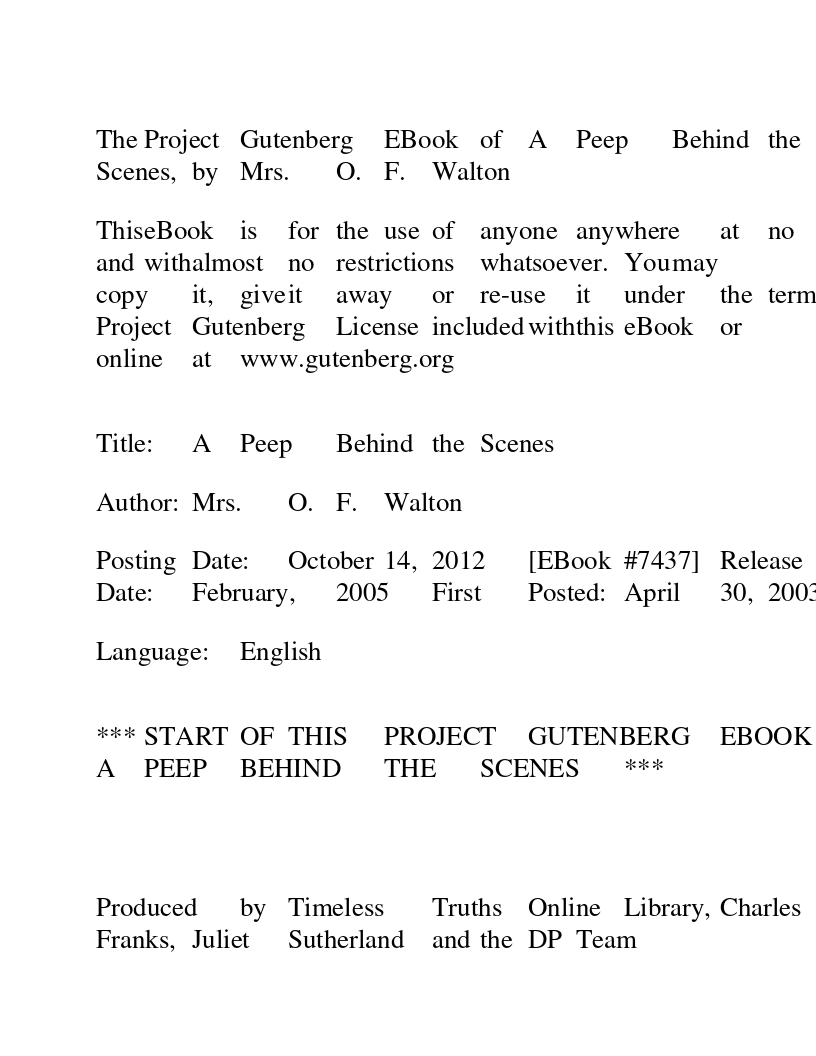
A Peep Behind the Scenes Book and Study Guide
In this 1885 novel by O F Walton, a family of gypsies moves from place to place, putting on performances at various carnivals and festivals. At one of the stops an evangelist gives a young gypsy girl a poster of the Good Shepherd carrying the lost sheep with Matthew 18:11 written below. This gift causes the young girl to confess to the Good Shepherd that she is lost and needs Him to find her. This heartfelt prayer is answered by Lord and the girl, her mother, and many others are brought to the Good Shepherd through the simple gift of the evangelist. The Good Shepherd refines each of them and ultimately they all leave the theater. This story has lots of surprises along the way and is a very engaging read while also showing the vanity and emptiness of theater life.
The accompanying study guide encourages student comprehension.
For more freely downloadable books and study guides, visit Edward's website.
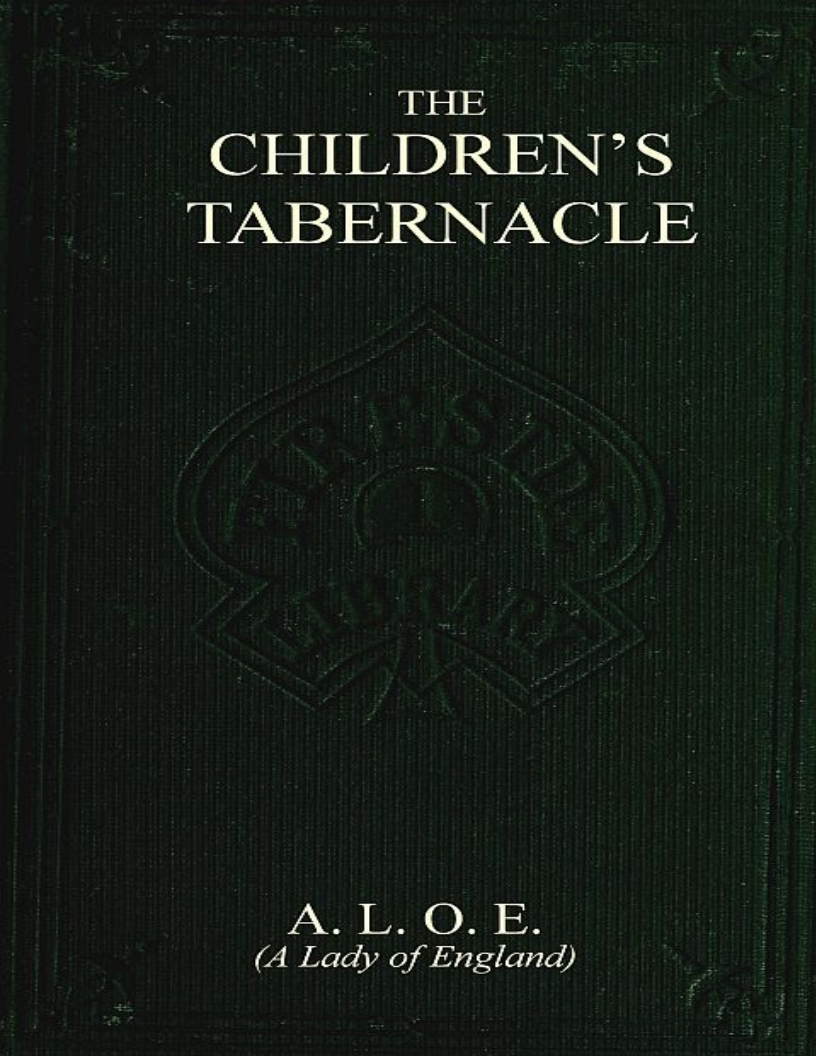
The Children's Tabernacle Book and Study Guide
In this 1875 novel, Charlotte Tucker follows a family as they build a model of the Tabernacle while quarantined with an illness. A girl named Dora works on the project on the Lord's Day and becomes burdened with guilt, but ultimately finds relief in confession. Meanwhile, Dora's sister learns to subdue her envy and temper. This novel also explains the various shadows in the Old Testament and their application in the New Testament.
The accompanying study guide encourages student comprehension.
For more freely downloadable books and study guides, visit Edward's website.

It Makes Life Really Simple: How LastPass Lets You Forget Your Passwords
Yes, I wanted to share that. Let's go for it.
If you're like me, you may be a busy teacher who doesn't have time to worry about technology and security and all those kind of fun things that aren't really fun. I found out a while ago that I could have one password and that would be the only password I ever have to remember.
It took me almost a year before I ever did the simple steps that I'm about to explain to you. I'm going to show you how to create a LastPass account and how to create a master password, which is the last password you ever need to remember, and why this is so important and also why it’s so easy.
You just open up your browser. You go to lastpass.com. You get LastPass Free. And for master password they explain to you, give you an example there, and their advice is to tell a story that's unique to you, and their example is Fidoate!my2woolsox, which is just kind of fun.
The thing that I learned from them about creating a master password is that if it's easy for you as a human to remember, it's going to be harder for a computer to remember. If it's very difficult for you to remember, it's going to be easier for a computer to remember. Just create a phrase that makes sense to you.
My personal adaptation is that each word that I use, I put the first letter of the first word as a capital letter and the last letter of the next word as a capital letter. Let's just make up a password and we're going to do Go preacH, with a capital H, to, with a capital T for The, Go preach to The worlD. We're going to make that capital D. We're going to confirm that master password, and then we're going to sign up for free.
Right away, they offered to install LastPass and I would definitely recommend that because that goes right into your browser, and that helps the process of remembering all of your passwords for you, and it's going through the process now of installing that. The reason this is very valuable is because, after you have this password, it's your one password you have to remember, you now don't have to have Chrome or any of your browsers save your passwords anymore, because that is very insecure because anybody can open up your computer. If you happen to be logged in, all your passwords will be available for them.
With LastPass, if you open up the computer, then you have to re-login with your master password. And so, just maybe a small piece of inconvenience: to have to log in every day. But it's your one password you have to remember it and it makes life really simple.
Here we are logging into our password extension and the thing that's helpful about that, this is the vault where it saves all of the passwords you ever need to remember. Now that I'm logged in, it shows to me how to get into all these accounts and it shows me also if I already have accounts, I can add those to my LastPass account right away.
The other thing that it explains to me is that I can get this on my device as well, so I can install it on any browser that I use. I can also install it on my phone. This is so helpful because it will start reminding, remembering everything that you agreed to let it remember for you. Whenever you start signing into accounts, it will start saving those for you. Whenever you create new accounts, it will generate passwords that are 60 characters long. It's double encrypted, and so they don't even get your password. You never have to remember it, but it's always secure and that is so incredible.
The other thing that's a blessing about it is, if you have signed into your password for all your other accounts, there's a button there that allows you to change all your insecure or your passwords that may have been breached in a data breach or that have not been changed for a while. You can press one button and it'll change them all for you. It's just incredibly invaluable.
It allows you to export passwords out of your browser and into LastPass. It will remember your addresses for you or remember your credit card information, your passwords, all of that. The amazing thing to me is that they never can get any of that information [but they] store it all for you, so really valuable.
The other amazing thing that's valuable about LastPass is that you can share passwords with other people that have LastPass accounts. For our school staff, we created LastPass accounts for all of them. Then any passwords that we need to know for school-related accounts we can just share. And then, the other amazing thing is that you can share it without them ever seeing the password. LastPass will put it in their vault, but they never have access to the password, but they get to use it for any accounts that you need.
That is how to do it and there's a lot more fun jazz that you can learn about when you do LastPass. That was very, very simple and it saves a ton of stress, and it makes you very secure.

Cultural Intelligence

There is only one place in the world where I can walk into the local TV station and get instant coverage just by picking up the mike, smiling into the camera, and announcing myself.
That place is a First Nations reserve in the bush of northern Ontario, a stretch of dusty roads and broken-down trailer houses surrounded by endless strings of untouched lakes and giant dark pines silhouetted against the sky. I will call the place Caribou Hill for the sake of privacy and convenience.
I have gone to Caribou Hill every summer for the past five summers. The small brown faces, the weather-wrinkled faces, the silent smooth faces, the alcohol-pimpled faces have all become mine: my cousins and aunts and uncles and sisters.
My friends from the States who are with me ask questions like, “What time does church start? How long does it last?”
I used to ask those questions, too. Now I know that church starts when it starts and lasts as long as it lasts. It all depends on the weather and the mood of the people and the number of testimonies and the inspiration of the Spirit. Time is not a number here. Things happen when they happen, and presence is something you are, not something you measure off in snipped quantities like a poor man parceling jellybeans.
The first time I visited Caribou Hill, I was frustrated by the lack of schedule, frustrated by the fact that I could never know exactly when something would happen or how long it would last. I hated that someone might tell me they would show up for something—and then never show. I couldn’t understand why people would leave trash littered through the woods, why teens stayed up until the wee hours of the morning and then slept until evening, why children were allowed to scamper up and down aisles during a church service.
That first summer in Caribou Hill, I found myself extra tired as my brain worked hard to process a new way of living. Now when I visit, I adapt without thinking about it and find myself surprised when newcomers don’t fit into the new thinking patterns as naturally as I do.
In college this past winter, I learned about the importance of cultural sensitivity when relating to people from different backgrounds. In an article called “Cultural Intelligence,” P. Christopher Earley and Elaine Mosakowsk categorize three components of cultural intelligence: cognitive intelligence (analyzing and understanding cultural differences), physical intelligence (learning acceptable ways to handle oneself and interact with others), and emotional/motivational intelligence (believing that your efforts at cultural adaptation will be successful and that any differences can be bridged). Some people naturally rely more on one component, some on another, but for the best kind of cultural sensitivity and adaptability, all three must be employed.
Earley and Mosakowsk further categorize six types of individuals.
- The provincial. Deeply immersed in his or her own culture. Can do very well at working with people in that setting, but may run into trouble when moving further afield.
- The analyst. High on the cognitive component of cultural intelligence. Adapts through learning the needs and expectations of the alternative cultural in a methodical way.
- The natural. Relies on intuition rather than deciphering cultural expectations analytically. Often does well in new situations, but often can’t explain
- The ambassador. High on the emotional/motivational component of cultural intelligence. Steps into any situation with confidence and the belief that he will be able to handle it.
- The mimic. Observes people in varying situations and mimics their actions, their mannerisms, their word choices, and even their tone of voice, finding they respond better to someone they perceive as like them.
- The chameleon. High in all three components of cultural intelligence and able to blend so well into the new culture its members may not realize the difference. Very few people fit into this category.
Although the insights given by Earley and Mosakowsk are interesting, nothing has helped me in cross-cultural situations as much as what I learned from Norm Miller of Northern Youth Programs before flying into Caribou Hill for the very first time. “Go to learn,” he told us. “Don’t go with the attitude that you have the answers and you are coming to help these poor people who don’t have life figured out. Instead, see what you can learn from them.”
My first summer in Caribou Hill, I remembered that, and because I remembered it, I noticed things. I noticed how easily the people laughed and how genuine their laughter was. I noticed they were fully present in every moment and didn’t spend time worrying how their day would play out or whether they would accomplish everything on their to-do list. I noticed their generosity, their acceptance of others, their gentleness, their ability to endure.
Different cultures don’t always come in the form of different countries and different languages and different ethnic groups. Sometimes they are near us, sitting in our church benches and knocking on our doors, even sharing our last names. All of us have been formed in varying circumstances and, to a large degree, those formative years make up our culture.
Teach your children, teach your students—know yourself—that culture matters. It matters that we be sensitive to different ways of doing things and different ways of understanding life. We can be more effective servants of the kingdom if we are flexible and willing to use our cognitive, physical, and emotional abilities in ways that make us attractive and understandable to others.
The most important part of cultural adaptability, though, is simply this: that we are willing to learn. As you lead your charges to interact with other cultures, remember to tell them that their first and most important task is not to give, but to take, not to teach, but to learn. In any culture, it is only when we value what others have to offer that we ourselves have anything worth giving, and only when we are smart enough to know our way is not the only way that we can call ourselves culturally intelligent.