
All Content
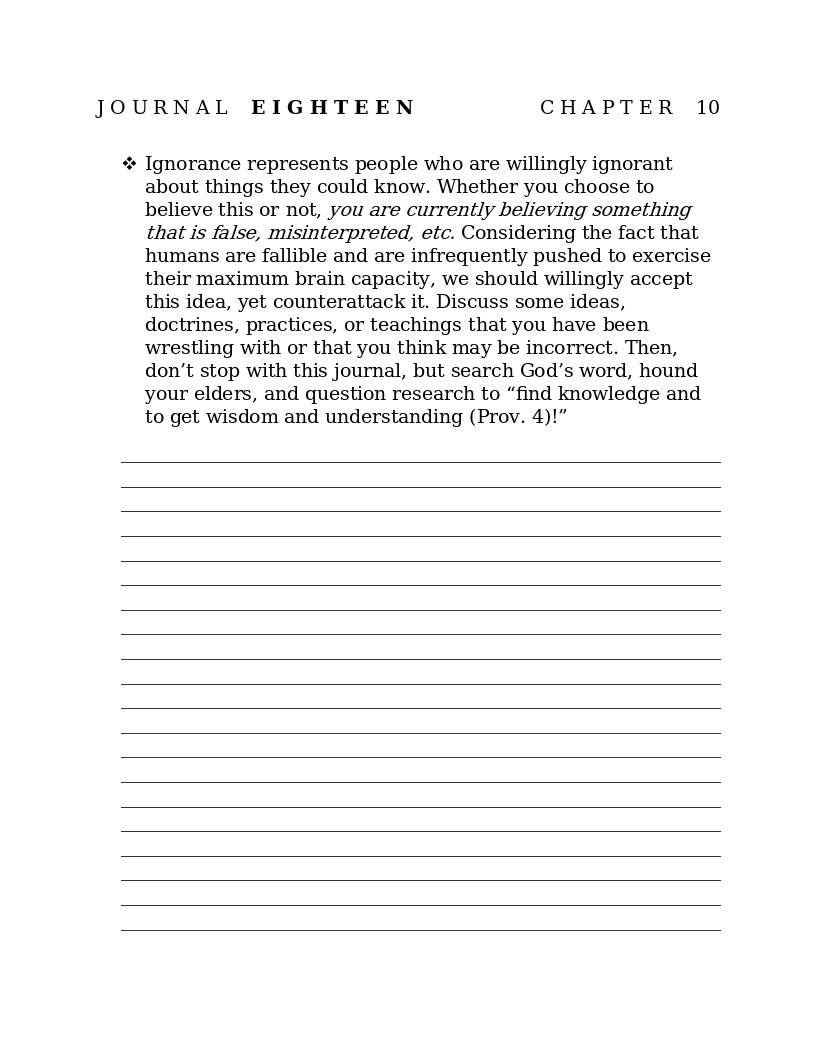
Journal Chapter 10
You believe something that is false. While this reality is disconcerting, acknowledging our limited understanding should encourage humility and faith in God's power to reveal. In this journal prompt, students are invited to describe areas of knowledge in which they lack understanding--and then to pursue greater wisdom in those areas.
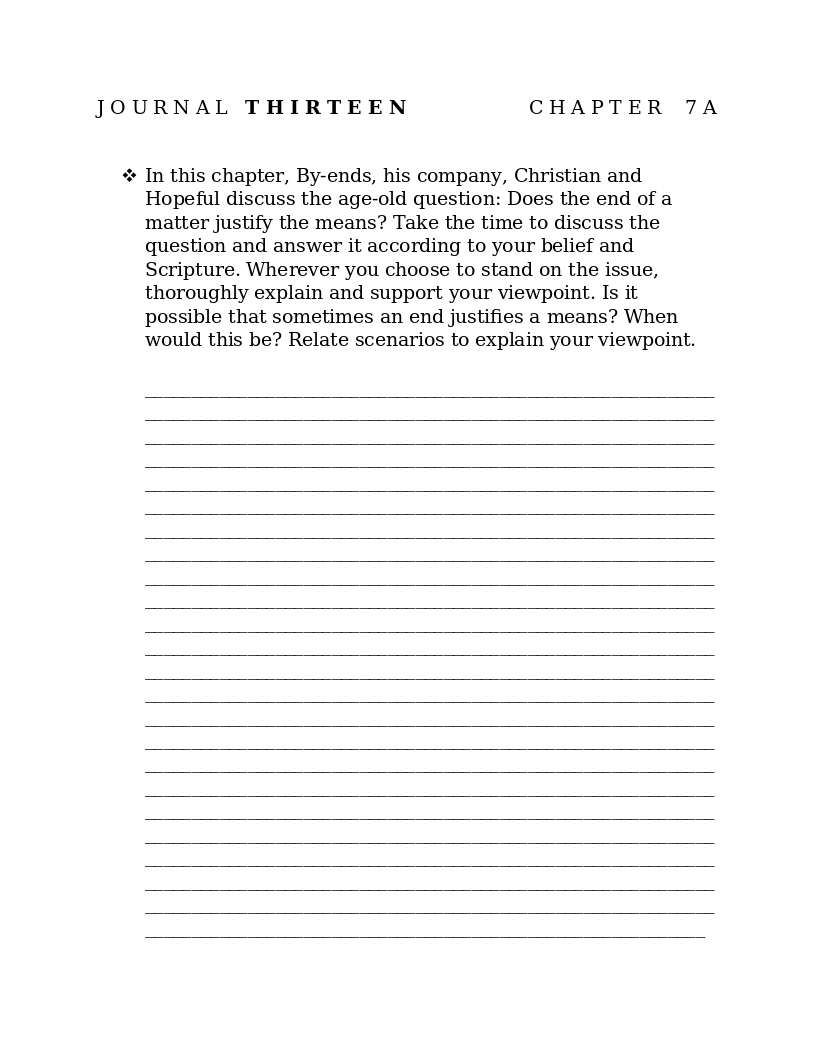
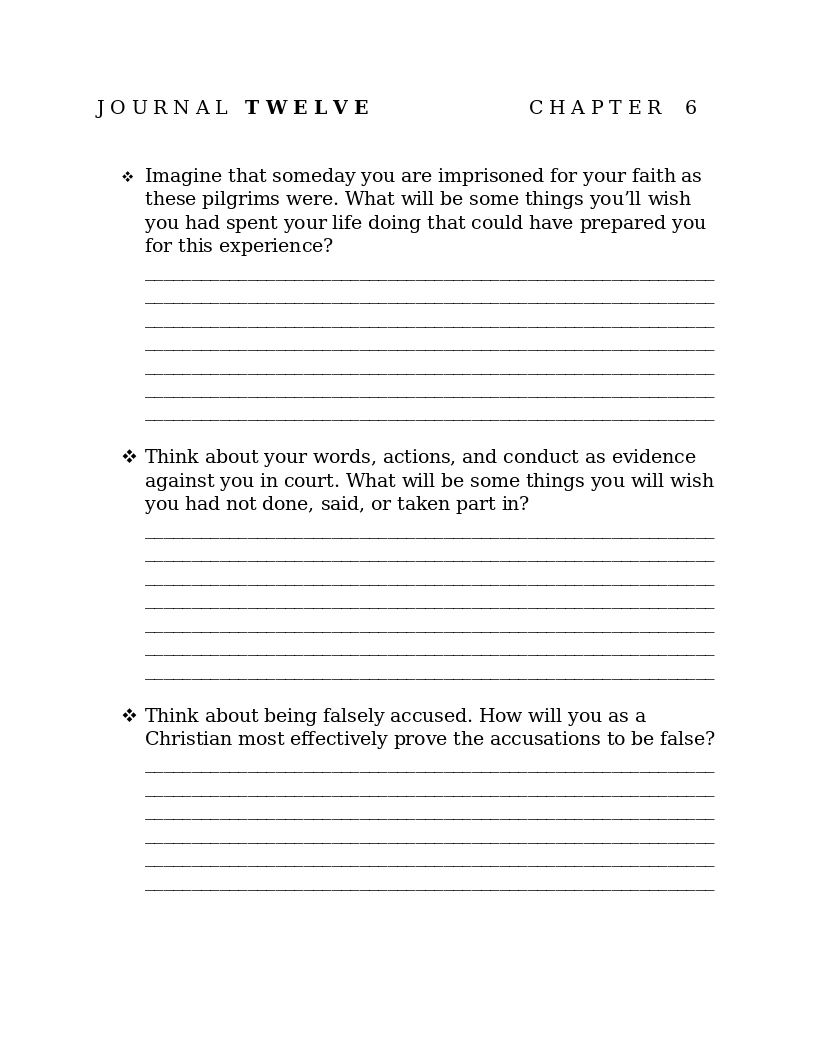
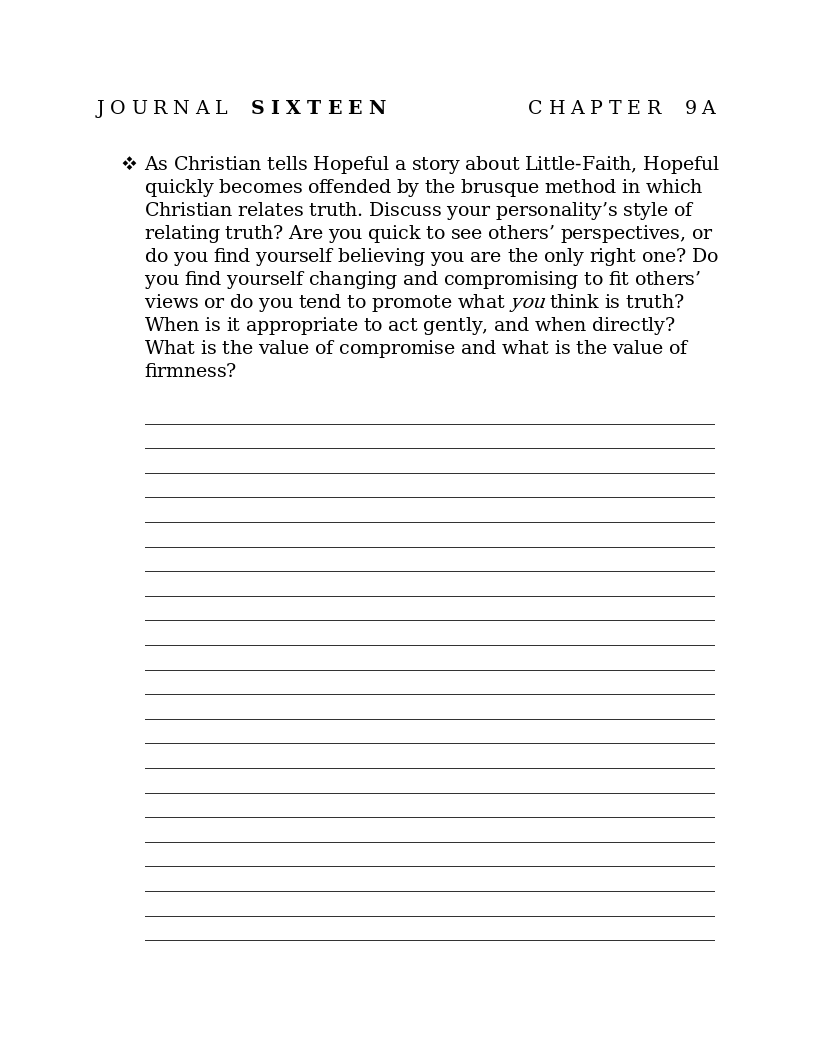
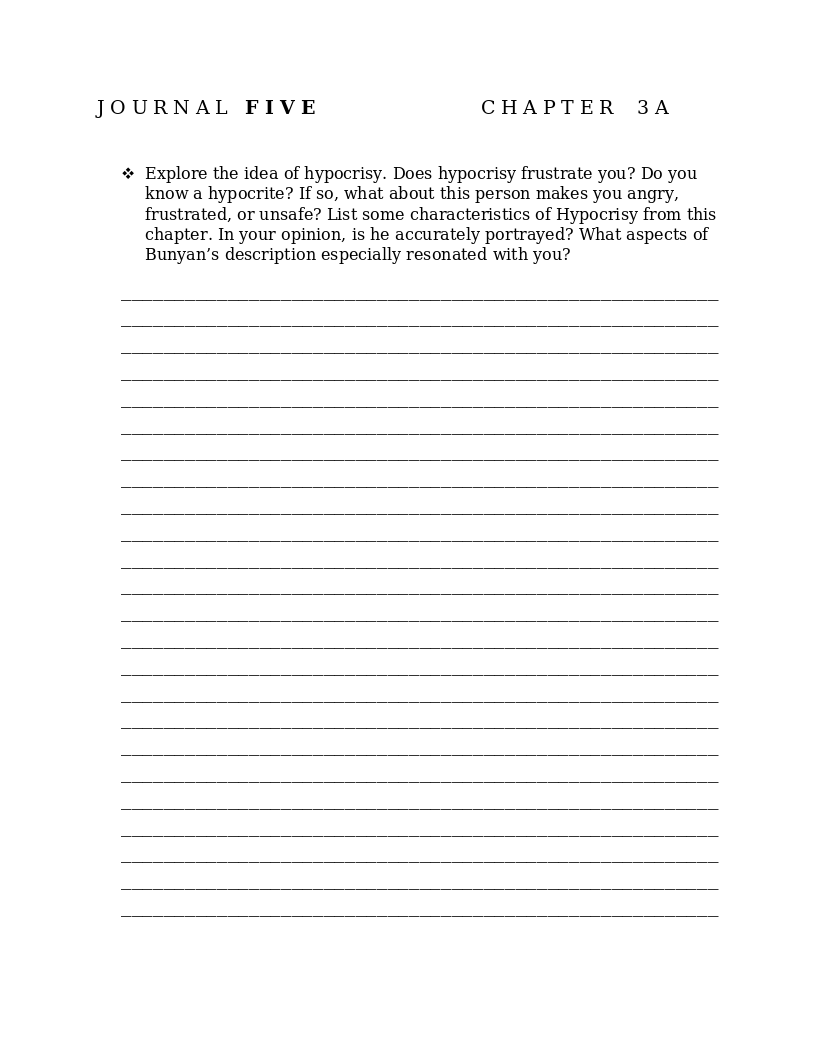
Journal Chapter 3 Continued
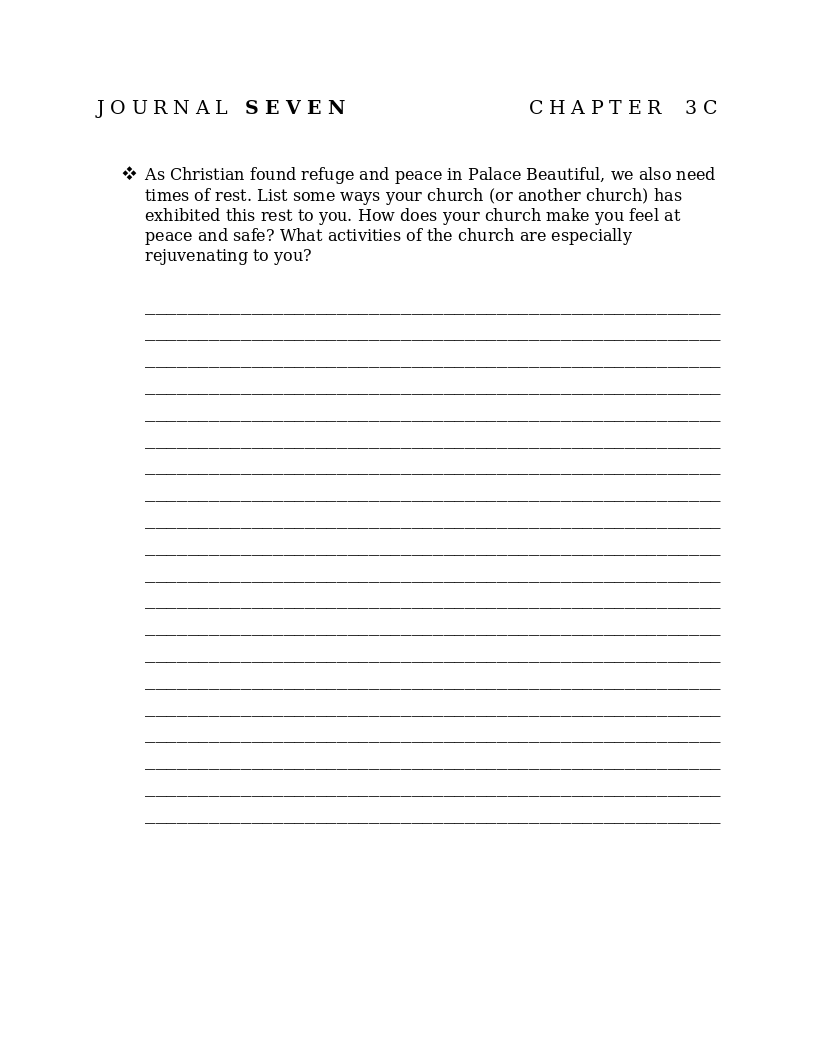
In this journal prompt, students are asked, "As Christian found refuge and peace in Palace Beautiful, we also need times of rest. List some ways your church (or another church) has exhibited this rest to you. How does your church make you feel at peace and safe? What activities of the church are especially rejuvenating to you?"
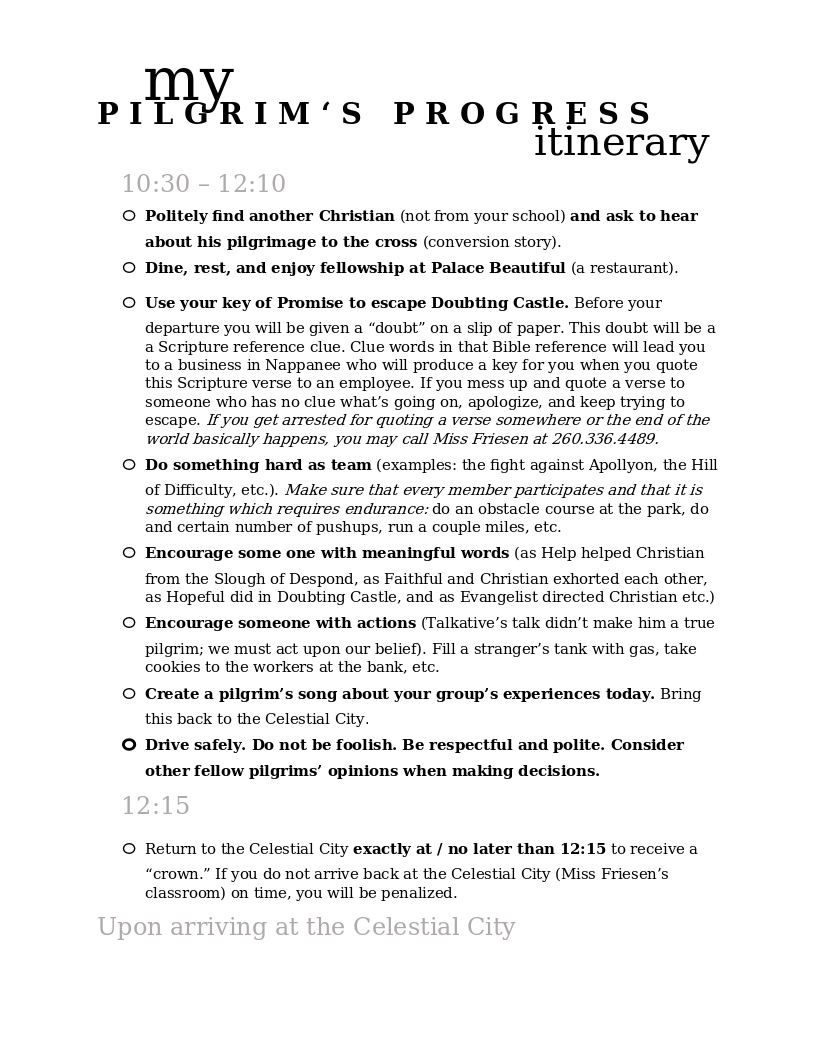

Resources available: Anabaptist history curriculum from Mennonite Education Agency
The Mennonite Education Agency has produced an Anabaptist history curriculum that is freely available on their website. Running the Race is designed for seventh and eighth grade. Be aware that, as a production of the Mennonite Church USA, not all the examples and emphases reflect a conservative Anabaptist understanding. However, with titles like "A Kitchen Evangelist," "I Appeal to the Scriptures," and "Prisoners Can Sing," the stories of early Anabaptists may be valuable as additions to your own church history curriculum.
The Anabaptist Dramatic Readings available on the same site may also be useful resources for church history class.

A Template for Teaching: Using EATS as a Path to Successful Lessons
What facilitates effective instruction in the classroom? What ensures student learning will happen? I'd like to share with you a lesson plan template that I've used some, which I feel is an excellent way to focus lesson planning for ensuring and helping our students to be successful in learning and to achieving the objectives that we have for them.
The template follows an acronym and it's the word EATS, E-A-T-S. The word EATS stands for an essential question, an activating strategy, a teaching strategy, and finally a summary of the lesson. Each of those four things is probably in every teacher's lesson, but if we think about them intentionally and we design our lessons based on that, I believe that we can have even more success as a teacher and ensure our students success in learning as well.
Essential Question
Starting with the first letter, the E in EATS stands for essential question. And the essential question takes all of the content, the information, what you want the student to learn and summarizes it into one question. "How do I find the unknown length of one of the sides of a right triangle if I already know the other two?" Or another example might be, "How do I greet someone in Spanish?" Another one from my field of mathematics: "How do I graph a linear inequality in two variables?" Essentially the question is what the students should be able to answer when the lesson is finished and the test to find out if you were successful is to have them answer that question when you're done.
The essential question of our lesson today is, how can I use this idea to determine an unknown length of a triangle? So if I know two of the sides of the triangle, can I use that idea to find the unknown third line? And the answer is yes. So that's the objective, how do I find the third side of the triangle? We are going to entertain a second question just a little bit later.So the essential question focuses the entire plan, focuses the entire lesson and says, "What do I want my student to be able to do when they're done?" I don't think the essential question entirely replaces a list of learning objectives. An essential question summarizes what the student should know, be able to answer when they're done, but there's probably a number of secondary objectives that should also be achieved by the students. When listing off objectives for my lessons, I like to say: "What do I want the student to be able to do when they're finished?" Well, an essential question is a nice single question that the students should be able to answer. It may not cover all of the prior information and skills that the student needs to be able to do already in order to be successful, and those kind of items would be listed as objectives as well at the beginning of your lesson or they should be in your mind as you're teaching. "The student needs to be able to do this in order to be successful in this lesson."
For example, again, in working with a right triangle, a previous skill may be that the student needs to be able to solve an equation algebraically or a student needs to be able to find the square root of a number using their calculator. Those are skills that they perhaps already should know, but identifying them before you teach a lesson helps you to make sure that some prerequisite skill is not missed in the process. So we have an essential question and this focuses the entire goal of our lesson.
Activating Strategy
The second letter, A in the word EATS, represents an activating strategy. An activating strategy is a nice place in the class period, in the lesson, to get the students doing things that are out of the ordinary; an activity that may involve a partner or a group of people; an activity that helps them to review information that they should know, but will need in the in the coming lesson; or it may be a discovery type activity that will prepare them for something that they're going to be receiving in the lesson.
First thing I'm going to have you do is talk to your seat partner about any words or ideas that relate to the right triangle. Anything you know that relates to the right triangle, you're going to tell each other and then I'm going to call a couple of you to list those. Okay?This activating strategy draws the student in. It builds interest within the student. It primes the pump. You may call it a hook, whatever you call it, it's something that is to draw the student into the content and prepare them to receive what you have for them. An activating strategy could be as short as a single question or it may be a 5- or 10-minute activity that the students work at. Having students brainstorm about the information is a good way to get them thinking about what is coming, what they already know.
And then we have a cutting out activity and a puzzle putting together activity. What I need is for the two of you to decide who is the better cutter and who is the better puzzle putter together. Putter together, all right? So one person will cut pieces out, one person will be the piece manipulator and try to put the puzzle together with your partner's help of course. I will tell you more about that in just a little bit. The first activity again is for you and your partner to discuss the words, phrases, ideas related to a right triangle. Nothing is too simple for that list. So go ahead and slide your desks over with them. Talk quickly. I'm going to give you about one minute. Go ahead.
Activating strategies also help the student to bridge from what they know to what they're going to learn. I think that connection is one of the keys to successful learning when the student can connect the new information to something that they already understand or already have a scheme for fitting into their knowledge base. When they're able to plug it in, when they're able to connect it, then they can use that information. I think that's a good indication of learning taking place.
During that activating strategy, a teacher may want to apprise the students that at the end of the lesson there is going to be some type of assessment activity to motivate the students to pay attention. That could be any number of different things, but knowing that they're going to be held accountable for what is coming will help them to stay engaged.
Leave your desk right where they are. If I call your name, please list one item that you and your partner talked about or added to your list. We're going to start with Nicholas.Nicholas: It has the right angle.All right. The definition of a right triangle is it's a triangle with a right angle. The second one, Trent.Trent: The two other angles have to be acute.Great. Good. So the two other of the three angles, both must be acute or less than 90 degrees. Diana, third one.Teaching Strategy
So we have an essential question which summarizes the goal of a lesson. We have an activating strategy to draw the student into the meat of the lesson and what they're supposed to learn, what they're supposed to be able to do. And then we have actually what most of our lessons—what takes most of the time, that's our actual teaching strategies. So the letter T in EATS stands for the teaching strategy.
The teaching strategy is the set of activities that you plan to actually teach the material to help the student to be able to connect this information and understand it.
There is a right triangle. The ladder is 20 feet long. So we're going to label the diagram 20 right there. That will be the hypotenuse of a right triangle. It says that we're going to place it so the base of the ladder is 5 feet from the base of the wall.Good questions are an important part of I think any teaching strategy to get immediate feedback from your students.
So now the question is how far up the wall will the ladder reach? Once again, using the squares, I'm going to draw a square down here. Class, this square has area say 25, all right? Square units. The square on the hypotenuse has what area? The square on the hypotenuse, John, has?Javon: 400.Very good. So now the question is, what is the area of this square? This one's a little different, isn't it? So what is it?Wayne: So you have to replace ... Like you still have to find the these. You have to do 400 minus 25.Stop right there. All right. He said take the area of the largest square and subtract the area of the other square that we know. On our cutting out activity, we took two of the squares and put them together. But if you know the larger one and one of the smaller ones, does it make sense that you can take the area of the larger one, subtract the area of the smaller one to find the area of the other smaller one? Does that make sense?All right, so this area here has to be the large square area minus the one that we know. 400 minus 25 or 375 square units. Remember, the objective here is not to find the area of this square, it's just to show you how it connects to finding the unknown length, which is what we want to know. That's the distance of the wall. So what else do we need to do yet, Wayne?Wayne: You have to square root 375.There it is. And could I have a volunteer, someone with an approximate decimal value? Javon already has it.Javon: 19.4.To one decimal place. The squiggly equals sign. 19.4 means it was approximated.These learning activities, your teaching strategy, is going to be determined by the kind of content that you have to present and also by the students that you're teaching. You aren't going to prepare the same learning strategy or the same teaching strategy for every situation, but knowing your audience and knowing the type of content helps you to determine what can be an effective or a meaningful teaching strategy.
Lectures, demonstrations, discovery activities, group activities, a video, a reading, any number of things can be used as teaching strategies. And I think a good teacher plans several of them and varied strategies within a single lesson so that we can reach as many students as we can.
The strategies should be engaging. They should be made as exciting as we can and varied in style as you move through the lesson. Having students do things with their hands, have students talking verbally to one another or to you as the teacher are different ways of changing the learning activity to keep the student interested throughout the presentation of the lesson. The teaching strategy needs to take the new information and place it into a context.
Again, the areas of the small square and the next larger square together fit right inside that one, as you saw in your little activity. So that area must be 296. Now, we didn't talk about how you can go the other way.For the students to learn that they have to be able to connect at some way. And so keeping that in mind will help your students to be successful.
Questions are a really important part of the teaching strategy for the teacher to be able to assess, "Are the students connecting with me? Are they understanding what we're doing? Are they with me, following me here?"
So what is the length of the dimension of the square if 296 is the area? I'd like you to take your calculator and if you know how to do it, do it for me.A teacher may not want to embarrass a student or put them on the spot and shame them if they aren't able to answer the question. And so a way to maybe avoid that is to ask the question, then say, "Now, tell your seat partner what you think the answer is and share what you think the answer is." And tell them that once you're finished, in 30 seconds, I'm going to call on several of you to answer. That allows the student who maybe didn't connect it to hear it from another student, maybe hear it in a slightly different way. Even if they don't understand, they at least hopefully know what to say if they're asked the question.
A skills lesson: If you are teaching a skill, I think a nice little outline for the teaching strategy is "I do it, and then we do it together, and then you do it to show me that you understand or to demonstrate that you're able to." So I do it, we do it, and then you do it.
Formative Assessments
Formative assessments are little activities which may be as short as a question or maybe a written activity or maybe a oral or verbal activity between students or a group of students. A formative assessment activity is a short activity that allows the teacher to judge if he's been successful, if the students have been able to put together the information. And so I think a good teaching strategy has formative assessments built into it for sure at the end, but maybe even at steps along the way so that you can gauge how the students are doing. Those activities help to build learning in the student. They may not know it, but then when they find out what it is or they find out what they should have known or they find out what they should have done, then they'll remember it better.
What is the area of the blue square, which is now the a medium-sized square? And Wayne, I would maybe be more interested in how you got this than actually what you've got, but tell us both, go ahead.Wayne: So you have to do A plus X equals C because X—or the B—you don't know.Correct.It gives them the chance to try it and and to see how they'll do.
Those are parts of what I think make up a good teaching strategy. The meat of the presentation, bringing the new information to the student, assessing, making sure that you're connecting with them, they're understanding what they're supposed to learn, what they're supposed to know, what they're supposed to be able to do when they're finished.
Summary
So we have the question, we have the activating strategy, we have the teaching strategy, and finally the S in EATS stands for a summary or a summarizing activity. Bring the lesson back together again.
A good thing for a summarizing activity, I think, is just to go directly back to the essential question and find out, can the students answer the essential question? It might be simply asking them and getting them to respond. It might be asking them to do something to see if they're able to answer that essential question in their response.
So the question was, “If I know two of the sides of a right triangle, how do I find the length of the third side?” I need you to talk to your seat partner, decide how to answer that question, and then I'm going to call several of you to give answers in about one minute. Go ahead.The summary reviews the most important information in the presentation. You won't be able to review every detail, it's just a summary, a couple of minutes at the end of the lesson to tie it all together.
So here's the test, how do I find the third side of the right triangle if I know two of them? Go ahead, Trent.Trent: It depends which two sides you know.So what's the difference? Case one, case two, what are the two cases?Trent: If you have one side and the hypotenuse, you have to subtract instead of that.Okay and both explanations gave this case, one, where we know the two legs, the two other sides and then we add the squares of those together to find the third square and take the square root. So watch out for case two where you know the hypotenuse instead of one of the other legs and that you need to subtract those areas before you take the square root.In the summary, you can assess the objectives for your lesson, find out, can the students answer that essential question? Are they able to do what you wanted them to do?
Questions, short activities that provide you feedback are very important. If a student wasn't able to understand, those activities can help a teacher to find that out and know which students they need to go to individually to maybe give some special instruction. Formative assessment activities, again, are really good to use in that summary time to reinforce what has been presented.
A summary may also be a place where you can bridge into the next lesson and say, this is what we learned today. Tomorrow, we're going to extend this or add to this or connect another concept to prepare the students for what is coming.
EATS in Summary
The EATS template for a lesson plan design is number one, have an essential question that summarizes the overarching goal of the lesson. Number two, to have a exciting activating strategy of some kind to draw the student into the lesson and prepare them for what's coming. The teaching strategy is the main set of activities designed well to try to help as many students be as successful as possible in being able to understand and acquire the necessary skills or acquire the necessary information, what you wanted them to learn to be able to do through the lesson. And then finally to summarize for them again, what is it that they were supposed to be able to do after this lesson was over. What is it that we went over in a short summary at the end.
Intentionally designed lessons are probably the best way to ensure student learning and to help students to be the most successful. And having a plan for how to design a lesson makes the job easier I think. Whether it's EATS or whether it's some other way, I encourage all teachers to think of the lesson as a whole, beginning to end. Have a plan, intentionally plan the activities toward the end that you want to achieve. And hopefully at the end, your students will be able to answer that essential question.

Three Things I Wish I Had Known Before I Started Teaching

As a 20-year-old, I started my career in education with no desire to make it a career. I knew it was a good work and I wanted to do well for at least one year but I had no idea then that I would be entering my 9th year as I write this.
Over my short career, I learned three lessons I wish I had learned before I started.
Make it a career
Many staff entering our schools do not have a long-term vision for the ministry of Christian education. Like me, they know it is a good work but don't see themselves in it long term. If I had treated my first year as if it were my career I would have made many better choices. I would have tried better to organize and save my schedules and bulletin boards. By the end of my first year, I was much more convinced I wanted to make a career of it, but many of my hours of prep and creation were lost forever. The first couple years are the hardest because of all the learning and creation needed, and regardless of whether it is you or a successor teaching nine years from now, your labor won't be in vain if you save your work. For specific advice on how to do well in this regard listen to Jonah's talk: Avoiding the 40-acre toolbox.
You aren't going to be a perfect teacher
One night as a new teacher I was sharing with my wife the frustrations of the day. As she listened she sensed I was trying to be a perfectionist in the classroom. I was beating myself up for all the disciplinary opportunities I had missed. She responded with eight words that transformed my career. "You aren't going to be a perfect teacher." God knew what he was doing when he had me marry a teacher and He knew I needed to hear that then. My focus changed immediately to focus on the student's success at learning and spiritual growth instead of my image as a teacher. Her comment made me realize I had been teaching for myself and the praise of man and not for the glory of God. I’m never going to be a perfect teacher, but I can always focus on my student's success instead of mine.
Teaching is an art, not a science
My wife and I taught one year together before getting married. Among our many other responsibilities, she taught art and I conducted science experiments. It doesn't take a rocket scientists to know there is a difference between the two academic disciplines. However, it did take me a few years of teaching before I realized teaching is an art, not a science. Although I heard it early in my career at a summer term at Faith Builders, I was a typical man and it took several years for reality to sink deep into my heart and practice.
One afternoon while filling in as principal for my father, I issued a demerit to a very respectful student for a very procedural violation. According to the manual, he earned it and my experience of him was that he would take it willingly. Was I ever wrong. He stormed out of the room and punched a hole in the wall. Defying my stern commands to stop and talk, he left the school and went home. Once again, according to our policy, he earned an immediate 3-day suspension which I communicated to him immediately. How severely I failed.
As I reviewed my actions, I realized how scientifically I had approached the problem. If I had used my artist eyes, I would have been able to see him as a respectful individual. I would have known that a simple instruction to follow the procedure would have produced the desired effect. In the years since this event, he has moved on from the school and we are still friends when we meet. Since then, there have been many similar situations that ended so differently because I now see teaching as an art.
To those who helped me learn these lessons I say thank you. To those who haven't learned these lessons, please take my word for it and do better than I did. May God richly bless your career!
Your Homework
- Establish a clear organization system for storing and sharing your work.
- Find a close friend other than a coworker with whom you can regularly share your less-than-perfect teacher moments. Make sure you get these meetings on your calendar.
- Start intentionally viewing your career as an art and not a science. Make your interactions with students and coworkers the kind that will build your relationships.

Colors of the School Year

Blue plaid for first-day dresses, carefully sewn by loyal mothers. Blue for vibrancy, excitement, stability: the color of winners. Blue for the verity of friendships forged in school days. Blue for fidelity, honor, courage at beginnings.
White for freshness, an unmarked year unbroken, sharp and novel as the new crayons with the perfect point—like our brand-new lesson plans, not yet dulled by the wandering eyes and restless bodies of an apathetic audience. All is new.
Red for second place, for mishap, for failed attempts. For knees skinned on the gym floor, for bloody noses after urgent softball plays in which the catch mattered more than the collision. Red for cheeks, faces, skin shining with exercise. Red flags on the field. Red caps on the birds we’ll watch out our window and log into our bird books. Red is failure to camouflage.
Green for the bean sprouts we’ll grow when we delve into biology and soil, green for the veggies that mothers tuck into lunches, green for the oh-so-tempting summer grasses out the window, when the approaching fall has failed to leave so much as a blush on the verdance. Green for all that is wholesome and growing, green for the life of the body and soul.
Yellow for joy, sunshine in sparkling windows, bright braids falling over shoulders. Yellow for classic number two pencils, smooth and unmoved between persistent pudgy fingers. Yellow for the buses, for the first few of the changing leaves.
Brown for the mundane, the practical sneakers and the chore charts. Brown for Wednesdays and bagged lunches and wheat bread sandwiches, brown for the things that raise strength slowly while the world is looking elsewhere.
Pink for vulnerability, uncertainty, the shy love of fingers that reach to hold a teacher’s.
Orange for energy, charisma, flamboyance: students who can’t morph docile flesh-colored to match their environs. Orange for surprises good and bad, for days when the mischief is running high for no discernible reason. Orange for the unpredictable, showing up when you least expect it.
Gray for days that don’t go.
Chartreuse for the intersection of novelty and ambivalence. Do we like it or do we not? Hmm.
Purple for the luxury of a comfortable building, the wealth of children who come, the pomp of being the answer giver when the answers are unknown. Purple for holding one’s head high, for doing the right thing, for remembering whose people we are.
Let the kaleidoscope begin.

Teaching Out of Who You Are: Avoiding Pitfalls as You Build on Your Strengths
Understand your strengths and weakness. This I find so fascinating: None of you are exactly the same. Of course not; that's probably good, isn't it? We have teachers who are very expressive and very bubbly and outgoing and they come into the classroom with all the pitazz, I mean they just love life and love students, and those of us who are not exactly that way look with some jealousy on those teachers.
There's other teachers who are more stoic, disciplined, and those who are on the outgoing side look with jealousy on those well-disciplined, well-mannered people who don't get themselves in trouble nearly as often.
I think it’s worth some time: What are your strengths? What kind of teacher are you? Are you an academic teacher? Wow, why do they teach school? Because they love the books. They love learning, studying. And then they enjoy, of course, teaching and imparting that, but “The students are there, good, glad I have an audience, but boy, do I ever love to study, I'm fascinated with information.”
Other teachers are quite so on the other end, they're relational: “I love children, I love being with children and you know what? Teach school! That's where you can be with children and get paid. Sort of.”
There's maybe also, fitting in there somewhere, the creative teacher or the stylistic teacher. They just love a place where they can have a theme. That's sort of their thing: “Yes, teach the books, okay, whatever, and yes, children, but I just love my room. I love the decor, I love bulletin boards and posters and I love the creativeness.”
Guess what? You're all good teachers. Don't try to be somebody else. Have you ever tried it? Don't try to be like another teacher. I didn't say don't learn! But don't try to emulate them and almost reinvent who you are. That's no fun. You won't enjoy it very long and you won't do well and you won't even be like that other person.
Be what God has created you to be, but think of the challenges that go along with your particular set of gifts. There is a range, folks, somewhere, that works and doesn't work as a teacher. Maybe “Bring in the edges,” would be one way of thinking about it. The person who is very—a sanguine, I believe they're called, and they are high energy and like to talk a lot and they're full of fun: We love those people of course! But those of us who are that way or a little more undisciplined. If it wouldn't be for last minutes we'd be in big trouble. We forget a lot of things and we make a lot of last-minute photocopies and the art projects are planned up to the last minute. There's some of you out there. I can see it.
Well, don't say, “That's who I am. That's just how I am. I just hate planning ahead. I hate schedules and writing down lists of things. That just gets me all befuddled and I just—It's okay. It works.” Well, you know what? It works, but it could work better maybe.
Pull in the edges. Just insist on becoming more disciplined if that's where you are. And by the way, I tend to be on that edge of things. My wife has helped me. I have better lists than I used to, check things off, I write more things down and use lots of sticky note. It helps, but I've had to work hard at bringing that edge in of “Just a little more, I'll get by somehow.”
If you're the rather stoic teacher, have a hard time building relationships—and I've worked with teachers like this: very academic, very disciplined, expect the same out of their students, studied well, the outlines are always done well, the syllabus is just so—Well, there's challenges with that as well, right? Winning the heart of a student. You would rather eat at your desk and page through your notes than eat with your students. Go eat with your students.
“Well, I don't know if they really want me to.” Guess what, they probably do. Get that out of your heads: that your students don't like you anyhow. Well, what can you do about that? Just learn to ask questions of your students. Just try to become comfortable around them when they go out and play volleyball or whatever they're playing—younger students, whatever they all play—just go out and be among them. Just be with them, be accessible and you'll find that that can grow. You can learn to enjoy your students better.
Please don't just say, “Well, that's who I am. I just—I'm half scared of children. They intimidate me.” Well, students intimidate me as well. They can be amazingly young students who can be intimidating. Aren't you glad they don't know that? How intimidating they really can be? I don't think they know that.
Bring the edges in. Say, "Now, wait a minute. I don't—This isn't going to be healthy, I'm going to need to learn to just relax, be among my students.” Ask good questions and try to develop the ability to connect with your students. It does really matter.
The creative teacher: kind of the same thing. Don't become obsessed with all of those things. They're great things to do. They're probably your energy: doing those things. But you need some energy to study. You need some energy to teach your classes well.
You’re not becoming a different person, but you're working out of who you are to try to expand where you can expand and bring in the edges. God bless you as you find your role as a teacher.
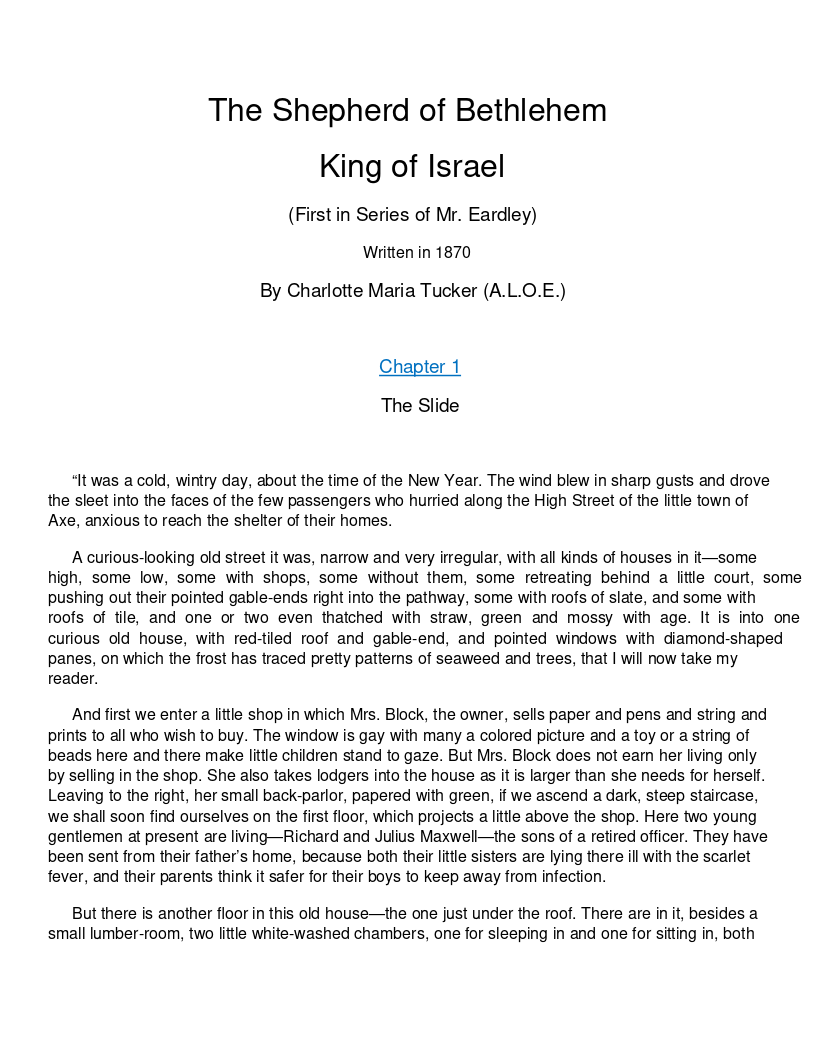
The Shepherd of Bethlehem, King of Israel Book and Study Guide
In this 1875 novel by Charlotte Tucker, a minister moves to a new town, but breaks his leg and must be laid up for weeks while it heals. While there, the minister has a tremendous impact on various people in the town and gives regular lessons about King David's life and their application to Christians. The novel highlights Christians' response to trials.
The accompanying study guide encourages student comprehension.
For more freely downloadable books and study guides, visit Edward's website.