
All Content
Missionary Posters
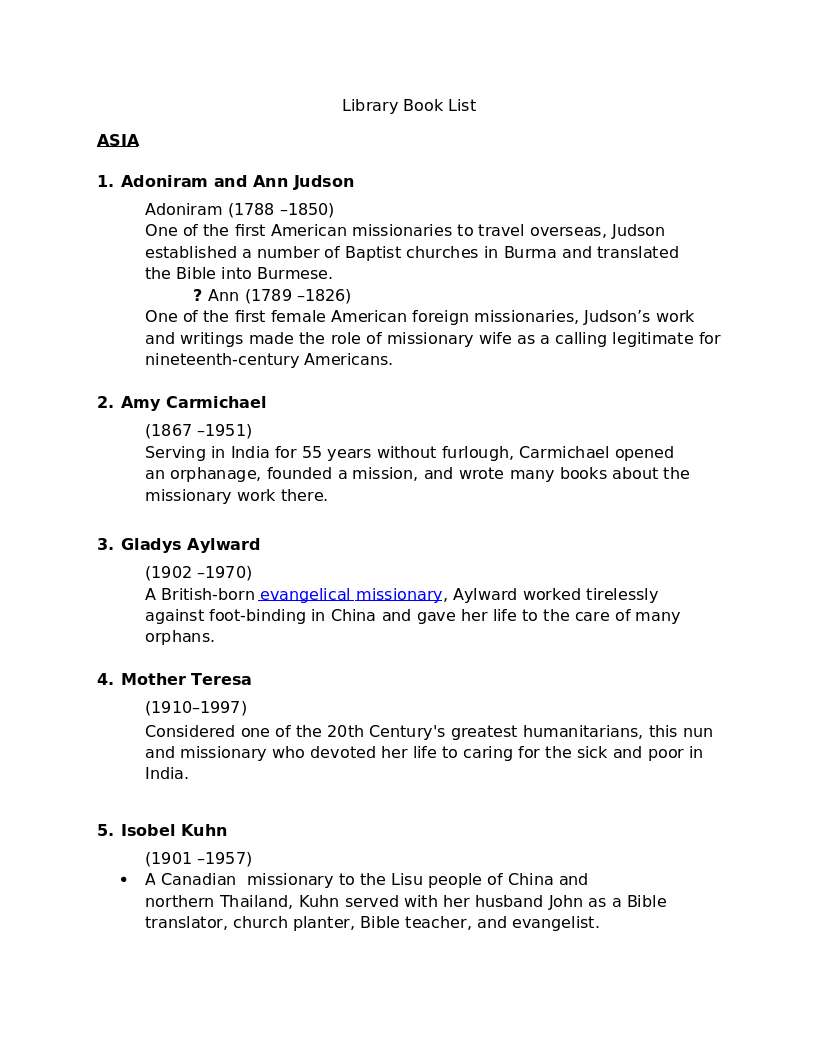
These four sets of slides were designed to be printed as posters. Feel free to print them or use them as slide shows. From Adoniram and Anne Judson to Clair and Clara Schnupp, children are introduced to notable people from the church history.
Download the presentations and customize to fit your library or your classroom.

Place Yourself in the Feet of a Child

Years after my childhood, I returned to the school I once attended. The rooms of the building were empty and cool, the tiled hallways vacant. A musty smell lingered in closets and in corners of classrooms. My feet sounded loud on the floor.
When I was young, small bodies that seemed large to me sat in rowed desks, and teachers that seemed sometimes terrifying, sometimes sympathetic, surveyed us. One teacher had a crisp voice and a classroom control methods as fair and as firm as a ruler. I could not bear to look her in the eye. Another teacher was soft, unassuming. She brought her boyfriend to visit, and he put a tick on the ground—someone had found it on their body—and pulverized it beneath his twisting boot. He was tall and had a longish nose. I never forgot him, or her either, since she was my favorite teacher.
The world was real when I was young. Visiting later, I almost remembered that world and how it was to stand beneath scuffed blue shelves and empty hooks. Living lunchboxes used to line those shelves, each lunchbox possessing both a personality and an owner. My own lunchbox was tin and had a curved lid and metal buckles that clasped, like an old man’s lunch box—all the other children had square plastic lunch boxes with pictures of popular characters on them. My lunch box was a relic from the kitchen cupboard. I hated it at first. But Dad, who understood something about children, decorated it with stickers of every shape and size, and it became my favorite.
The trees lived in those days, too. Seeing them years later, I was surprised by a memory of a world where every object, every room, had a character on a level with a person. I had forgotten what that world was like. In my memories, the trees speak.
As an adult, the world is flat, and my mind rules it. Tables are just tables. Chairs are just chairs. I once heard of a class that adults can take to experience again what life is like for a child. They sit at a large table with their head just above its flat surface and realize how small you feel when you see the world at that level. As adults, we forget.
Recently, I saw a child run in from playing, crying over a fall he’d had. “Stop crying,” said his father, without raising a hand to comfort or hug. “Stop crying,” said his mom. Their entire goal seemed to be to make the child an adult, to raise him from the plane where scraped knees matter to the plane where scraped knees are an inconvenience, unworthy of the tears of a man.
Have they forgotten the tender place that is childhood? Maybe children have become flies to them, to be brushed away with a broad sweep of the tail and returned as full-grown, useful herd animals with every emotion in place.
Another father, when his daughter began sobbing after a minor dust up, squatted down beside her, looked into her eyes. “Were you hurt, or did it just scare you?” he asked, trying to understand her emotions. In his comforting arms, she quieted.
Oh, to be parents, to be teachers, like that: to remember what it is to be a child and to relate on a level they can understand. Don’t brush off their fears, their questions, their tears, their imaginings. To children, the world is real.

Hands, Eyes, Feet: Good Posture and High Expectations
I've learned a few different things over the years in just classroom management. One of the biggest things that I've learned was the thing with using good posture. My theory is that students—where their hands are is where their mind is. If their hands are folded on top of their desk, well, their hands aren't distracted, and so their mind is with you and focused and their eyes are on you. The first year I taught their hands would be in their desks, tapping on their pencils, maybe rubbing the sides of their desks, and their mind is pretty much there. Their mind is with their pencil inside their desk or on the sides of their desk. They had a hard time focusing.
Since then, the second year, I changed that by… They always, whenever I'm teaching they need to have their eyes on me, their hands folded. And that's really helped. They do forget during class time, but if they do forget I do put a mark on the board and that pretty much straightens them up pretty quick. Sometimes I give them a little reminder before I do that. Or else to help them remember to use good posture I pick out the ones who really are sitting well and I'm like, "Wow, so-and-so is sitting very well and so and so… That's great," and then suddenly all of them straighten up because they all want to be doing a good job, too.
Good. I see one, two people with good posture. You did it quickly.
Posture has been a very big thing in being able to focus and pay attention in class and they learned so much more.
And Brianna is sitting very well. I think she can do the last one. Which one does not belong?
I had a lot of problems sometimes with students just having little problems, little issues with each other. I hadn't really focused on teaching them manners. This year I focus more on that and each week they have a new manner. For example, first they learn using please, then using thank you and building on that and more manners. It's taking care of a lot of issues. There have been times where one student is like, oh, they don't like this about the other student. And then I tell them, "Can you say, ‘Can you please stop doing it,’" or whatever. I direct them in how to use which manner. It's minimized a lot of problems and so that's been very helpful. It's just very pleasant being with students who appreciate things, remember to say thank you, please, excuse me, things like that. I've really enjoyed seeing the change in that and using good manners.
Another thing I've learned is that it's easy to teach school and it's easy to teach your class and be trying to get through the work. There's a lot to teach them in a short amount of time. It's very easy to try to rush through the lesson and, "We really need to get this chart started." "We need to get these words written down." "We got to do this, we got to do that." But [we need] to make sure that each student is doing it right. And sometimes there's one who is off in their own world or not giving their 100% best.
I think it's really good, towards the beginning of the year especially, getting right on that, that we need everybody in the class and if even it's just one person not helping along, that we'll all stop and redo it because we need every single person.
Practicing that more and more, soon they'll know that they're needed along with everybody else, and they're just as important and if they're going to learn they need to help out with things too. In the long run, it's very worthwhile even if it makes your classes take longer. Oftentimes students give less than their best and they don't even know what their best is, I don't think.
We're going to start off with counting by threes our octopuses up here. So, remember, counting by threes we skip every two numbers and count the third one. All right, all together:
"3, 6, 9, 12, 15, 18, 21, 24, 27,30, 33, 36."
Good job. Let's do it one more time. I need to hear your voices a little bit louder. Together:
"3, 6, 9, 12, 15, 18, 21, 24, 27,30, 33, 36."
Way to go, that sounded great!
Setting the bar high and—instead of just being okay with, "Okay, at least we got through it"—instead, raising it higher and higher because they can become so, so much. It's great to see how they can perform. It does take work, but it's good to see that.

Organizational Systems for Teachers

Teaching is a stressful job. Teachers must prepare classes, grade student work, plan special activities, and deal with relationship issues. You have so much to do and so much to remember that you inevitably forget something. Forgetting isn’t usually a disaster, but it adds anxiety to an already demanding job.
For many years, I didn’t take time to establish a system for remembering and organizing the events in my life. Unsurprisingly, trying to keep everything straight without forgetting anything was a constant source of stress. When I finally put together an organization system, it lifted a load from my mind. No longer was I forced to keep a window open in my brain simply to remember what I was supposed to be doing. Now I was free to teach while my system took care of remembering for me.
David Allen, author of the productivity book Getting Things Done said, “Your mind is for having ideas, not holding them.” This quote has stuck with me. If you let a notebook or app hold your ideas, events, and tasks, it frees your mind to do what it does best: think through problems, help you be a better teacher.
My organizational system consists of three pieces: calendar, task list, and notes. Although many people prefer using paper calendars, planners, and notebooks for each of these, I prefer digital applications for reasons that I will give throughout this post.
Calendar
The calendar is the storage place for your events. Events are activities that must occur at a specific time and place. Teacher-parent meetings, special activities, due dates for papers—these are all events to enter into your calendar
Why Use a Calendar?
Not only does a calendar help you remember activities, it also helps you avoid overloading your schedule. If you already have several class activities scheduled during one week in February, you should probably push the due date for that research paper to the next week. If you notice a week is too full, you can open it up by reshuffling things. Calendars are also useful for mapping out intermediate assignments and due dates for long-term assignments. You can read what I've written about intermediate assignments here.
Here are tips for using your calendar effectively:
- Enter all school calendar events into your calendar at the beginning of the school year.
- Teacher-parent meetings and faculty meetings
- Report cards due
- Student birthdays
- Holidays, teacher work days
- Enter events throughout the year.
- Due dates for larger assignments
- Special activities
- Enter events that your students should see on a calendar hung on the wall of your classroom.
Which Type of Calendar Should I Use?
Before personal electronics became inexpensive and user-friendly, there was only one choice: paper calendars or planners. Now we have a plethora of digital apps to choose from. Keeping your calendar on paper certainly has its benefits, but I’ve found that I prefer a digital calendar. I use my smartphone and computer daily, and I love that my digital calendar automatically syncs between all of my devices. This means I always have my calendar nearby to reference or enter a new event.
There are many good calendar apps, but one of the best is Google Calendar. Many people already have a Gmail account, and Google Calendar comes free with Gmail. The Google Calendar app is simple and easy-to-use. It works on either Apple or Android devices. If you don’t have a Gmail account, the Outlook app from Microsoft integrates both your email and calendar into one app. Many smartphones already have a built-in calendar app that you can link to your Google Calendar account.
Task List
Not only do I love checking off tasks on my task list, but it is also a vital part of my organizational system.
The task list is a place to store items you need to complete that don’t need to happen at a specific place or time. Grading math tests, calling a parent about an issue with a student, or preparing a lesson plan for literature class next week, are all examples of activities that would go into a task list. The purpose of a task list is both to help you remember what you need to do and when, and to organize your tasks so you can find them later.
Your task list should be easy to use and ever-present. If it takes too much time or effort to use, you won’t use it. If you never have it with you, you won’t be able to enter the tasks that you think of in unexpected moments. For both reasons, I prefer using a digital task list app that can sync my tasks between all my devices.
As with digital calendars, you’ll find many different task list apps, and I’ve tried quite a few, but I finally settled on Todoist. One of the best things about Todoist is its natural language processing. This means that you can type “Grade Unit 7 Math tests tomorrow” and Todoist will automatically schedule the task “Grade Unit 7 Math tests” for tomorrow. Todoist has many more features that I can’t explain in this blog post, but if you are interested, you can find more information on the Todoist Getting Started web page.
If you don’t like Todoist, Microsoft To Do or Google Tasks are both good alternatives. One benefit of Google Tasks is its integration with both Gmail and Google Calendar.
How to Use Your Task List
Categorize tasks. Many digital task list apps allow you to organize your tasks into projects or lists. Organizing your tasks into separate buckets allows you to quickly see what all tasks you need to complete for “School” or “Personal,” instead of seeing all your tasks mixed in one jumbled list. Some examples of projects or lists you could use might be “School”, “Personal”, “Writing”, or “Trip to Iceland.”Use due dates and reminders. Tasks that must be completed by a certain date should be assigned due dates. Most task list apps have a viewing option that allows you to see the tasks due that day or week. This allows you to see at a glance all you need to accomplish during that time. You can also plan your day or week by giving due dates to the tasks you want to complete during a given time.We’ve all realized we were supposed to do something after we were supposed to have done it. Set reminders for tasks that must be done on a certain day or time. The little ding or vibration from your computer or phone may remind you of a task just in time and save you embarrassment or frustration.
Use recurring tasks. In both your personal and professional life there are certain tasks you need to do every day, week, or month. Most task list apps allow you to set up tasks to recur the first Monday of every month, every Friday afternoon, or almost any other time you would like. One such use would be to set a recurring task for the morning of the first weekday of every month to remind you to transfer the class schedule or activities from your personal calendar to the classroom calendar.Use it! This seems obvious, but you cannot reap the benefits of a task list unless you take the time to use it. It may feel like you don’t have enough time to set up a personal organizational system, but spending a few hours organizing your life now will save time and reduce anxiety in the future.Notes
Every teacher needs some way to write and keep track of their notes. Whether it is jotting down ideas for class activities or writing lesson plans, having well-organized notes helps you be better at your job while saving you time.
Just as with calendars and task lists, you can use a paper notebook, but I prefer a digital app because I can always have it with me on my phone—and I can type much faster than I can write. You could take notes using a word processor like Microsoft Word, but a specialized note-taking application, such as OneNote or Evernote, has some advantages over a word processor.
A digital notes app syncs between all your devices, is easily searchable, and can be organized into notebooks and sections that match different areas of your teaching and your life. Instead of trawling through folder after folder of Word documents, you can search all your notes at once and find what you are looking for in seconds.
Conclusion
None of these apps or methods will magically make you more organized or productive. It takes discipline to enter events, tasks, and notes into your organizational system. You may think setting up your own system will take time and energy you don’t have. However, I will attest that a little time invested now will help prevent or minimize the stress that comes with a complex job like teaching.

Care for the Teacher Is Care for the Student: Healthy Routines that Support Your Work
We can be really busy teaching and think that our students are important. We can think they're the most important. We neglect some of our own self-care. That can be in a lot of different ways: your health, having some hobbies, having friends, family, being connected in your church.
If you're teaching in a different location than you grew up, sometimes that's extra hard because you don't always know a lot of people or you're in a new church for a little while. I think it's important to develop those relationships with people in the community and people in the church early, just as part of taking care of yourself so that you don't get so absorbed in your schoolwork that you never develop those, and then you're lost for a long time.
Hobbies: I think they're important—to have hobbies that are outside of the teaching circle just to give yourself some downtime. Develop some hobbies and schedule some time to do those. It's not selfish to ignore your teaching stuff to take care of some hobby because it can make you better at your teaching craft because you're not over-stressed or overworked or worn out when it comes to putting energy into your teaching stuff.
Self-care starts early in the day, I think. Michael Hyatt talks about morning routines in some of his stuff. I have developed a morning routine. I look at it as part of my self-care. I stumble out in the morning, I get the coffee started, and then I sit on the chair for a little bit while it brews. I get my coaster ready. If it's in the wintertime, I have an afghan that I get ready and my books and my Bible. Then I get my cup of coffee and then I take a few sips. That's getting my morning started. It's like momentum, getting the ball rolling.
It's in the habit that I have. I do some reading in a Bible reading plan, do a little time praying and then I have some time where I just read about tech or news or some other book that I'm interested in.
It sounds like, "How do you get up so early to do that?" It starts with that beginning routine. I know what I'm going to do the first thing and so when I get up it just happens. It's just that time and it ends up being anywhere between 30 minutes and an hour. There's some calming about it, but I'm still getting things started.
Then it's off to the races. I'm married, I have some children, so it's getting the children up and having breakfast and driving over to school.
To start something like that, some people are like, "I could never do that." Focus on starting the habit. You can write down what you want your morning routine to be and then just start working on that habit. After a bit, it becomes a habit and it's a good routine to be in. You're able to start doing some things that are profitable and getting the ball rolling for the day.
Unplugging and going home, it's hard for me. It takes some intentionality. One thing that makes it really hard is I only have about a quarter of a mile home. It's not long enough to close off and change gears and get my mind off of what happened at school.
Some teachers, they get to school early and they do lots of stuff in the morning and then they leave right after school. I tend to get here about 15 minutes before I need to be here. We have a staff devotions at quarter of eight and so I try to be here at 7:30. Then I'll stay till 4:30 or 5:00. I've got an hour, hour and a half where I'm basically in my office and there aren't really many people around, at least for the last hour. That helps with that changing gears. I do take some stuff home, but I try not to take too much stuff home. That way it's not there in my mind: “Oh, yeah. Go back to my office and do this or do that.”
Health is an important thing. Proper sleep, proper nutrition. Caffeine addictions are probably pretty prevalent in teachers' lives. I go to the Faith Builders Administrators Retreat. One of the first times we were at this one location, the people there at the retreat center said that there's one group that drinks more coffee than these Mennonite administrators. That was the AA group. The Alcoholics Anonymous. Let's not become addicts to our caffeine products, I suppose because it disrupts a lot of things in just taking care of yourself.


Teaching Special Education
It is a challenge to reach those who have special needs and need to be shown patience and love perhaps more than the average student. This challenge can be turned into success as we give God His proper place and do our sustainable best to find techniques that work for these students.