All Content

Jonny and the Pencil: An Object Lesson on Letting Jesus Help
 The most memorable object lesson I heard as a child was told to me by an old preacher with a gray beard. I don’t remember the preacher’s name, but I remember his story. It went something like this:
Once, a long time ago, lived a little boy named Jonny. Now Jonny was six years old and ready to go to school for the very first time, and he was excited about it. His mama bought him a brand new shirt, and a brand new lunch box, and a brand new yellow pencil. Preacher pulls pencil from his pocket. Jonny liked the pencil best of all.
Well, on the first day of school, Jonny arrived in his classroom with his brand new pencil, and the teacher told him where to sit, right at the front of the classroom with all the other first graders. Then the teacher saw his pencil and asked, “Jonny, would you like me to sharpen that for you?”
“No,” said Jonny. “I want to do it all by myself, and I’ll do it right now.”
Then Jonny reached into his pocket and pulled out his pocket knife. Preacher reaches into his pocket and pulls out a pocket knife. See, back then, people didn’t use pencil sharpeners; they used a knife to sharpen their pencils. So Jonny took his knife and started to sharpen his pencil. He took a hunk off one side of the pencil, and then he took a hunk off the other side. Preacher demonstrates.
The teacher was watching, and he said, “Jonny, let me help you with that.”
But Jonny said, “No! I want to do it all by myself.”
So he took another hunk off his pencil on this side and another hunk on that side. Preacher demonstrates as he speaks. But the pencil still wasn’t sharp. So he took off a little more and a little more and a little more. Preacher demonstrates. And after a while the teacher said, “Jonny, are you sure you don’t want me to help?”
But Jonny said, “NO! I want to do it all by myself.”
So he took off a little bit more and a little bit more and a little bit more until the pencil was quite a lot shorter. Preacher holds up the pencil, now half its size. When the teacher saw how short his pencil was getting, he asked, “Jonny, are you SURE you don’t want help?”
This time Jonny didn’t sound quite as sure of himself, but his face looked just as grim and just as determined when he shook his head. “No,” he said. “I want to do it all by myself.”
And he kept trying. He took off another hunk on one side and another hunk on another side, and a little more here and a little more there, and his pencil kept getting shorter and shorter and shorter, until all of a sudden Jonny realized he only had a little tiny pencil left. Preacher holds out the short pencil. Jonny just sat and looked at his short pencil, and two big tears rolled down his cheeks.
The teacher didn’t say anything. He just came up behind Jonny and took Jonny’s hand in his and, very carefully, he whittled a little bit here and a little bit there until that pencil was sharp. Preacher sharpens the tiny pencil and holds it up.
The message was clear, wrapped tight in the words of the old preacher’s story and in the vivid image of a pencil held in a man’s strong hand, attacked by the blade of a knife, growing shorter and shorter until there was only a tiny stub left.God has given each of us a life: a brand new life, like Jonny’s pencil. Each of us gets to decide what we want to do with our life. Some people don’t want to let Jesus direct their lives. Instead they say, “No! I want to do it all by myself!” And they whittle away and whittle away and make a big mess of things, and finally, when they get almost to the end of their life, they realize they can’t do it by themselves. Finally, they ask Jesus for help... but by that time their pencil is almost gone. They’ve wasted all those years.
Ask Jesus to help you right away, so He can make you useful while you’re young.
"Remember now thy Creator in the days of thy youth, while the evil days come not, nor the years draw nigh, when thou shalt say, 'I have no pleasure in them.'" Ecclesiastes 12:1

Visualizing Writing: How Graphic Organizers and Prewriting Make a Hard Process Easier
Writing can be a difficult subject to teach and it can be a difficult task for students to complete. Staring at a blank page can sometimes be overwhelming to a student. I find that teaching students to prewrite before actually drafting a piece can help to put their mind at ease and take some of the stress out of writing. It also helps them produce a more cohesive piece of writing.
Prewriting is simply the first stage of the writing process in which a writer brainstorms ideas that he or she can use so that the student has some raw material with which to work. Lists, outlines, and graphic organizers can all be used for prewriting. The type of organizer that I usually choose to work with depends on the type of writing that I'm going to be doing. My favorite tool to use for prewriting is the graphic organizer. Graphic organizers add a visual component that really aid in organizing information.
Graphic organizers can take many different shapes. The Venn diagram is a really good tool to use for writing comparison and contrast pieces. Contrasting information can go in the outside of the circles and the comparing information can go in the overlapping part of the circles. If I were using the Venn diagram to plan a comparison and contrast piece of writing, I would pick one circle to represent one topic and the other circle to represent the other topic.
Let's suppose I were comparing and contrasting alligators and crocodiles. I would put alligators here, crocodiles here, and the ways that they're different I would list in the outside circles. For example, I believe one has a shorter snout than the other and so that information would go in the outside of the circles. The fact that they're reptiles would go in the center where they overlap. Then I find that it's also helpful to provide a list of comparing words and contrasting words along with that to help support the students when they actually go to write their paragraphs.
A cluster or web is helpful for organizing nearly any type of writing. A cluster can really help students add good supporting details to a paragraph. It is versatile because it can also be used to write a multi-paragraph assignment. Simply add more levels of circles for more details.
A beginning-middle-end organizer is a good choice for writing a narrative piece, especially a personal narrative. It helps students think through each part of the story and also helps them keep details in chronological order. If I were going to use the beginning-middle-end organizer to plan a story, I would have students think about details that happened in the beginning of the story they're going to write, and they would list the details in the first section. If I give them an organizer with boxes like this one, I would have them draw a picture as well, but depending on grade level, I would not necessarily do that. Then I would have students think through what happened in the middle of the story, and they would put those details in the center column and then after they think about what happened at the end of the story, they write those details and the last column.
Students need explicit teaching for each stage of the writing process, and this includes prewriting. The first step in teaching a new concept is modeling. When I thoroughly model writing for my students and guide them through group practice, I find that they are much more prepared and enthusiastic to complete their own writing later. Sometimes I have a model of the desired piece of writing that I want students to produce, but I also like to model the writing process for the students. I find that thinking aloud can help students know how to process information and also teaches them how to structure their own thinking processes in order to get their thoughts onto paper.
After modeling, students need teacher supported practice. One way to guide students is through the process of shared writing or interactive writing. In both instances, the teachers and students work together to create a group writing. In shared writing, the students provide the ideas and the teacher writes them down. In interactive writing, the students still provide the ideas, but the students themselves take turns writing down their ideas. In both cases, the teacher helps with phrasing, placement of information, and any other details that the students may need assistance with.
When I use shared or interactive writing with my students, I like to write on chart paper so that students can have it as a reference later. After students complete prewriting, I will use another class on a different day to show them how to turn their thoughts from their prewriting into a paragraph.
Teaching writing this way means that the writing process will span several days or even weeks. It will depend on the project. Most times, we're able to do it in one day. Sometimes I will have the students write their own or fill out their own organizer on the same day depending on the level of writing and also how much class time we have. Other times I might have them on a separate day and I will revisit a writing project a week or two after we've done the first part. It's not something that I feel like has to be done the very next day.
Even though this process takes time, I find that it's worth the investment.

When Expectations Are Not Enough: Supporting Students through Difficult Life Events
Every day, I have expectations and I have goals and I have dreams. I have aspirations, I have rules. And then depending on the mood of the student, it can all go south. When expectations aren't enough, what do you do?
Teaching in a city school, an urban setting, I encounter trauma all the time. Students come in and they just got cussed out by their mom or their dad's in prison. All of us have at least experienced what it's like to have a student in a traumatic situation and have to work them through that.
I want to speak about what happens when we have to adjust expectations and how we can best love the students when they come in with those things going on in their lives. Every teacher likes clear expectations, or at least they're supposed to. It's the first thing you hear when you get an intervention from an administrator: “What are your expectations?”
One time, I had a student come in and I knew that they were sexually active. I had to decide what I was going to do with this. This is against our school policy. It's against a lot of rules that we have and we couldn't just gloss over it. I had to figure out how to address and how to ask these questions.
That was the easy part. The hard part was when she came back into school. We had a confession time and it was a wonderful thing; God worked in marvelous ways. But then she had to open up a math book and do math. What do we do when expectations fall short and love and compassion and conversation have to take its place?
The first thing that I would do is to establish a good relationship with the parent. Now, for many of you, you may already have it, but my experience in the urban setting is that it's a journey, it's a process. They don't want to get close unless they have to. They don't want to talk to you unless something's going wrong. It's more of a cause-and-effect type of relationship. When there’s something bad happening, we can communicate; otherwise, they get ignored.
I value strong relationship. It's better to build that before the incidents than to try and build it in the middle of a crisis. But at a bare minimum, you want to go to the parent and you want to discuss with them what you plan to do. You can communicate with the parent: “So I realize that so and so's going through something very serious. I would like to make these adjustments.” And if the parents are on board with that, that empowers and strengthens your methods so much more because the kid can't go home anymore and say, "I'm having a bad time in school because of this and this,” and the mom's going to be like, "Wow, that's strange. Why did your teacher do that? Or why would they do this?" Because they already know, they already agreed to it or at least allowed you to try it.
If the student can't jump ahead and get the parent against the teacher, and vice versa, you don't believe everything the student says about the parent either, then that will help in traumatic experiences because a lot of students, especially ones in the city, when their backs are against the wall, that is when they start to manipulate. That is when they start to try and get people against each other. We have to be prepared by communicating with parents, not just to protect our own selves, that's not the goal, but to communicate. And how can we—me, mom and dad, and the leaders of the school and the student—how can we all work together to make this student successful, and introduce godly principles and values in their lives.
I have to humble myself and say, "I can't do this alone. I need the parents. I need my boss. I need the student." We all have a part in this and most importantly, we need God.
You, as a teacher, know that something's going on, but fellow classmates may not, and we have to be very careful with protecting confidentiality. Think of it in terms of, “I'm protecting this information for the sake of the student and helping them grow.” Because if you go around just telling all your fellow staff and telling your sister, cousin, friend, and church body prayer requests about your students, then more and more people are hearing about this. Hopefully, they're praying, but often what ends up happening is it just becomes a project to work on. We don't see it in a spiritual aspect, and that really weakens our ability to address this properly.
As teachers, we can have a running list of things we want to see improved. We don't have to share that list with our students. We can inspire change through devotionals, through one-on-one talks, through our academics. We go from math to life skills to relationship advice all the time in my classroom, and it’s because I have in the back of my mind that this student bullies people and I'd like to see that change.
If I went in there and I just said “Somebody's bullying someone because they can't speak English,” or “You guys shouldn't do, you guys need to have love for people no matter what their languages are,” they're going to know that I'm talking about so and so. That's not as productive. We have to be discreet. We have to be tactful and smart about how we react when things are going wrong. If you compromise their confidentiality, they lose trust, and I think we ought to protect that more than we do.
Reconsider your expectations. We have expectations and we ought to have them followed, but when things aren't normal, we can't force a student into normalcy. When things aren't going well, we cannot just pretend they're not there. We can't just say, "Yes, we'll talk about that later, but for now, open up your science book." The thing that I enjoy about teaching my students is I've lived lives like them. I've seen what that's like and I've also been able to, through God's grace and the people around me, move beyond that poverty, move beyond those drugs and those issues and become successful. If I then start to treat them like, "Hey, I did it, you can do it, too," they're not going to receive that.
I tell my students all the time, "I want you to be compassionate beings. I want you to be people who care about people." If I know that we just had a very stressful day, something happened in school and the principal just reprimanded them all because of something that happened outside of school, and they're all tensed up, I don't mind a good conversation happening as long as I'm in control. But if I have to hold to this hard, fast expectation because it's written on my wall and I can't compromise or I'm going to lose respect, then you will lose respect, but it's not because you didn't follow the written rule on your wall, it's because you didn't adapt to what the students actually needed.
We have to come in fresh every morning and say, "What is going to make my students the most successful today?" One of the ways that we can figure out what expectations to set is to ask questions. It's always a shock to my new students when they come in and they've heard Mr. Washington doesn't play around and Mr. Washington gets really, really serious when you do bad things. [But] when they're in their lowest moments, I'm trying to pick them up.
I think that if I can provide that for my students, they feel confident that even though Mom and Dad are mad at me, even though these things are going on, when they come into my room they're safe.
The truth is, we are inadequate. We are inadequate to fix the problems of a divorce, a suicidal temptation. We are so inadequate to fix these things. The truth is, so often, we're just brought back to prayer. I have students that have ongoing problems, probably until they graduate. These are issues that will not go away because it's their life, it's their family.
If I help students get through hard things in the classroom, then I think that they learn to trust that God will get them through hard things that I can't get them through. It's so sad to see traumatic events happen and how they seep into the classroom and affect their productivity. Productivity sometimes has to take a backseat to love and saying, "Today, you're going to have a growth day spiritually. It's not going to be a growth day in academics. Your brain's not going to grow today, but your heart is, and so let's sit down and talk about it."
The last thing we have to do, after we've talked with the student, we've talked with the parent, we have loved them, we've loved the parent, we've said, "I'm here to serve, what can I do? How can I help?" we've asked lots of questions, is to bring them back to earth and say, "You're still my student. I'm still your teacher. I'm not a close friend. I am a professional and I'm responsible to make sure you're successful academically too.”
The expectation may change: “I now want my history test to be done next week”; “I'm going to give you some time to study”; “I'm only going to give you this many pages of work today because you're having a rough day”; “We're going to sit, take it easy, work you back in." Whether it's going back to the same expectation or not, whether it's resetting the expectation, whether it's adjusting it, making new ones, we have to go back to clearly communicated expectations.
I think the failure of many compassionate and bighearted teachers is that they're there for their student, but they lose track of the fact that at some point they have to pull back. We have to have expectations because if we're not, we're not preparing for the real world. Life isn't going to wait for us, we need to keep going.
We need to stand up, and that takes faith, it takes a trust. We're going to have to bring back the hardness of schoolwork, but as we do that, we do it compassionately. We do it when we know that they're ready. We can push them, we can test them, we can feel bad doing it, but it's a part of life that we have to get back. We have to step away from the trauma and focus on our responsibilities.
They won't trust you if you don't do the other steps. They won't trust you if you haven't already communicated with Mom and Dad so they can support you in the back end, if you haven't already spoken with them and asked them what they want and what they need, if you haven't already been a listening ear, if you haven't already given your advice. Then when you try to pull back to the work, they are not going to want to work. They are still sad. They are going to milk this for all they want.
Expectations matter. We need them. But it's not all that matters. There's so much more than expectations and they are not always going to work. We need to be prepared to address these traumatic experiences. I have to figure out what that thing is with them as much as they're willing to share and help them get through it, and then we get back to life. The next time it happens, I'll be back again, and we get back to the classroom.
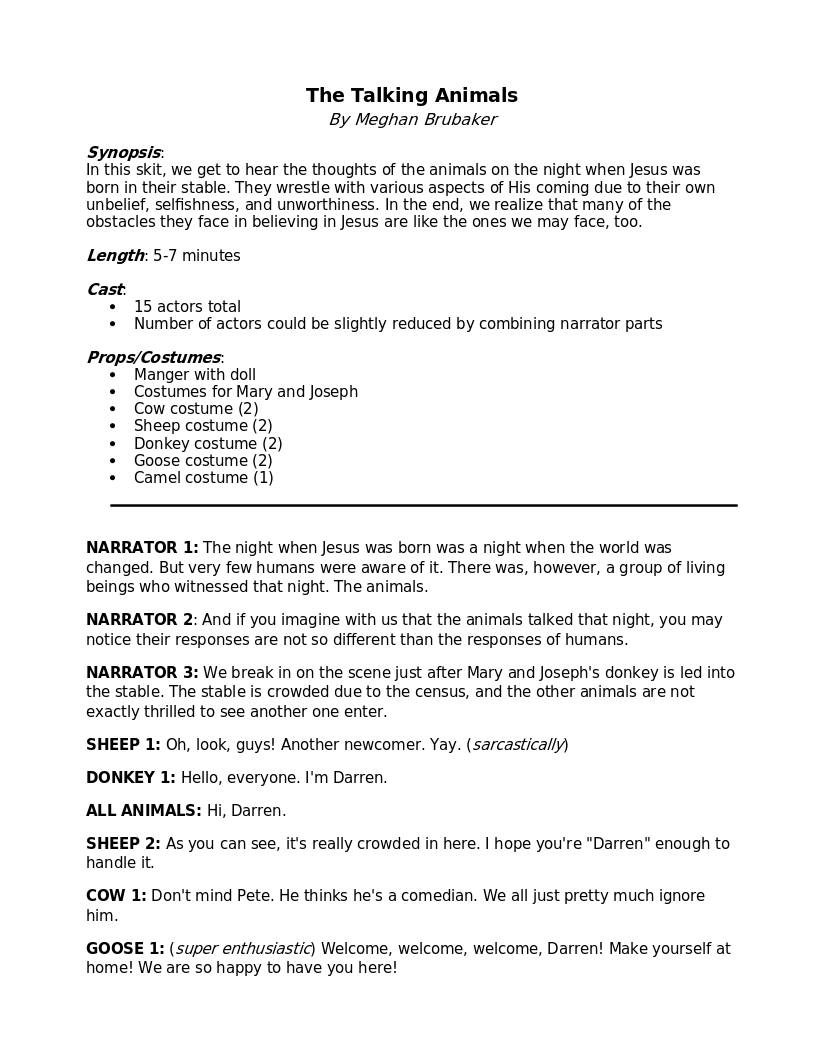
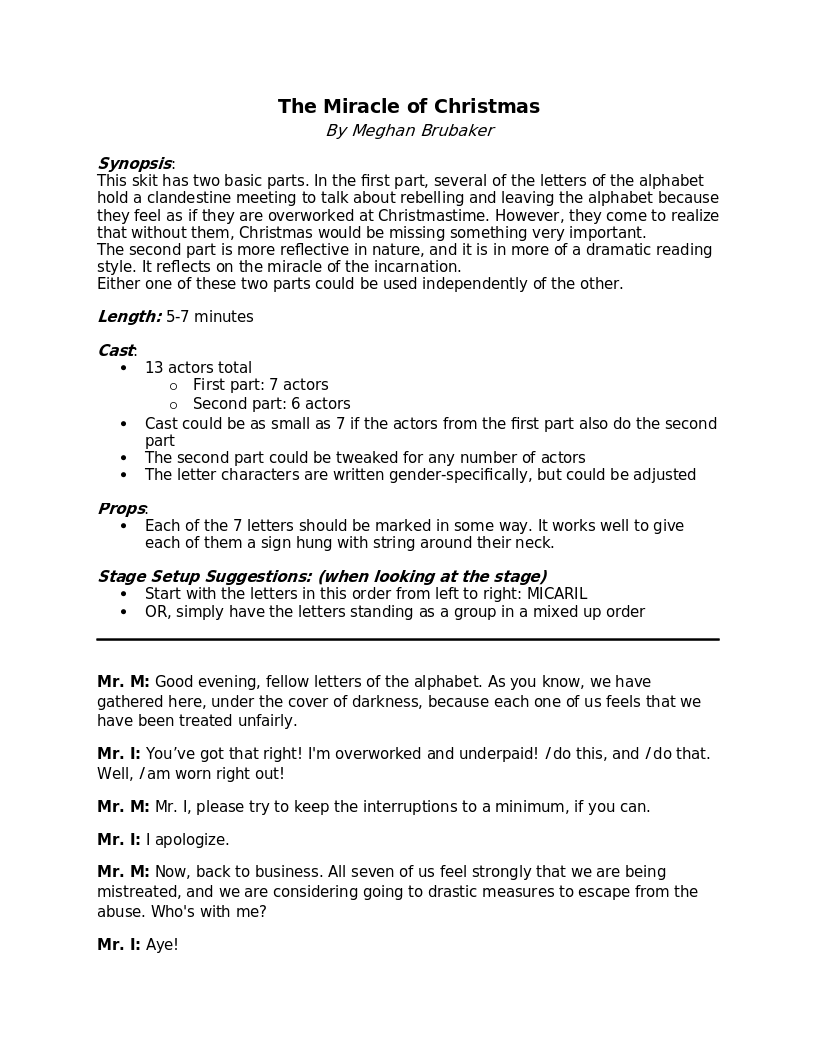
The Miracle of Christmas Skit
A Christmas skit for 7-13 actors. In the first part of the skit, several rebellous letters of the alphabet talk about leaving the alphabet because they are overworked at Christmas time. The second part is more reflective in nature, more like a dramatic reading, on the the miracle of the incarnation.
The Largest Tool in the Room: Solving Problems of Understanding at the Chalkboard
A lot of times they think they understand. I say the concept, I say the rules and like, "Yeah, yeah, yeah, we get it." And then once we get up to the board, they're like, "Wait, how do you do that?" Or, "I don't understand what the next step is."
So, I like using the chalkboard in my classes. It gives me a chance to evaluate how the kids are doing with their work, if they understand what I've been saying, and it gives me an easy way to catch those mistakes and to be able to fix them.
15 cents is what part of one dollar? So, if you want both of them to be cents?
It's kind of like an evaluation tool, I guess you could say, but it's also can be a little bit tricky to keep them focused. So it's just good to make sure that they know what the rules are: Keep your hands to yourself, stay quiet, stay focused. If you're waiting on someone else to finish, just be patient. As long as they're not copying off of each other... I haven't had a lot of problems with that. They're fairly careful with their own work and pretty good with that. So I guess that would just be another procedure to be careful of as they go up [so that] they know what they're doing.
I really like to use the same problem for all of them because—and I use the problems from the book—it keeps everyone on the same page. It's very easy to see if someone's going off track. That way if they all have the same problem, it doesn't use as many problems from the book then as well if you do all the same.
There are problems with that then as well if you have a slow student [or] you have a fast student, and I'm still working on those as well. For slow students, in order to catch mistakes I'll often watch them specifically doing the problem. Let's say they're doing multiplying, and I'll see that one of their lines of multiplying is incorrect, so you just go over to them and say, "Oh wait, you messed up on that row. Check that line again." That way they don't have to wait until they're done with the complete problem and then have to go back and try to find their mistake. So that's a way to keep them all together. With fast students, make sure they understand to be patient and just, yeah, be okay with waiting for other kids to up.
The chalkboard method is especially for small classes. I have, my math class has five kids in it, so it's easy to put five of them up on the board. With larger ones, I'm not sure this would be really a advisable way to do it. But for mine, especially small classrooms, small grades, it's an easy way to watch their progress.
Teacher!
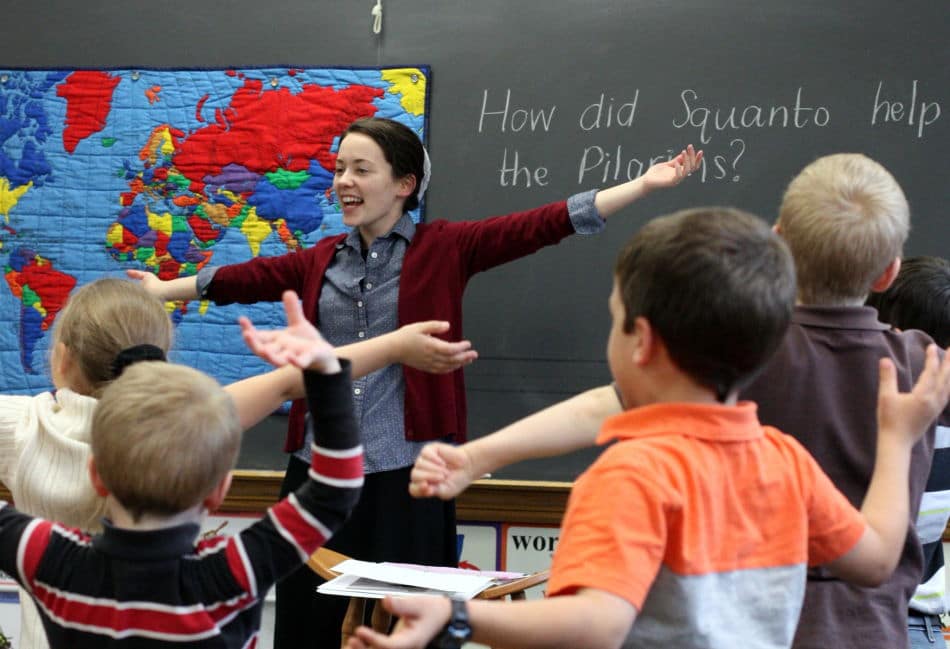
“Teachers have a big impact and people remember their teachers years later. I had lots of great teachers and they impacted and shaped who I am today. Whenever I think of my favorite teacher, I think of Miss B because she really cared for you and was willing to help. That was my favorite year and I loved going to school.”
This quote is from one of my students in the high school “Intro to Teaching” class that I co-taught a few years ago. I asked the students to reflect on great teachers and respond to questions such as:
Which teacher touched your life?
Who kindled your interest?
How did they do that?
Who pressed you to do your best?
Another student responded, “Mr. R is definitely someone who pressed us to do our best in our Christian walks. I would say that Miss A really showed love to us, since she always had a gentle but firm spirit. Mr. G and Mr. R both had a passion for their subjects and communicated it by being excited and fired up about what they had for us to learn.”
Good teachers have to wear many hats. You may be an instructor, coach, nurse, preacher, traffic controller, cook, janitor, evaluator, and librarian all in one day. I’m sure we could list many more roles that we assume.
“Classroom manager” is an important role for us. There are many aspects of classroom management as we manage the teacher, students, instruction, behavior, motivation, discipleship, classroom environment, and relationships.
Classroom management begins with the teacher and significantly impacts student learning and teacher satisfaction. Students remember great teachers who touched their lives, sparked their interests, and encouraged them to do their best. They maintain powerful images of the teachers who demonstrated deep love and care for children. These great teachers passed on a passion for the subjects they taught and captivated their students with that passion. “They approached their work with creativity and imagination, striving constantly to improve” (National Board for Professional Teaching Standards, 2002).
The classroom teacher is the most important component of education (Beaty, 2010).
Research shows and Marzano’s (2003) meta-analysis supports the idea that effective teachers make a big difference in student learning. As the leader of the classroom, the teacher sets the emotional tone in the classroom. The teacher establishes the environment for students, for their success or failure, their feeling safe, and their confidence (Sprick, 2006). The teacher must know how to interact with students, and must show care and respect for students. The teacher should model positive character traits and show students that school is a place to love learning (Selig, 2010). Each student should feel noticed and cared for.
The teacher’s behavior is an important factor in student behavior (Sprick, 2006). The teacher needs to be “with-it,” having the ability to identify and quickly act on potential behavior problems (Marzano, 2003). Good teachers are aware of what is happening in the classroom at all times. They scan the room even when working with individuals or groups and demonstrate their awareness by intervening promptly and accurately when behavior threatens to disrupt.
The teacher must make presentations interesting and involve students in learning and activities. He should be dynamic, clear, use humor, vary the tone of voice, vary intensity, make the lesson’s purpose clear, and clarify information (Sprick, 2006). She must give clear instruction, prepare opportunities for practice, and offer feedback.
Teachers need to maintain a positive attitude toward students. They can do so by taking care of themselves, keeping a positive and realistic view of student success, reflecting on their plans, and determining to interact positively with each student. They should not take student misbehavior personally. They may need to consult with colleagues about challenges (Sprick, 2006).
The effective teacher will be a praying teacher who applies the learning and practical application. She acts on her research and theories to teach well. His goal for students is that they “grow in grace and in the knowledge of our Lord and Savior, Jesus Christ”, 2 Peter 3:18.
Professional development questions:
- How can you build positive relationships with your students? What might interfere with making those teacher/student connections?
- Think of a teacher with whom you connected. What was it that enabled you to connect?
References
Beaty-O’Ferrall, M., Green, A., & Hanna, F. (2010). Classroom management strategies for difficult students: promoting change through relationships. Middle School Journal (41)4. Retrieved from https://www.amle.org/Publications/MiddleSchoolJournal/Articles/ March2010/Article4/tabid/2149/Default.aspx
Marzano, R. (2003). Classroom management that works. Upper Saddle River: Pearson
National Board for Professional Teaching Standards, (2002). What teachers should know and be able to do. NBPTS. Retrieved from https://www.nbpts.org/sites/default/files/documents/certificates/what_teachers_should_ know.pdf
Selig, G., Arroyo, A., Jordan, H., Baggaley, K., & Hunter, E. (2010). Loving our differences for teachers. Boston: Pearson Learning Solutions
Sprick, R. (2006). Discipline in the secondary classroom. San Francisco: Jossey-Bass.



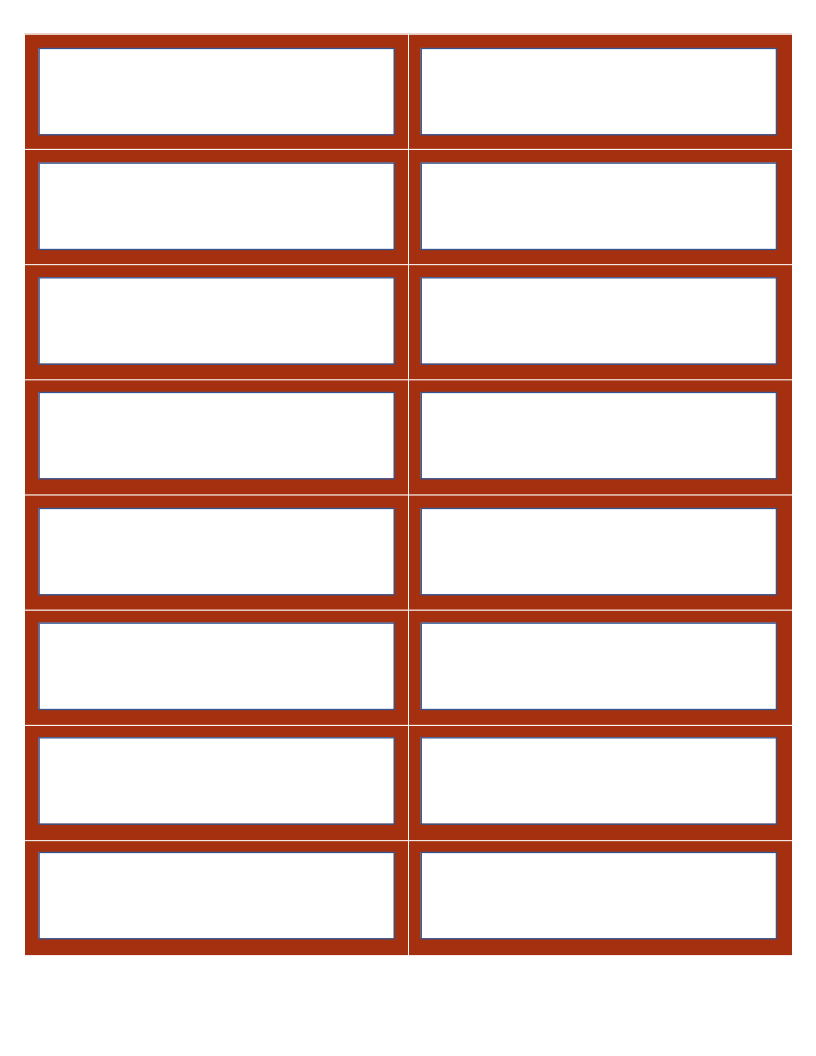
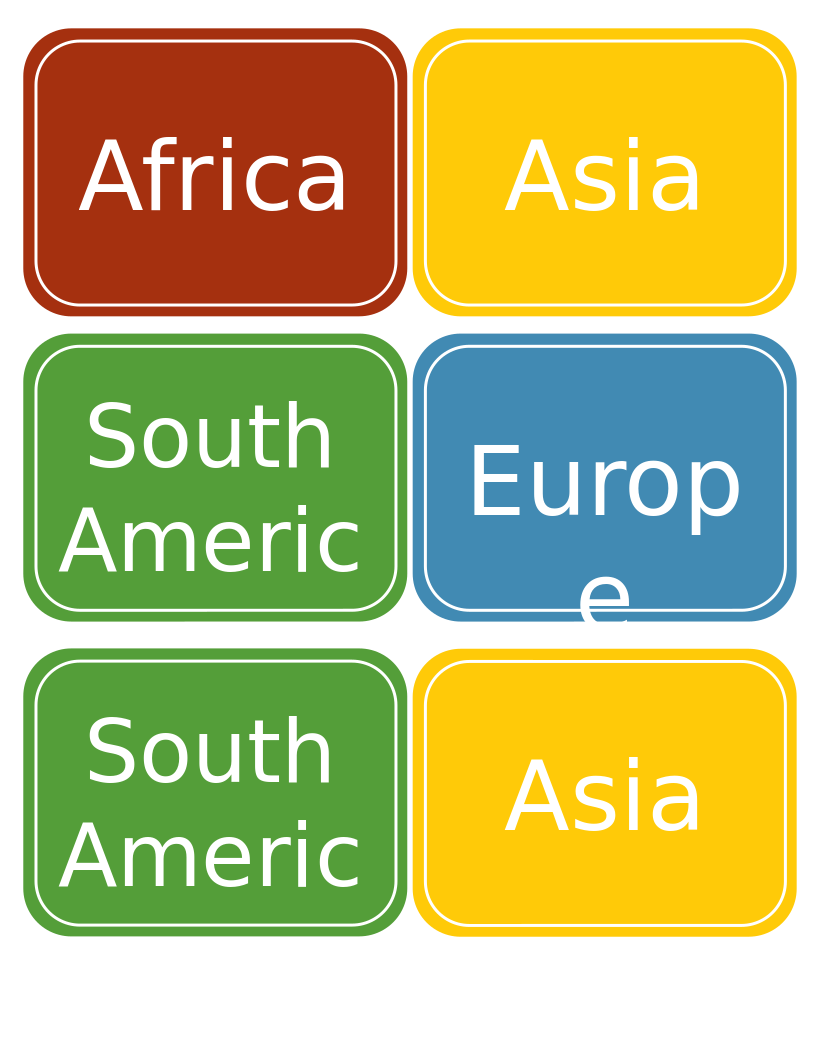
Student Name Tags with Continental Theme
When a student reads a biography about one of the featured people, the student or teacher writes the student's name on a name tag and it will be stuck underneath the poster. The different colored papers represent different classrooms so that at a glance it can be seen who is reading what. Students may be asked to show the biography to the teacher as verification, but only their name goes on the tag.