All Content





Modeling Faithfulness
 Image by Steve Evans on Flickr; CC BY-NC 2.0
As a 20-year-old, I entered the teaching profession as a pit stop on my way to bigger and better things. Nine years later I’m still here. In that time, I’ve learned the best thing a teacher can do for the kingdom is to keep teaching. The following story shows the value of faithfulness even if faithfulness to the teaching profession is not possible because of extenuating circumstances.
My great-grandparents were asked by Eastern Mennonite Missions to answer the plea of Ethiopia's emperor, Haile Selassie, for the Mennonites to start a blind school for boys. They had a very receptive audience with great support from the government. Although they hadn’t been asked specifically to evangelize, a church soon sprang up and grew. After only a few years my grandfather was ordained a bishop at their congregation in Lancaster. His glorious teaching opportunity was done. They went home to Lancaster and never returned to Ethiopia.
A few years later, the Communists took over and all foreigners were forced to leave. Those who had stayed to keep the school and clinic open left. The church with a few hundred members went underground. It looked like the Mennonite story in Ethiopia had come to an end.
With Christianity outlawed, the Mennonite congregation was forced to meet in groups of twos and threes. They were able to illegally print small pamphlets which they distributed among themselves. In this way, the groups continued to multiply. When Communism fell years later, the congregation had grown to 80,000 strong.
This is the part of the story I have known for as long as I can remember. Just recently, I met two people who updated me on the rest of the story. One was an Ethiopian, Zenebe Abebe,Ph.D., a retired professor who is currently an author and speaker. He said my great grandparents taught his high school teacher. He also said all his classmates went on to lead successful lives of service as doctors, teachers, etc. The other person I met was a church leader who visited Ethiopia last year. He reported that they have 1,050 congregations and 1,021 church planting centers. They are growing by leaps and bounds with no end in sight!
I don’t share this story to lift up my ancestors, but rather to show how God worked in spite of their limited time in Ethiopia. God doesn’t require much from us except faithfulness. The teaching profession draws people with big hearts but also loses them because their big heart is drawn elsewhere. In my great-grandparent’s case they were called by God elsewhere. But until you receive such a clear call, stay faithful where you are!
Homework
- Thank 10 faithful people in your life.
- Be faithful today on the lesson plan, delivery, or divine distraction.
- Find one or two people you can meet with weekly or bi-monthly who will encourage you to be faithful.

Airplane Party
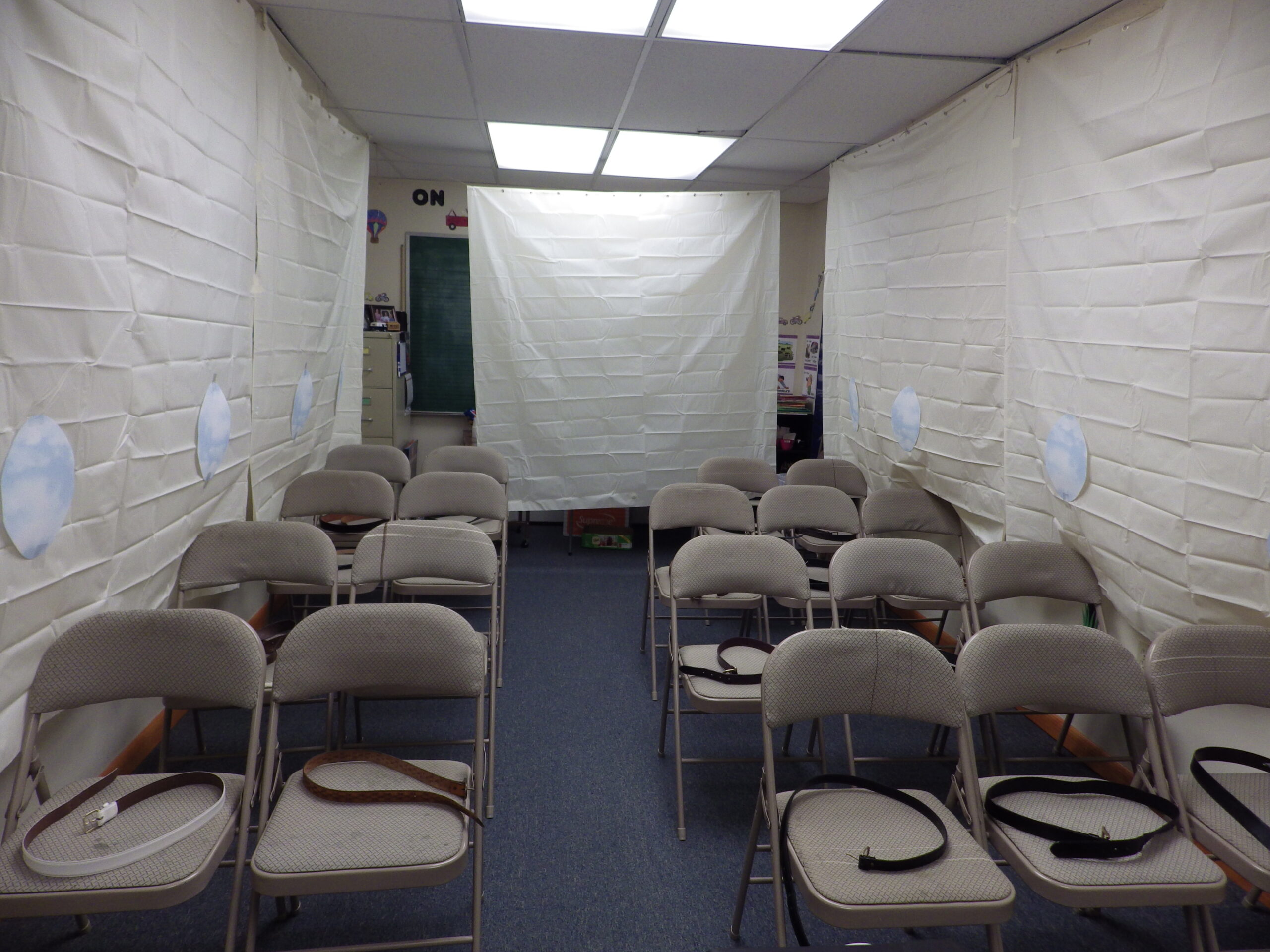
My classroom theme was traveling, so I hosted an airplane party for my students. Their moms and younger siblings were also invited.
I started by handing out passports to my students, as well as boarding passes. Then they were supposed to pick up a gift bag as their carry-on. Next they went thru “security”. Off with the shoes and sweaters, put them in a dishpan. Then they were pushed thru a cardboard box to be collected at the other side. After that they needed to go wait at the gate number. When boarding time came, their ticket was punched with a hole punch, and then they were allowed to find their seat number on the chairs in the classroom.
Safety instructions were given, carry-ons put under their seats, and seat belts fastened. (I used men's belts.) And we were off. I also offered them snacks. A small cart was pushed down the center aisle and they were served small bags of snacks and small cups of drink. Then we visited the country of Nepal. I showed them pictures from when I had visited there. After that we took a break and played a game that we also played in Nepal. Then we repeated the whole process again. Going through security, waiting at the gate and boarding the plane. Two friends of mine also shared pictures and talked about Grenada and Nicaragua. It took up a good bit of the day. It was a lot of work and planning ahead, but it was so worth it and thoroughly enjoyed by all.



Key Differences Between Evangelicals and Anabaptists
Evangelicals have more influence on Anabaptists in the United States than any other Christian group. Because they believe the same as the Anabaptists on issues such as the authority of Scripture, we feel a certain kinship to them and desire to minimize our differences. When Anabaptists need Bible study resources, they turn to Evangelical books and commentaries. Many Christian radio stations are operated by Evangelicals, and many Anabaptists who have radios tune in and listen to Evangelical teaching and music. This Evangelical influence has a tendency to erode the distinctive beliefs of many Anabaptists even more than physical persecution did in Reformation days.
What are the distinctive beliefs of Anabaptists? Perhaps the only difference many Anabaptists would mention, is their belief in nonresistance, which Evangelicals do not hold. Although this visible divergence is a significant difference, it springs from deeper doctrinal differences. The most basic of these differences lies in the interpretation of Scripture. Although both groups believe in the authority of Scripture and would even use similar methods to interpret Scripture, Anabaptists approach the Bible with some different presuppositions that lead to vastly different outcomes.
First, an Anabaptist interpretation of Scripture is centered on the teachings of Christ and his call to discipleship. The rest of Scripture is then viewed through this lens and interpreted so as not to contradict the teachings of Christ, the head of the church. This produces different conclusions than when interpretation is centered on the writings of Paul as often seen in Evangelical teaching. A Christ-centered interpretation maintains that Christ's teachings can be followed with God's enabling grace and must be followed if an entrance into the kingdom of God is to be gained. A Paul-centered interpretation tends to overemphasize man's sinful nature and makes man utterly helpless in the pursuit of good. Consequently, many of Christ's teachings are considered unattainable in the present. In fact, some who interpret the Bible this way postpone the validity of Jesus' teachings to some future time. God's mercy and forgiveness is emphasized in this system rather than careful obedience.
Second, Anabaptists believe the New Testament takes precedence over the Old Testament. They believe the Old Testament points forward to Christ, whereas the New Testament is the final and ultimate revelation of Christ. On the other hand, many Evangelicals have a "flat Bible," putting the Old and New Testaments on the same level. Except for Jewish ceremonial and dietary laws, Evangelical morality closely resembles Jewish morality. Oaths, accumulation of wealth, participation in war, and divorce and remarriage are acceptable for Evangelicals because they were acceptable in the Old Testament. For the Anabaptists, the New Testament teaching on these issues trumps the Old Testament teaching.
Third, Anabaptists believe the Bible is best interpreted when the believer is committed to obeying it. Early Anabaptists were concerned about how the learned of their day “twisted” the Scriptures to get around the force of a command. Anabaptists today reject the common distinctions made between New Testament commands on the one hand that are binding both in form and spirit upon Christians for all time and those on the other hand that are to be observed only in spirit. Many hold that to the former class belong such items as baptism and communion, whereas to the latter class belong such commands as to greet one another with a holy kiss, to wash one another's feet, and to anoint the sick with oil. Anabaptists hold that these New Testament commands as well as communion and baptism are to be observed by all Christians everywhere until the end of the age. Mennonite theologian J. C. Wenger said, "There is no exegetical consideration against the observance of feet washing, for example, which would not also bear against the observance of baptism."
Moving from Bible interpretation, another key difference between Anabaptists and Evangelical Protestants is their view of salvation. Anabaptists emphasize that salvation is by grace through faith that works (not faith plus works). They believe that at conversion God purges a person's past sins by Christ's blood and changes that person at his very core, freeing him from the enslavement of sin and enabling him actually to live a righteous life. God declares the sinner righteous because of Christ's work on the cross and his present work in the heart of the believer enabling him to live righteously in reality. Right living is therefore crucial evidence that an individual has repented, believed, and yielded to Christ.
This is in contrast to the Evangelical view that justification is the result only of an accounting procedure in the books of Heaven that happens totally outside the person. According to this view, when a person says the sinner's prayer, his sins are deducted from his account, and Christ's righteousness is credited to his account instead. Thus, when God looks at the person, all He will ever see is Christ's righteousness regardless of how the person lives (or dies). God declares the sinner righteous regardless what is true in reality. In this view, right living should follow conversion but is unrelated to God's evaluation of the person and will affect only his rewards.
Evangelicals see a huge, oversized cross on top of Scripture that obscures Christ's call to discipleship and renders obedience unnecessary. Anabaptists, on the other hand, see no distinction in the Bible between a disciple of Christ and a saved person. Milo Zehr wrote, “Protestants believe Christ did enough on the cross to deliver those who believe from the guilt of original sin, and Anabaptists believe Christ is doing enough day by day to deliver people from both the guilt and practice of sin.”
The Evangelical view of salvation leads to careless living in many cases. For example, the divorce rate among Christians in America is nearly equal to that among non-Christians. Is this not a small window giving a view of something seriously wrong within popular Christianity? Most Evangelical Christians see no advantage to living a holy life because of their view of salvation.
One clarification should be made. Anabaptists do not believe a Christian will never sin after conversion. According to 1 John 1:7, “If we walk in the light . . . the blood of Jesus Christ his Son cleanseth us from all sin.” If the Christian never sinned after conversion, he would not need this ongoing cleansing from sin. The apostle John infers that a person walking in the light would still stumble at times and need cleansing. The two ditches that must be avoided are these: (1) We never sin after conversion. (2) We can habitually sin and have fellowship with God. The cleansing of sin does depend on our walking in the light, which means striving to obey Christ and do what is right.
The Bible says Noah, Abraham, and Job were righteous in the sight of God. Yet we know they weren't perfect. We also know that their righteousness was not just the result of an accounting transaction in the books of Heaven, but rather a righteousness (right living) that was a basic pattern in their life. What kind of affront to Satan would it have been if Job's righteousness had been just the result of bookkeeping in Heaven?
Another difference regarding salvation is the status of children. Although Anabaptists are diligent in teaching children the word of God, their focus is not on converting the child as soon as possible. They believe their children are safe and covered by the blood of Jesus until they reach the age of accountability, at which time the child will either accept or reject Christ. This age varies between individuals, but for most it falls between the ages of 8 and 17.
Evangelicals believe children are lost until they accept Christ. Their focus therefore is on getting the child saved. Many of their children will say the sinner's prayer by the age of 7. But is child evangelism much different from infant baptism? Any parent or pastor could get most 3-year-olds to say a prayer accepting Christ into their heart. But 3-year-olds know nothing of discipleship, and unless they are taught discipleship later in life when they can truly understand what it means, they will never become true disciples of Christ, which is what a Christian really is. Thus, sadly, many say a sinner's prayer by age 7, but by 17 they are following the world rather than Christ.
Anabaptists believe their chief citizenship is in the heavenly kingdom ruled by Jesus Christ. Thus they believe it is not their job to keep order in the kingdoms of this world wherein they are only pilgrims, but rather to invite people into the heavenly kingdom. Evangelicals believe Christians need to help keep order in society. They have never been able to figure out, however, how to follow the laws of Jesus' kingdom, which he taught in the Sermon on the Mount, and still keep order in the kingdoms of this world. It seems they have ended up dropping the heavenly kingdom values.
Because of Jesus' commands to “love your enemies” and “resist not evil,” Anabaptists believe strongly in non participation in war. Yet they hold that the state is necessary and ordained by God to keep order in an unregenerate society by using carnal force (Rom. 13). They therefore do not oppose the just use of the death penalty, recognizing that the government "bears not the sword in vain.” They also are not, as Harold Martin says, "Humanitarian pacifists crusading for the end of all wars." Their attitude is that they will thankfully accept the protection the state provides as the Apostle Paul did. But if that protection should fail or if the state should turn against them, they will rather suffer violence than harm a fellow human being.
In the 16th and 17th centuries, the Catholic and Protestant controlled governments in Europe did turn against the Anabaptists and persecuted them with terrible cruelty. Despite the horrible persecution Anabaptists maintained their beliefs and multiplied. We are grateful the Protestants no longer persecute us and are rather apologizing for their forefathers’ persecution. Anabaptists need to stay on the alert, however, so they do not now unconsciously and gradually surrender their beliefs during this time of geniality. The issues for which the Anabaptists were persecuted have not been resolved. We made it through the physical persecution. How are we doing in the face of the subtle onslaught of Evangelical books and media?
We as Anabaptists do not "have it all together.” We certainly have quite a few problems of our own which we can work on. Wherever we are right, it is by the grace of God. Neither are Evangelicals all wrong. As was said at the beginning, Anabaptists and Evangelicals have some common beliefs. Many Evangelicals are sincerely seeking God and striving to do His will. It is important, though, that people understand that there are significant differences which go deeper than dress and nonresistance and which make Anabaptist denominations necessary.
Furthermore, let us all grow in grace and in the knowledge of Jesus Christ while living up to the light we have already received.
The Russian Mennonite Story: The Bitter End
Thousands upon thousands of Russian Mennonites perished in Russia from 1917 until the 1980s.
Summary of the six turbulent times
- The Civil War of 1917 – 1920 and the famine of 1921 – 1922
- The liquidation of kulaks and collectivization, 1928 – 1933
- The purges and exiles of 1936 – 1940: 62,000 Mennonites forcibly moved north and east throughout the USSR, almost all the German settlements dissolved, over half perished, survivors treated like criminals.
- The evacuation eastward at the beginning of World War II, 1941
- Evacuation westward by the German Army, 1943
- The repatriation by the Red Army in 1945
Step by step, the once-prosperous communities disintegrated. Never since the days of the martyrs have the Mennonites suffered so much as during the twentieth century in Russia.
Summary of the migrations to the Americas
- The first group came to the prairie states and provinces of the United States and Canada in 1874 and following years. 18,000 Mennonites
- After World War I, from 1923 to 1927. 21,000 Mennonites to Canada. Then 1929, 1930, 3000 to Paraguay and Brazil
- After World War II, 12,000 Mennonites, half to Canada and half to Paraguay
From 1951 – 2004 Germany has received 2,300,000 Russian German resettlers (Aussiedler), about 285,000 of them of Mennonite or Baptist connection. Of that number only about 50,000 or 60,000 were believers. This migration is the largest in all of Anabaptist history.
Sources: Smith’s Story of the Mennonites by C. Henry Smith revised by Cornelius Krahn and Testing Faith and Tradition by John Lapp
For the story of Mennonites during the Russian Revolution, listen to "Mysteries of Grace and Judgement":
https://thedockforlearning.org/audiovideo/mysteries-of-grace-and-judgement/

Mennonite Holocaust Perpetrators?
Mennonites as Holocaust perpetrators? Did Mennonites actually help destroy Jews? Yes, unfortunately so. Recent research is uncovering this unsavory truth, too long hidden in darkness.
Consider the following quote from "Mennonites and the Holocaust" in the October 2010 issue of the Mennonite Quarterly Review. “SS-Hauptsturmfuhrer Heinrich Wiens … had a record of efficient methods in this ghastly business....For his tasks Wiens had the advantage of using “gas vans,” newly arrived from the manufacturer of “murder implements” in Berlin. As in all massacres by the Einsatzgruppen the 800 to 1000 Jewish people in the area were first “registered,” which took eight days. Then came the command to start the killing process. Jews from the city itself and the surrounding localities … had until September 5, 1942, to report to the calvary barracks in Pjatigorsk. At the barracks they were told that they would be resettled and were to prepare themselves for travel. Then they were transported in trucks a short distance to a gravel pit guarded by the members of EK 12....As each truckload of Jews arrived they were ordered to disembark, deposit their valuables on spread-out blankets and then told to remove all their clothes. They were then forced to climb into the “gas van,” which drove back and forth several times before it stopped on the edge of the pit. There several Jewish prisoners were compelled to pull the bodies from the truck and throw them into the pit on the promise that they “would be saved” from such a fate. None of the Pjatigorsk victims survived, including the prisoners unloading the corpses of their fellow Jews, who were killed when their grisly work was done.”
Commander Weins went on to systematically repeat the procedure in other places, becoming personally responsible for the deaths of thousands of Jews.
Henrich Weins, born March 22, 1906, was the son of a prosperous Russian Mennonite farmer and merchant who lived in the South Russia Mennonite settlement of Molochna. From 1926 till 1930 he served as a dairy inspector at various Ukrainian locations. On January 10, 1931, he joined the Nazi party in Danzig, Poland, and two days later intensified his identification with Nazism by joining the elite SS. By April 1939 Weins was an SS captain.
He described himself as a “believer in God” while working in the officially atheistic Nazi SS. He had left the Mennonite church somewhere between 1931 and 1939.
For the complete story and much more read Gerhard Rempel's Mennonites and the Holocaust: From Colaboration to Perpetuation beginning on page 507.
Heirich Weins was just one individual among thousands and thousands of Mennonites in Germany, Poland, and the Ukraine who identified with Adoph Hitler and the Nazi Party. While only a few like Weins participated actively in destroying Jews, most Mennonites in Europe just looked the other way. They were mostly silent participators, although some Mennonites did dislike Jews because of Jewish involvement in Communist government. They were proudly pleased with their German nationalism. They could be this way because they had already lost their Two Kingdom Concept, and thus their nonresistance by World War 1. These German Mennonites supported German nationalism so strongly that one hundred forty-four Danzig Mennonites lost their lives in combat during the Great War. (Two thousand German Mennonites served as soldiers.) The next generation, living while the Holocaust was happening, seemed glad to rally around Adolph Hitler and the Nazi Party. German nationalism had become more important than the eternal Kingdom of Christ.
What happened? A detailed story of what happened is chronicled in Mark Jantzen's recent book Mennonite German Soldiers (2010). The book recounts the gradual step-by-step downward spiral experienced by the Danzig Mennonites. From the principled stance of a persecuted sect, yet recognized and tolerated by the government, the Danzig Mennonites completely lost their recognition as nonresistant people in the space of one hundred years. The Danzig story happened in a completely different political and social environment from what we experience in the United States. Thus the Mennonite parallels are not identical. However, large historical lessons loom. Human beings face similar situations in all ages and places.
For preservation as a people part of the Kingdom of Christ, we must be realistic with the issues we face. The Kingdom of Christ does not just happen; it is perpetuated by people cooperating with Christ in the building of that Kingdom in the midst of a hostile society. He has been fair to educate us with stories and teaching from the Scripture as well as non-Biblical stories of those who lived before us. We have a wealth of information at our disposal. We need interpreters and appliers!
Reading these accounts provided me with quite a bit of food for thought. We are also writing a story that will be read by our descendants (if Christ tarries). I look at the German Mennonite story from a distance of time, geography, and ethnicity and yet some lessons loom large. What will people read about us? What life lessons will those who read about us, make about us? We do not live in a vacuum or in an obscure corner of the world. It seems that Christ has put us close to front and center in the American context.
Following are some of my observations and interpreted life lessons as I try to bridge the gap between the German Mennonites and ourselves. Much more could be included.
- The Kingdom of Christ is separate from the kingdoms of this world. They can never be presumed to be one and the same no matter what rationalization we try to make. The two operate with two different operating systems. The Kingdom of this world centers on “ME,” while the Kingdom of Christ centers on “HIM.” Jesus Christ said, “Love the LORD with your entire being and love your neighbor as yourself.” Such love requires “setting our affections on things above” because naturally we love ourselves.
- The Kingdom of Christ is incompatible with a political system. Participation in politics by voting and office holding denies and confuses the two separate systems. Jesus simply said, “My Kingdom is not of this world.”
- When hearts truly are seeking Christ first, His grace goes to work to accomplish what we in our human weakness can never do. We need not worry about having the right strategy or the proper five-year plan. The secret is seeking Christ first; His blessing will follow. Too often the German Mennonites lowered their gaze to themselves.
- If we took three words CHRISTIAN, AMERICAN, MENNONITE, in what order would we arrange them? Am I a Mennonite Christian American, an American Christian Mennonite, or an American Mennonite Christian? Mennonites who participated in the Holocaust decided that German was the strongest word.
- The way of acculturation, the way of gradual compromise with the system will eventually lead us to embarrassing places. Jesus tells us to “endure until the end.” The downward pull is relentless; the availability of grace is limitless! If we surrender to the downward pull, we have only ourselves to blame.
- An aggressive teaching program is essential to reproducing conviction in each succeeding generation. We may spare no effort here because the society around us is also attempting to teach our children. The Kingdom's teaching program must provide solid, satisfying answers to young people who wonder about the issues of life.
- While tradition is right and proper in many areas of life, tradition can become a binding and limiting force which actually sets itself against the movement of the Spirit of God. The Kingdom of Christ can never be frozen. The German Mennonites agreed with the government to allow no non-family converts into their churches!
- Individualism is a corrosive force. The people of God must remain solidly together. To remain solidly together much Gelassenheit must happen. Christian community is a wonderful experience, one of the best on this side of heaven.
- Unsound, non-Biblical doctrine must be met head-on and exposed for what it is, either on the leadership or membership level. We cannot press into the Kingdom of Christ while we are ignoring unsound doctrine among the people of the Kingdom. Christ and His message are an integral unit.
- Leadership must know the way, show the way, and go the way. Leadership by default is not leadership. Christ appoints leaders which He then commissions to energetically lead the way into Kingdom fullness.
- The Kingdom of Christ has boundaries. Those boundaries must have substance, not just exist as ideas or theories. The boundaries may differ at different places within the Kingdom of Christ but they must exist.
- The Kingdom of Christ is always expensive; we must lose ourselves in order to be obedient to Christ. That obedience may demand our very earthly lives. But is earthly life the most precious possession we have? No, our faith is. Kingdom Christians with their faith in Christ first have always been misunderstood by their neighbors, often resulting in persecution.
- Rewriting a confession of faith to accommodate a different value system is different from updating a brotherhood agreement. Our church standards must always be relevant and meaningful to the membership. To rewrite a confession of faith is a momentous experience for any group within the Kingdom of Christ; we had better know what we are doing!
- Attempting to construct a bridge between the past and present when the present is on a different foundation from the past is a lack of integrity. The Danzig Mennonites claimed, “agreement with our forefathers that every war is a great evil that results from sin.” Yet they also said, “It appears to us to be very difficult to find an absolute prohibition of military service in the Holy Scriptures if such is required by the state of all citizens.” The German Mennonites now claimed that it was their Christian duty to seek the “prosperity, rights, and preservation of the state in which God has placed us.” The leadership claimed that their principles had not changed, only their form.
- If families cannot support what is happening on a local level, their only recourse is relocation. In the Danzig area, out of twelve thousand Mennonites, two thousand emigrated, mostly to Russia, with some to the United States. Those emigrating felt the need to remain true to their convictions. Those not emigrating were often tied to their locality by wealth and power.
- Governments get to know their people. Even though the state constantly pressed against the German Mennonites to take up arms, they did recognize that they were great taxpayers. Since governments need both men and money, the Prussian government reluctantly lived with just money, always wishing for the men also. Eventually the state got both the men and the money. Once they got both, they would not reconsider moving backwards. In America the Anabaptist people have a nonresistant reputation and liberal concessions from the government. We may never lose our reputation. It is better to remain as a thorn in the side of society as a separate Kingdom.
- The Kingdom of Christ must educate its own children. To allow the state (the Kingdom of this world) to educate our children is serious collaboration with the enemy. No educational system is neutral; education always happens within a context of values. Why would any member of the Kingdom of Christ be content with education by the enemy? The German Mennonites became content with such an arrangement. The rest is history.
From colonial beginnings, especially with William Penn, the Anabaptist people have been favored with government respect and provision. Thus American Anabaptists have had an easy road compared with Anabaptist experience in the past. That easy road has too often caused us to be shallow, apathetic, complacent, and materialistic. Too often we have lost our sense of being Kingdom Christians and thus have lost our message. In our day American society knows and respects Anabaptists to a greater or lesser degree. They are observing the acculturating process at work among us, sometimes distressed when they see us succumb. So far the United States government has made liberal concessions to the Anabaptist people because they understand them as a people with a long history of authenticity. Will that reputation continue?
But with the freedoms we have, what is to hold us back from being aggressive with the Kingdom of Christ? Only our shallowness, apathy, complacency, and materialism. What would happen if conservative Anabaptists were wholly filled with the Spirit of the Living Christ?
Download the Word documentFor the story of Mennonites during the Russian Revolution, listen to "Mysteries of Grace and Judgement":
https://thedockforlearning.org/audiovideo/mysteries-of-grace-and-judgement/

Freedom in Christ: Two Object Lessons


 Why Did Jesus Have to Die?
 Who hasn’t asked this question at some point? A simple object lesson involving bleach, food coloring, and water visually illustrates how Jesus took upon him the sins of the world and how He can also cleanse each of us from our sin.
You will need:
A jar of half water, half bleach (represents Jesus).
A jar of water made dark with food coloring (represents sin).
A jar of clear water (represents you).
Watch:
https://www.youtube.com/watch?v=8Z_SMrnEiaI
Will You Choose Jesus or Bondage? This object lesson illustrates in a simple yet profound way the freedom that comes through walking with Christ.You will need:
- Two ropes.
- A scissors.
- A stationary object such as a post or heavy piece of furniture.
- A willing child.
Tie a rope to each of the child’s legs and then tie him to yourself on one side and the stationary object on the other. Hand the child a scissors and tell him he has a choice. He can cut only one rope. He may either remain tied to the object and not be able to move around, or he may remain tied to you and walk around with you.
Children will almost always choose to be tied to the teacher.
Explain that the stationary object represents the bondage of sin (or emotional or spiritual bondage). Walking with the teacher represents walking with Jesus. When we choose to have a relationship with Jesus and go where he leads us, we are set free from the bondage of sin.

A Context for Learning: Using Current Events in the Classroom to Spark Student Interest
One of the things that I enjoy about teaching is being able to bring current events into the classroom. My love for current events was fostered by one of my teachers. He really encouraged us to involve ourselves in what was happening around the world.
One of the ways he did that was by dedicating a bulletin board to current events. After we had that board totally covered with news articles, we were able to take an extra fifteen minutes of recess.
One of the other things that he did that we didn't enjoy so much was he had us summarize the article for the class. Then also, if there were any pictures, we took the article around the classroom. Then after that was done, we finally got to hang it on the bulletin board.
Another thing that he would do was put bonus questions on tests that reflected what was happening in our world. He might have asked us who the prime minister was, or who the governor general is, or maybe even the American president, or sometimes he may have asked us about a current event, like where a Boeing 737 Max 8 crashed recently.
I've noticed that my students’ awareness to current issues can actually be helpful in helping them learn terms and concepts in our subjects. Four years ago, a word like “tariff” was just another vocabulary term for students to learn, but thanks to the American president and his work on NAFTA, my students now all understand what a tariff is. Another word that my students understand better than ever before is nationalism, because they all understand that many of Donald Trump’s supporters are very nationalistic, and so they get what nationalism is.
A few ways that I try to incorporate current events into my classroom include setting aside a time for current events, as well as tying it into appropriate subjects. In my homeroom, I set aside a time for current events, and I will bring in articles of interest on current issues and we'll talk about them and get the students caught up on what's happening in their world. If there's an election going on, that's a wonderful time to give students a brief lesson in civics because elections are usually exciting things to follow. Students are interested in learning what's going on and how this is working in order to get a person to the position of prime minister or president.
In social studies or geography or history, students tend to be interested in news from countries that they're currently learning about. Recently, we learned about Europe. Students were very interested in hearing about the spats between Kosovo and Serbia. They're also interested in news from local cities and areas. A number of years ago, one of our local cities found a corduroy road six feet under the main streets through town. That was an interesting topic for us.
It could be a scientific discovery. Recently, I was reading an article about—It was a tongue-in-cheek article that a scientist had written after visiting a Flat Earth convention. Again, a good opportunity to teach your students about theories that people have in our society.
Another thing that I try to do is be somewhat conscious of where my news articles are coming from. Are they heavily biased towards the left, to the right, or they somewhat in the center? There are various websites that you can use to find out what a newspaper or a news organization’s rating is. Allsides.com has some media bias ratings, marketwatch.com has a chart on that, and mediabiasfactcheck.com also has some interesting resources for that.
Another thing that I have a thought of, but I haven't learned well enough myself, is to teach students how to notice bias in articles, whether it's looking at the pictures, the way things are said and portrayed, and so on. Is the pose a flattering pose for that politician or is it not flattering? That can tell you a lot about that particular news organization’s view on the topic.
Print media is becoming more and more scarce, so I feel there's a greater responsibility on the teacher to make students aware of what's happening in their world and to spark interest in that because there's less ready access for them. I think we're helping students to be more well-rounded when we help them to be aware of current issues in their country and in their world.

Foundation of Brotherhood
Every Christian can lay a foundation for brotherhood by participating in four construction phases: demolition, reconstruction, renovation and habitation. In which building phase is God calling you to do some work? What posture of heart do I bring with me to the ministry setting where I am called?


Climbing inside His Skin

“Who is my neighbor?”
When the lawyer tempting Him asked this question, Jesus responded with the story of the Good Samaritan. A man was robbed, beaten, and left for dead. A priest and a Levite passed the injured man, but were unwilling to help. Finally, a Samaritan stopped and helped the injured man.
At the end of His parable, Jesus asked the lawyer, “Which of these three was the neighbor to the one who was injured?”
The lawyer responded, “He who showed mercy on the injured man.”
Jesus then commanded, “Go and do likewise.”
Notice the lawyer replied, “He who showed mercy.” It seems the lawyer was unwilling even to admit the good person in the story was a Samaritan, a class of people the Jews despised and discriminated against.
What was Jesus teaching with this story? That priests and Levites are bad people? That Jewish lawyers are bigoted? I don’t think so. Jesus was teaching that our neighbors are not merely those like us; our neighbors are also people different from us, even those many tend to look down on. Jesus was also calling us to live out the commandment “Love your neighbor as yourself” by following the example of the Good Samaritan.
What made the Good Samaritan different from the other travelers who passed by? The Samaritan loved the injured man enough to overcome any disgust or prejudice there might have been between the two cultures. To follow the example of the Good Samaritan, we too must love others without prejudice.
The Importance of Empathy
It’s easy to love people we know and see every day. When those close to us go through a difficult time, we do everything we can to help them. But what about the “worldly” family living three houses down? What about the homeless panhandler? What about a street child in Thailand—or in your own town?
We often fall into the trap of judging people we don’t know by our own privileged experiences. Why doesn’t that bum get a job? Why don’t those parents control their children? Why is that foreign tribe so superstitious? Sure, if they knew what you did or had your life experiences, they may know better. But they don’t. They have a set of unique experiences that affect them and shape their beliefs and actions.
The fact that almost everyone on the earth is different from us means it is vital for us and our students to develop empathy for others so we can carry out Jesus’ command to “love our neighbor as ourself.” Develop because empathy will not happen automatically due to the inherently selfish nature of our hearts.
What is empathy? It’s not the same as sympathy, just feeling sorry for someone. If you have empathy for someone, you can see things from their point of view, you can understand where they are coming from, and you will be compelled to act by your selfless love for others.
A quote by Atticus Finch in Harper Lee’s To Kill a Mockingbird tells us what it takes to gain true understanding and empathy for another person.
"You never really understand a person until you consider things from his point of view. Until you climb inside of his skin and walk around in it."
To have true empathy for our neighbors, we must somehow climb inside of their skin and consider things from their point of view. If we are unable to understand others and empathize with them, we tend to judge them instead of being loving and compassionate. To show our neighbors Christ’s love, we must do our best to understand them. We love ourselves enough to do something about our problems; loving someone as ourselves compels us to help others.
Teaching Empathy
It is the teacher’s job to teach his students the basic skills they need in life—math, reading, and writing—but even more important, he should mold them into productive workers in God’s kingdom. Children are naturally selfish; it doesn’t take long for human nature to show itself in the home or the classroom. Teachers help our students see things from another child’s view, helping Johnny understand why Sally is crying, and why it’s wrong to yank the ball out of her hands. Teaching our students how to understand and empathize with others is one of the best ways we can help our students show Christ’s love to the world.
God wired us to respond to stories about other people. Jesus, the perfect teacher, used stories like the parable of the Good Samaritan to teach people about the kingdom of God. We can use our students’ love of stories to teach them empathy.
Pick stories with characters who have different experiences and cultural backgrounds than your students. This will broaden your students’ horizons and help them see other people as individuals, not as some stereotyped, faceless group. Stories about people from different cultures enable our students to see life through the eyes of another, to help them realize that people quite different from themselves still have many of the same desires, dreams, and struggles they do.
Look for opportunities during the school day to help your students see when they are failing to love others as they should. Be on the lookout for bigoted, prejudiced, and judgmental comments. Kindly remind them that Jesus loved many classes of people that the unempathetic look down on today. Teach them that we must follow Christ’s example—not the cultural norms—to truly love others.
The school years are a formative time for young people. We have a powerful opportunity to expand students’ horizons and show them we are called by Christ to love others, even those who may seem different or strange. Empathizing with our neighbor is a vital part of loving others as Christ did.
Recommended Books and Short Stories
These stories help develop greater understanding and empathy for others. Some of these stories have material that may not be acceptable in your community, so be sure to check with your principal or school board if you are unsure whether they are appropriate for your class.
Young Children (Grades 1-3)
Crow Boy by Taro Yashima—Japanese schoolboy who is mistreated and understood because he is different.One Green Apple by Eve Bunting—told from the viewpoint of Farrah, new in America, new at school. Just the story of a field trip, but shows aloneness and confusion felt by someone in that situation. Also how she begins to find common ground and acceptance from classmates.Gettin’ Through Thursday by Melrose Cooper—The story of a boy whose family lives from paycheck to paycheck, and how they have to scrimp sometimes to get through Thursday to payday on Friday.Four Feet, Two Sandals by Karen Lynn Williams and Khadra Mohammed—Two girls in a refugee camp in Pakistan learn that it is best to share a special pair of sandals. My Name Is Sangoel by Karen Lynn Williams and Khadra Mohammed—A refugee from Sudan settles in the United States and struggles to fit in.Middle Grades (Grades 4-6)
Bluish by Virgina Hamilton—friendship between three very different fifth-grade girls, especially centering around relating to the one who has cancerThe Jacket by Andrew Clements—When Phil sees another kid wearing his brother’s jacket, he assumes the jacket was stolen. It turns out he was wrong.The Janitor’s Boy by Andrew Clements—A boy is ashamed of his father for being the school janitor. (Minor language warning)The Wheel on the School by Meindert DeJong—The town’s schoolchildren set off a quest to find a wheel for storks to use as a nest base—a quest that eventually involves the whole village, and during which the children learn to appreciate people they had misunderstood. (Minor language warning)Charlotte’s Web by E.B. WhiteThe House of Sixty Fathers by Meindert DeJong—Tien Pao becomes separated from his parents during the Japanese invasion of China in the 1940s. Lost behind enemy lines, he struggles to stay alive and find his family again.Save Me a Seat by Sarah Weeks and Gita Varadarajan—An immigrant from India and a special needs boy become friends.Homeless Bird by Gloria Whelan—The experiences of a child bride in India.Someone on This Bus Is Going to Be Famous by J. B. Cheany—Various perspectives show the lives of regular children in America and their many needs.The Great Gilly Hopkins by Katherine Paterson—Troubled foster girl finding a home but messing it up with unwise decisions (language warning, nonfunctional family).Upper Grades (Grades 6-8)
Words in the Dust by Trent Reedy—Set in a Muslim home in Afghanistan A Long Walk to Water by Linda Sue Park—True story of one of the lost boys of SudanOkay for Now by Gary D. Schimdt—Struggling teen in a dysfunctional familyWild Bird by Wendelin Van Draanen—Young teen heroin addict is sent to wilderness campThe Heart of a Chief by Joseph Bruchac—Native American teen on a reservation with modern strugglesHigh School
To Kill a Mockingbird by Harper Lee—A young girl in the Depression-era South learns that people are not always as they seem, and that people can be cruel to others for no real reason. (Language and several references to sexual assault.)The Prince and the Pauper by Mark Twain—A prince and a pauper trade places and learn that each other’s lives weren’t as great as they thought they would be.“The Outcasts of Poker Flat” by Brett Harte—A group of “unsavory” people are thrown out of town and are caught in a snowstorm high in the Sierra mountains. This story highlights self-righteousness, hypocrisy, and forgiveness.
“The Frill” by Pearl Buck—A tailor is China sews a frill on a dress for a demanding and bigoted customer.
“My Father's Hands” by Calvin R. Worthington—An emotional look at the strengths and weaknesses of a father’s hands.
A Ticket to Math: Flashcard Practice Certificates
Click for full-resolution images.
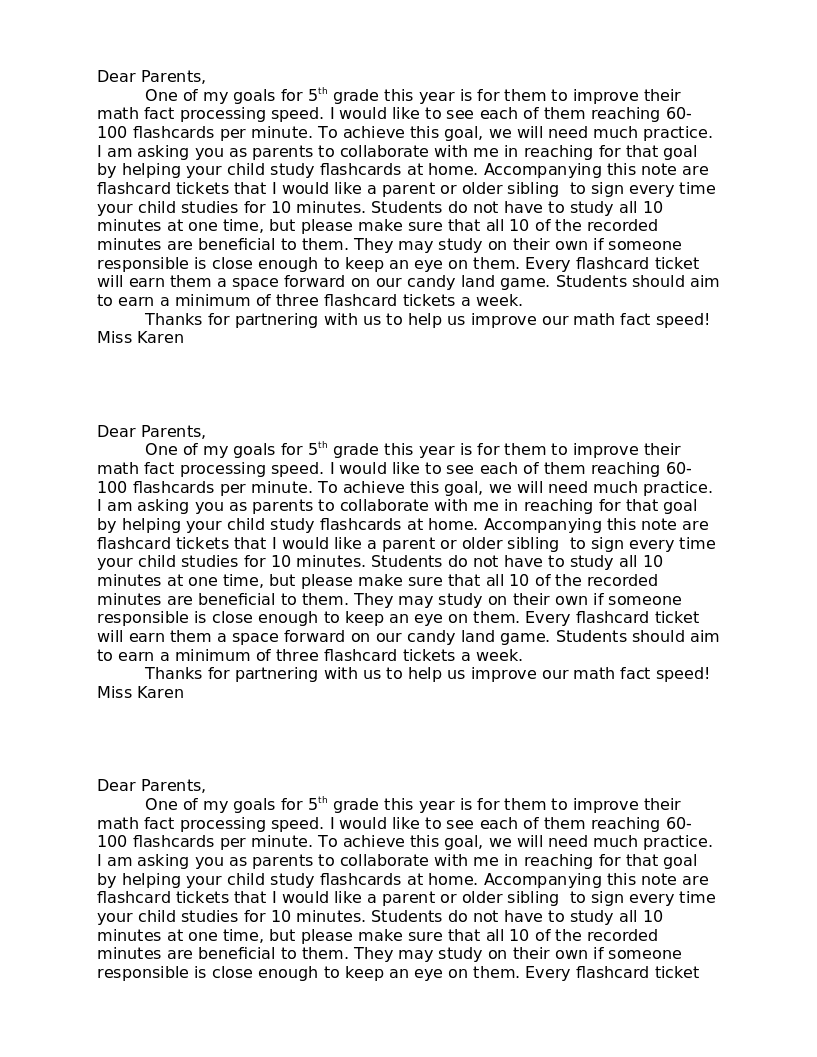
Karen used tickets and certificates to keep her students on a path of math skill improvement.
The letter to parents explains the process.
The second page of the document contains the printable tickets.

Candyland Land Game Door Décor
Decorate your classroom door with a Candy Land theme! Scroll down for a description of how Karen used this to motivate academic achievement.

Karen incorporated the theme into classroom management as follows:
Candy Land Game
To go forward:- Study flashcards 10 min
- Get a better score on your speed drill
- Study for a test or quiz (when announced)
- Get a better-than-your-average score on a test or quiz
- If someone recommends you to move forward a space because they caught you being kind
- Saying good morning with a smile and eye contact on a randomly-selected day
- Having a neat desk at a desk check
- Break a rule or procedure
- Get a worse-than-your-average score on a test or quiz
- Use the restroom during non-designated times
- Have an unfinished assignment
When you get to a pink candy spot, you get the reward stated beneath the card.
- Put a quarter in the jelly belly machine and turn!
- Once everyone is past, we will have a day that you may sit anywhere in the room during lunch.
- Choose a piece of candy from any of the candy banks.
- Once everyone is past, we will have a day that you can trade your lunch food with each other.
- You may bring something other than water in your water bottle. No sodas or energy drinks. Suggestions: Gatorade, fruit juices, tea (not iced tea), milk (on cold days)
- We will get one minute of extra recess for every person that passes this space. We can add it up and use it as I say we have time.
When you get to a licorice spot, you may sit on a beanbag for something: silent reading time, story time, spare time, study together time, or other special permission times. You may save it until you are ready to use it.
When everyone arrives at the end of the game, we will choose a special day. Then we will all start over together.
If you are behind:There is one bypass in the game. If you are behind the others, you may have to use the bypass so we can have our special day sooner. That means you will miss privileges 5 and 6, as well as a beanbag day. You must ask permission to take the bypass.
See more from Karen on classroom procedures:
https://thedockforlearning.org/contributions/sample-classroom-procedures/

Bookworm Reading Tracker Theme

With this classroom theme, students write a bit about books they have read on a worm segment. Karen has each student tell the class about the book before adding their segment to the bookworm.
A pattern for the head of the book worm and the segments:
A bookwork bulletin board:
 Be a Bookworm
See more bulletin boards from Karen:
https://thedockforlearning.org/contributions/classic-poetry-bulletin-boards/