
All Content

Short, Fun, and Often: Using Journals to Spark Creative Composition
Today, I'm going to share with you something that I found really useful in this last year of teaching. I've taught for two years previous to this, and this is the first year I've started doing journaling. Journaling was something I learned at Faith Builders when I went to Teachers Week last year, and I found it very useful in my classroom.
Before this, I had really struggled with composition grades. I struggled with ideas. I struggled with marking them because it was this big stack of long essays and corrections and groans from my students.
I try to do about one fun assignment a week. What this looks like is different every week. Sometimes it will look like painting, drawing, doing a map of their house, doing an invention, creating something that they think would be fun, maybe a career they would like to do or something that gets their imagination going. A country they would like to visit and why, or places they want to go. Vacation spots. Draw something that you think has never been drawn, something like that, and they always have a lot of fun with that.
I also maybe get them to do some language assignments. In our books—we do A Beka language, and so in there there's writing assignments, and sometimes it tells them to write a story about—maybe, for one example, it's a monkey and a gorilla. So a really fun way to do that is to simply print out a cartoon monkey and gorilla from the computer, give them to them and tell them "Today we're going to do this in journal!" And suddenly it seems so much more fun than it did if they were just doing it in their diagramming books or their notebooks or had to suddenly write down a paper. They were expecting it. They knew it was coming and they were just excited to know what today was going to be.
So I'm going to read you an example just to get your minds rolling. Then we're going to take a look at doing these and filling them in on your paper.Joy. Joy is bright green. It tastes like orange juice. It smells like sunshine. It looks like fireworks.
I found that really helped with language assignments as well, and it was really fun when they came to that page, then just skip over it and it feels like less language as well. The idea of having something short and fun for the students, and for myself, with different ideas and lots of different styles of writing, was really inviting to me.
One thing that I found useful was to buy notebooks that were really fun, not just your ordinary school notebooks. They had to be colorful and I allow my students to decorate them however they want, so it's their own personal space.
Another rule I have for my journals is that they're their books. I'm not going to be sharing their content with every person that comes into the classroom. I always tell them that their parents will probably be reading them as well as me, but beyond that it's their books.
I try to keep them really short. We do about 15 to 10 minutes of journal every day. It depends on what the project is, but we try to keep it short and often, so that they know what's coming and they get very excited.
For grading, mainly I put their grades in under composition and some of them, especially if it's a language assignment, sometimes I mark it as a quiz and put it under their language grade. A main part of it is completion. So, if I give them a specific assignment—so sometimes I'll tell them they need to write a paragraph. It needs to be fully functional, it needs to be have everything proper. If I lay that all out, I will mark that on completion. I always let them know which ones are graded, and which ones are not. Some things like a painting one, I don't grade it all, and it's just a fun project. I usually tell them which ones are being graded and which ones are not, and then I put them under assignments. The bigger ones, something like poetry or a longer story, I will put as a test mark.
I've had a lot of positive feedback from parents. I have heard conversations spilling over into lunch from my students discussing what they are—what they invented or what fun thing we're going to do next, or "We should do this for journal." I feel like it's a really fun way to bring the classroom together, and a really fun way to do writing. I thank Deana Swanson for the idea, and I just really enjoyed composition this year.

Why Should We Teach Government?

Image by Ann Dixon via Pixabay
In a recent email exchange, David Yoder asked, “What would be your response to a student asking about why we as an Anabaptist, largely non-politically involved, school teach Government?”
Below is a selection of responses.
If we understand how our government functions, we can appreciate the amazing work, sacrifice, etc., they put into the work God called them to do.We can also teach them that the government is not the only entity that God has established.
He also created the church for his glory, and we should be passionate about it. And give our life for his eternal mission.
–Austin Shenk
- Informed respect and prayer
- Determine our responsibilities relating to the law
- Helps us better understand current social problems and tensions
- Laboratory for examining human behavior
- Develops critical thinking skills
- Understanding how government policy affects the economy allows for informed business decisions
- Understanding how the past informs the future (the historic part of studying government)
–Darren Fox
We asked that question several years ago, and are working to answer it. Below I've excerpted some of the goals that I would highlight as being key motivations for us. I've gone from feeling like it's a required course that we creatively try to redeem to feeling like this is an essential course that I would want to require regardless of state regs.We are getting ready to run this for the first time next semester.
Course GoalsUpon the successful completion of this course, students will be able to:
Unit 1 Goals--Bible Survey (excerpted)
- Identify, summarize, and embrace the Scriptures that are key to understanding God’s design for civil government. (Unit 1)
- Compare, contrast, evaluate, and appreciate various forms of government and their associated economics systems. (Unit 2)
- Appreciate the breadth and complexity of governmental systems. (Units 2-4)
- Identify key terms and ideas associated with government. (Units 1-2)
- Describe the principal provisions of the US Constitution. (Unit 3)
- Describe the roles and functions of national, state and local government. (Unit 4)
- Develop a Biblical framework for dealing with questions relating to the following: (Unit 5)
- My duty to my community, to my nation, and to humanity as a whole
- My expectations from my government, and my response if these expectations are not met for myself or for others
- Operate Biblically within any country or locale. (Unit 5)
Students will be able to
Unit 2 Goals--Political Science (excerpted)
- Analyze how the Bible
- views civil government and its
- expects and/or instructs God’s people to interact with government
- Formulate a Scripturally defensible view of God’s design for civil government
Students will...
Unit 5 Goals--Being a Christian Citizen (excerpted)
- Recognize the validity of non-Western (non-American) perspectives relative to government.
- Understand the inadequacy of a simplistic view of government.
- Appreciate the breadth and complexity of governmental systems.
Students will be able to…
- Identify the opportunities/challenges that Christians may face in various forms of government
- Identify the priorities that motivate a Christian citizen.
- Craft a course of action consistent with these priorities on current or theoretical situations that call for decision.
–Arlyn Nisly
Christian School Options
In this article, Edward reviews strengths and concerns with several models of Christian schooling. What other considerations would you add?
1) Church Schools
This is when a single church or a collection of churches with a like Christian faith come together to create a school to teach the children of church members. These schools are non-profit and are supported through the church.
Positives
The doctrines and values are governed by the church, and so are reliable if the church is firmly established in the word. These schools should have students with solid upbringings if the church is solid and parents are raising their children well.
Drawbacks
These schools might be financially costly for a church to maintain if operating on their own.
A school established by a collection of churches might see disagreements in some aspects of operating the school or funding of the school.
2) Mission Schools
This is when a school is established with the backing of a church or Christian organization for the purpose of spreading the gospel. These schools have a foundational group of students that come from solid Christian homes and also a proportion of non-Christian students. The hope of these schools is that the solid Christian curriculum, Christian teacher mentors, and Christian students will make a positive impact on non-Christian students and influence them to become followers of Christ. This school would collect school fees from students, but might also be subsidized through a church or Christian organization. Mission schools are non-profit and often become financially self-sustaining over time.
Positives
This model often provides a very effective way to spread the gospel to non-Christians and is especially effective in foreign countries.
The non-Christians are helping to pay for the costs of the school.
Drawbacks
The non-Christian students may potentially influence children in a negative way.
The percentage of Christian to non-Christian schools might limit the effectiveness of this type of school. For example if only 10% of students were Christian and 90% atheist, then peer pressure might mitigate the positive influence of solid Christian curriculum and Christian teacher mentors.
Non-Christian parents might steer the school away from its mission if the school leader becomes too enticed with profit instead of mission.
3) Homeschool
This is often a good option for parents because parents can very carefully control the curriculum and instruction, can focus on character development, and develop family relationships further. Homeschooling requires that one parent stay at home and teach, which requires a significant commitment.
Positives
Children are usually able to get a personalized curriculum, which is geared towards their academic level and interests.
Students do not need to rush and can slow down on days when the content needs extra attention and also speed up on days when the content is easy for them.
Character development is given significant attention in addition to academic development.
Students who are homeschooled are typically more advanced academically and better established in the skills of self-management.
Families can take field trips as often as they want, which allows for excellent learning experiences.
Siblings develop stronger bonds in homeschool.
There are no outside negative influences.
Helps parents to develop patience and perseverance.
Drawbacks
Finding personalized curriculum, prepping lessons, and teaching takes time and commitment.
4) Private For-Profit Christian Schools:
These schools are owned by an individual or group and their primary goal is profit with a secondary goal of promoting Christianity. These schools make use of a Christian curriculum and hire Christian teachers to teach students. These schools usually open in areas where there are no church schools or mission schools in the hopes of better marketability. Since these schools are for-profit their fees are significant; however many parents are happy to pay such fees if the quality of instruction is good. For-profit schools that are well establish often have nice facilities and equipment.
Positives
These schools might promote an authentic Christian faith and have strong academics, which attract non-Christians and thus spread the gospel.
The non-Christians are helping to pay for the costs of the school.
The facilities, materials and equipment would typically be of higher quality than Church Schools and homeschools.
Drawbacks
Profit is always the first priority: These schools are marketed to both Christians and non-Christians and might focus on academics and include sports programs in order to maximize non-Christian enrollment; a solid foundation in the Bible, character development, and godliness might be given less attention.
Facilities, materials, and equipment might not be provided or of good quality if the owner thinks this will not negatively impact enrollment.
In order to maximize profits some for-profit schools pay teachers a low salary and thus get lower quality teachers.
*Please note: These are generalizations. Each school is different in its mission and effectiveness, but hopefully this overview helps to explain the general differences.
For more resources visit Edward's site.
A Command: Personal Reflection

When we think of commandments in the Bible, these come to mind: “Be ye kind one to another,” “Love your neighbor as yourself,” and the “Ten Commandments.” But how about the phrases or sentences beginning with, “Consider”? Throughout the Bible, the author calls the reader to take time to consider ninety-eight times. The word is found eighty-one times in the Old Testament and seventeen times in the New Testament (using the King James Version).
Recently, upon going through a study with my church body, I was challenged to do a word study on “consider”. Luke 12:24-32 was my first passage of study.
Consider the ravens: for they neither sow nor reap; which neither have storehouse nor barn; and God feedeth them: how much more are ye better than the fowls?And which of you with taking thought can add to his stature one cubit?
If ye then be not able to do that thing which is least, why take ye thought for the rest?
Consider the lilies how they grow: they toil not, they spin not; and yet I say unto you, that Solomon in all his glory was not arrayed like one of these.
If then God so clothe the grass, which is to day in the field, and tomorrow is cast into the oven; how much more will he clothe you, O ye of little faith?
And seek not ye what ye shall eat, or what ye shall drink, neither be ye of doubtful mind.
For all these things do the nations of the world seek after: and your Father knoweth that ye have need of these things.
But rather seek ye the kingdom of God; and all these things shall be added unto you.
Fear not, little flock; for it is your Father's good pleasure to give you the kingdom.
After pondering the passage, I was struck with the fact that Jesus is not simply asking me to not worry. It goes deeper than that. He is very clear on the directive to not worry about our life, our bodies, what we eat, and what we wear.
But. To. Seek. His. Kingdom. We are supposed to take all that time and energy that we were spending on the physical worries and invest it instead into the spiritual realm, His Kingdom.
He gives us a DO NOT and a DO.
The study took me about five to ten minutes. It was not huge or deeply profound, but God further revealed His calling on my life when I took the time to consider and evaluate myself by His standards.
How about you? When have you last taken the time to really evaluate yourself by God’s standards in His Word? And out of the evaluation and reflection, can you identify the what, why, how, and who that He is specifically calling you to?
Let’s Make It PracticalAs an educator, you are constantly giving, doing, and teaching others. Are you taking the time on a regular basis (daily, weekly, monthly, yearly) to consider, reflect, and grow? I am not talking about your daily devotions, prayer, and Bible reading. That is important, and this could be incorporated into that time, but can we go deeper?
As a personal stipulation for myself, I am committing myself to take the time to pause and consider for ten minutes a day, one hour a week, and one day a month. During that time, I plan to continue my word study of the “consider” passages within the Bible (Matthew 6:28, Matthew 7:3, Mark 6:52, 2 Timothy 2:7, Hebrews 12:3, Deuteronomy 8:5, 1 Samuel 12:24) as well as take the time to more intensely study the books of reflection and personal evaluation, Ecclesiastes and Lamentations.
As you are reading, considering, and personally evaluating, keep these questions in the back of your mind:
- the WHAT: what am I being called to do with the individual gifts and talents entrusted to me in building His Kingdom?
- the WHY: why am I doing what I am doing?
- the HOW: am I using the most effective method/mode/strategy/tool in accomplishing the job He has entrusted to me?
- the WHERE: where am I called to serve and build in His Kingdom?
- the WHO: who am I called to impact for Christ at this time in my life?
We are all familiar with the “New Year” craze of setting goals and resolutions for the upcoming year. There is value to setting smart goals for yourself. However, before you take the time to do that, I encourage you to spend adequate time reflecting, considering, and evaluating. Because, after all, to consider is a command.
Sources(Luke 12:24-32). Retrieved from https://quod.lib.umich.edu/cgi/k/kjv/kjv-idx?type=DIV2&byte=4686401.
Showalter, C. L., & Showalter, N. D. (2018). Discovery Handbook. Lancaster, PA: LMC.

Promote Excellence: A Christian View
If the purpose of your school is to bring people to Christ, why worry about academics? Matt challenges this view, and calls us to see Christian education as excellent education.This excerpt was taken from a longer talk, Supporting the Parents and Selling the Church, presented at Teachers Week 2018.
Dualism or Wholeness?
 Photo by Franck V. on Unsplash
The Dualism article is intended for upper grade discussion. Wholeness exists as a very basic philosophical foundation for a thoroughly Christian worldview, promoting human well-being. Dualism is a philosophic compromise, inviting all kinds of strange, non-rational hypocrisy into the hearts and lives of each person who lives out of the Dualistic worldview. Unfortunately, humans often settle for Dualism by being unwilling to pay the price for Wholeness. Wholeness turns out to be most liberating for those willing to pay the price!
Why all the doubleness in the world? Why has hypocrisy been a perennial human problem? Why do human beings settle for less than genuine? Why is the Church especially sensitive to charges of hypocrisy? Why do individuals wear masks? Why do not more people insist upon Wholeness/Oneness?
The simple answer is humanness. Doubleness is humanly doable; Wholeness requires a divine work inside of man, a miracle. Most humans are unwilling to pay the price for the miracle which delivers the Divine Answer of Wholeness. The world is broken and human beings know it. In disillusionment people settle for the lower standards of Doubleness because Doubleness seems to be the only way the world works. Wholeness would be nice but most people are resigned to Doubleness. Thus, Doubleness gets constant reinforcement from business, education, politics, entertainment (especially movies and drama), and polite society.
In the beginning Adam and Eve were created as Whole human beings, totally True, Beautiful, and Good. Sin destroyed that wholeness in our first parents and introduced them to the embarrassment of nakedness. Adam and Eve understood that their Wholeness was lost; their remedy – Fig Leaves. Their fix was insufficient. God’s remedy provided animal skins as clothing, animal death being the necessary price. Not since that time has mankind lost its consciousness of the shame of nakedness, of exposure. Something must relieve the burden of nakedness. The loss of the True, Beautiful, and Good was profound.
Clothing prevents exposure but it does not restore the Human Being to original Wholeness. A huge gap remains between what is and what is supposed to be. That gap is the reason for Dualism. To be naked, to be exposed as False, Ugly, and Evil, is simply unacceptable to human beings with distant memories of True, Beautiful, and Good Wholeness. What should be done?
God has one answer and Man has an alternate answer.
God used the entire Old Testament period to prepare the world for His Answer. He used history, Tabernacle/Temple rituals, Law, Prophets, and stories of judgment in preparation for His Answer, the Person of Jesus Christ. The story of Jesus Christ involves His miraculous death and His miraculous Resurrection. This God-Provision is the only, repeat the only, way Wholeness happens to the human family since the Fall. Divine Miracles are essential for Wholeness to happen. Wholeness will happen in no other way.
Humanity resists miracles; humans do like miracle showmanship such as magic and ventriloquism. But humans know that sleight of hand just makes magic look like miracle and they are not deceived by the facts. Nevertheless, humans really do resist genuine miracles. The world seems to operate on a working system based on cause and effect, the laws of logic, and naturalism, miracles being absent. Some people deliberately resist the miracles of Creation and the Flood as well as the miracles of Christ and His bodily resurrection. Everybody expects life to flow along in concert with the laws of science. Everyday social and emotional life does not have place for miracles. The flow of social currents winds downstream without a ripple; the water runs deep.
What then should be done with apparent Doubleness? How should the gap between what people instinctively understand as True, Beautiful, and Good and the obvious failure of humans to model these virtues? The gap is embarrassing!
Since Miracle must be avoided, humans have been quite creative in their endeavors to close the gap. Creative arrangements with “fig leaves” color the pages of history. While history records various efforts to close the gap, this article will focus on just two. These two have controlled the mental paradigm of the Western world for several hundred years. Today, we feel the pressure to adopt one of these same paradigms.
First, the Roman Catholic/Orthodox method has been to create a religious system whereby the Holy Mother Church controls seven sacraments which it can use to make humans feel better in their worlds of Falseness, Ugliness, and Evil. The Church dispenses sacramental grace in its effort to deal with the Fallen World. Grace is dispensed by the Church to the False, Ugly, and Evil. The Fallen World is not really fixed, the individual sinner is not really fixed either, but the participants feel better. No one should really raise questions about the apparent doubleness because such questions could destroy a working system. And work, it has. It continues to work quite well for millions of people in the world today.
Several hundred years ago, some courageous individuals did raise questions about the system. And as history readers have learned, those same individuals also raised the ire of the controllers of the system. But the Protestants did break free from the enslaving system. But simply being free from the system did not fix the Dualism problem. What should be done?
To fix the system Martin Luther and other reformers noted the New Testament answer to the ancient problem, especially as that problem is laid out in the Book of Romans. The just shall live by faith. Upon the exercise of human faith, God would declare a person righteous, recording that declaration in the Books of Heaven. Forensic righteousness. Declared righteousness. Human behavior naturally should match the declared faith. But what would happen if it did not? No problem, the human name was already written down in heaven. Works should match faith but humans being what they are, the discrepancy could be minimized. Forensic righteousness, declared righteousness, was what really mattered. And thus, another form of Dualism/Doubleness was born. This paradigm remains in place today in the minds of millions of people, providing comforting feelings for them. It continues to work well today.
However, not everyone was impressed with the sanctioned Dualism of Protestant Christianity. Religious “nakedness” continued to disgust people who understood that the Bible taught Wholeness. (Who would relish knowledge of immoral preachers?) These true-hearted people were seeking that which was actually True, Beautiful, and Good. These Bible readers understood that God’s plan insists upon actual Wholeness; any kind of Dualism is/was the spirit of antichrist as referenced in the First Epistle of John. But how was Wholeness obtained?
They noted that the Protestant Reformers taught part of Wholeness, the first part. Humans are not made righteous by obeying the Law; God does justify a believer who exercises his faith in Christ. Forensic righteousness does happen as the Book of Romans explains. But these discerning people insisted that if a believer does not live righteously, then the faith is not genuine. They noted that the Reformers preached Repentance for sin but sin continued to happen in the lives of the Repenters. And so these discerning people spoke of finished repentance, a life that actually demonstrated the fruit of repentance. Repentance was real when sin was continuously repudiated and shunned.
But how is this possible? Human beings are very weak morally. Romans 7 illustrates this fact by saying, “I do what I do not want to do and fail to do what I know I should do.” God has designed that Wholeness can only happen when humans come to end of themselves in the matter of sin itself and also in the matter of how to deal with it. Human effort simply falls short; humans cannot be righteous in their own power. They need to come to a complete end of themselves, to lose their lives for Christ’s sake. Dying to themselves is like dropping off the end of a rope gripped for dear life. But the drop is into the arms of Christ who miraculously raises that person up with power to live above sin on a daily basis. The dropping happens time and again; the miraculous raising happens time and again.
The Apostle John made a special point to emphasize that Jesus Christ had both a physical body in addition to His spirit. When Jesus walked the earth with His physical body, His body did not sin. Since that was true for Jesus, that must also be true for His disciples. Not sinless perfection, of course. People who claim that position “lie and do not the truth.” But those who experience both the Justification miracle and the Sanctification miracle live in Wholeness. These two living realities liberate the soul in ways that Dualists cannot understand. The miracle is actually a Miracle! Freedom to treasure and live into the True, Beautiful, and Good! Upright lives demonstrate to onlookers the “way it should be.”
But Dualism is not happy with Wholeness. Why not? Wholeness shows up the falseness of Dualism, its emptiness, its lie. Thus, because unrighteousness cannot tolerate righteousness, persecution happens, including all kinds of name-calling (such as “legalist”) in an effort to make Wholeness seem wrong. One person said to an Anabaptist one time, “Why can’t you be bad like all the rest of the good Christians?”
Dualism’s response to Wholeness is best illustrated by the scribes’ and Pharisees’ response to Christ while He walked among them. He called them out on their Dualism, asking them to clean both the inside as well as the outside of the cup. He called them Hypocrites (Dualists) and asked how they could escape the damnation of hell. Jesus encouraged His followers to do what they taught but not to practice what they practiced. This insistence upon Wholeness infuriated the Jews. Thus, the Jews could tolerate Him for just three and one half years, and then they were ready to kill Him. Interestingly, the Romans asked, “What evil did He do?” The Jews had no answer except, “Crucify Him.” Dualism cannot endure living in the presence of Wholeness.
Nothing is new under the sun. Today, Dualism is still defended by both the Sacramental System as well as by the Faith Alone System. Scripture is mustered to prove Dualism’s validity, its necessity, and its reasonableness. Dualism is encoded in official doctrinal statements. The religious world cheerfully lives dualistically every day! Most people understood that Dualism is the way human beings live in the world. To insist otherwise would upset multitudes of people, creating a religious uproar. Thus it is, that throughout history Wholeness has been resisted both subtly and not so subtly. Yes, people readily acknowledge that Wholeness is the way Christianity is supposed to be but such a standard is simply not practically attainable. Humanity is what it is.
But God is still God; His standards are immutable. Wholeness has raised a Prophetic voice in every generation. In every generation Wholeness has been resisted. Today, Wholeness continues to be resisted. Tomorrow, it will be resisted again. On that Final Day only Wholeness will hear, “Well done, good and faithful servant, enter into the joy of your Lord.”


Faithfulness Toolbox
 Photo by Nick Morrison on Unsplash
As a 20-year-old, I mistakenly believed that faithfulness meant saying, “Yes!” to every request I received. Not only was that unsustainable, it was also very unfaithful because of the amount of no's each yes meant. Although I didn’t know this quote at the time, I was living in a very unfocused way and was, by extension, unfaithful.
People think focus means saying yes to the thing you’ve got to focus on. But that’s not what it means at all. It means saying no to the hundred other good ideas that there are. You have to pick carefully. I’m actually as proud of the things we haven’t done as the things I have done. Innovation is saying no to 1,000 things. – Steve Jobs, WWDC 1997
Today it is obvious to me that faithfulness is a great need in my life, but how do I get it from paper to real life? I propose using more paper. There are three paper tools that help keep me faithful today: my journal, my 3-month wall calendar, and my Full Focus Planner®️.
My journal is a tool for faithfulness for three reasons. First, it helps me become self-aware. When I journal my thoughts, I discover what I’m thinking about myself and others. Secondly, it spurs me on to faithfulness because when I can see in writing what I’m thinking it takes care of my excuses. Finally, the words of Sir Fancis Bacon:
Reading maketh a full man; conference maketh a ready man; and writing maketh an exact man.
The exactness of my journal writing is not as perfected as my public writing, but there is a level of accuracy in it that encourages me to be the kind of person I think I am on paper. Journaling is a great tool, but it will all stay on paper unless it is moved to a calendar.
My 3-month paper wall calendar is only a new addition to my faithfulness toolbox, but it is already meeting a long-overdue need. First, it provides a visual snapshot of the quarter. When it looks empty, I can feel refreshed and when it looks full it reminds me to stand fast, be strong, and be faithful because this too will pass. Secondly, it allows me to have better communication. In my case it is with my spouse, but in yours it may be a co-worker or parent. We have three different colored pens we use for the different parts of our lives (school, church, family.) The tool does not have to be paper or just three months long but does need to not be digital. My brother who introduced me to the idea uses a 4-month white board with multi-colored white board markers. As soon as he erases a month that is finished, he writes in the next month.
Whichever calendar you choose to use is fine as long as it is not digital. The reason I believe it must not be digital is because electronics can be an enemy of focus as well as faithfulness. This is not a slam on digital calendars, because they are an important tool for our organization and planning where a lot of people are involved, but for our home a paper calendar makes the most sense.
Getting events on the calendar is a great tool for faithfulness, but the best tool in my toolbox is the paper Full Focus Planner®️.
My Full Focus Planner®️ has been a priceless tool for multiple reasons, but the best reason is their slogan:
Plan your Year | Design Your Days | Achieve your Biggest Goals
With 2020 just around the corner, it is the time of year when people think about New Year's resolutions, but by February most people have forgotten or failed to be faithful with their goals. The proven system of planning is not all in the format which is paper, but rather in the built-in routines that are essential for any type of faithfulness. The morning, evening, and workday shutdown and startup routines are lifesavers for me. If I miss one of these, my faithfulness score for the day drops by at least 50%. The daily pages allow me to choose 3 items I’m going to make sure I accomplish for the day and gives me space to plan them into that day’s agenda. Although I’m not always faithful at using the tool, when I use it, it gives my faithfulness a great boost.
The bottom line: faithfulness requires tools, and they can’t get rusty. For Christmas this year, get yourself a Faithfulness Toolbox and fill it up!
Homework
- Buy a journal. It doesn’t have to be expensive, but the nicer it is the more likely you are to use it and not lose it.
- Get a 3-4 month wall calendar. It can be paper or whiteboard, but make sure it is easily viewable and usable.
- Test Drive the Full Focus Planner.®️ You may not yet be convinced to put up the $40 necessary for the full quarter planner, but you can get a two-week trial version here.
https://thedockforlearning.org/contributions/modeling-faithfulness/
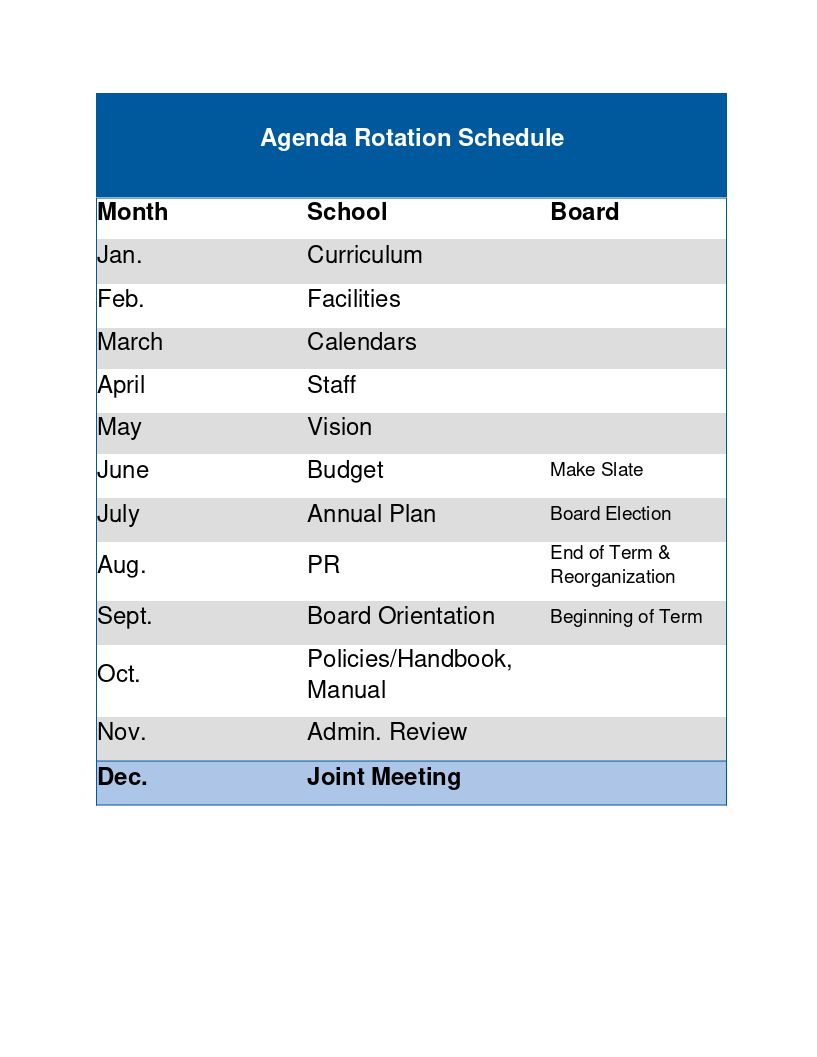
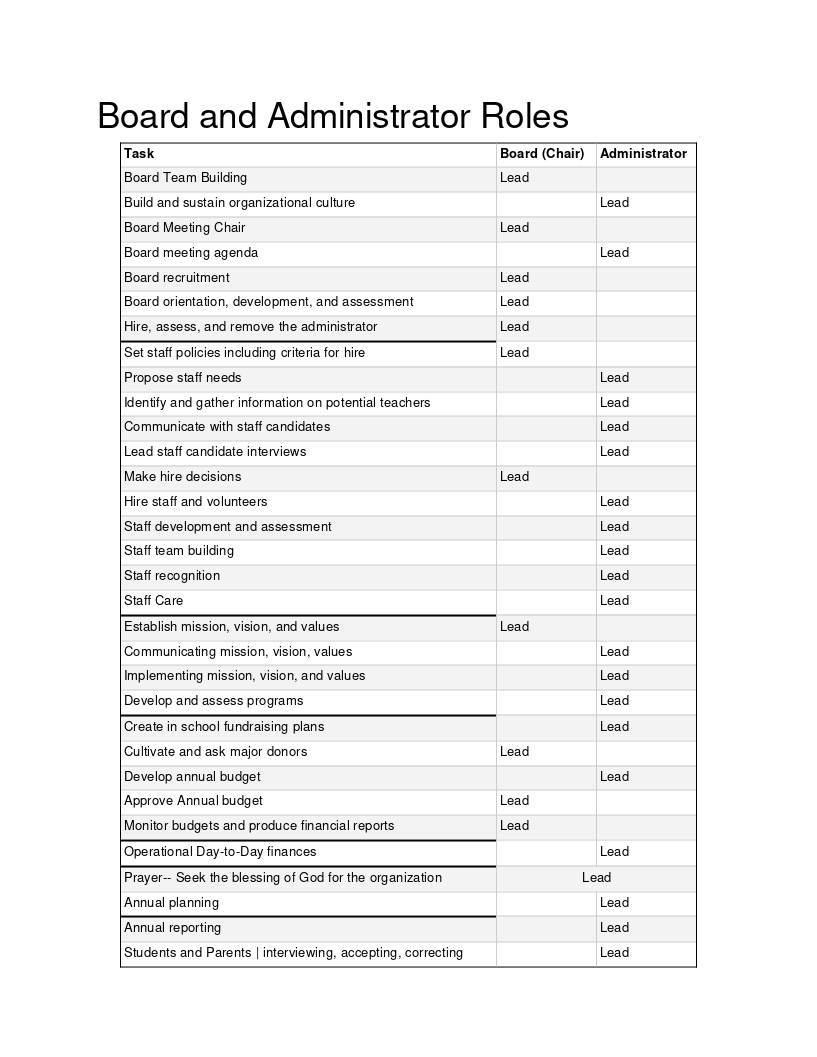
Board and Administrator Roles
In this list, the board chairman or the administrator is assigned lead responsibility for each of 34 tasks. Customize the list and the responsibilities to fit your needs.
Tidings of Peace Christian School By-Laws
Tidings of Peace Christian School's bylaws govern the qualifications, duties, and elections of officers, the protocol for calling meetings, and related agreements that allow the board to effectively guide the school. You may wish to modify relevant sections for use in your own bylaws.

TOP Parent and Student Handbook
The Tidings of Peace handbook explains schedules and procedures of the school's operations, but also grounds the expectations for parents and students in the school's faith and mission. The handbook describes expectations for dress, relationships, and financial participation. Sections of the handbook may be modified to fit your school's needs.
TOP Board Member Responsibilities
So you've joined the school board. What are you supposed to do? Tidings of Peace drew up this description of the opportunities and responsibilities of board members. The document deals, not with specific tasks assigned to board officers, but with the general work of serving as a board member.

The Teacher, the Foreigner

If you are a teacher, do not be surprised if someday you find yourself teaching in the context of a different culture. Maybe it will be in Mexico where termites come out of the wall to nibble into your history book... or maybe it will be in Eastern Europe, where you shovel coal into your little furnace to keep warm in winter... or maybe it will be with students of Asian background right in your own town. The possibilities and the needs abound. Someday, God might call you to engage with another culture.
What can a teacher do to get ready for this adventure? How can one live and teach well in a foreign culture? Gathered from the experiences of various teachers, here are pieces of advice which may help.
Ask God to help you become grounded in Jesus Christ.
When you enter another culture, everything familiar suddenly slides out from under you. Culture shock is normal, so be patient as you adjust. Realize that the Most Important One will not change, and He must be your anchor. If you stick close to Him and to His Truth, it will do you and your students more good than anything else could. As one teacher reflected, “The more stability I had in what I believed and lived, the more I could give.”
Do as much as you can to prepare ahead of time.
Every culture is multi-faceted, including language, traditions, dress, religion, and so on. Make it your business to learn all you can beforehand about the culture you are entering. This is an act of respect for your students and their background, and will also help you feel more comfortable. Try to find out what is or is not acceptable, and how different situations are handled. If you will be teaching among Muslims, what should you do during the ‘call to prayer’? How should you address a person who is older than yourself? Does this culture value directness or indirectness in communication? A friend teaching in Indonesia discovered that it is impolite for her students to leave the classroom before she does. Are there similar expectations of which you should be aware? Study the history, geography, and government, gaining some context from which to teach the children who live in this culture. Do you know anything about the Viking invasions, the Easter Uprising of 1916, or Cromwell’s Plantations? Important events such as these have shaped the very thought and character of the people you will be serving. Start studying the language—even if this is difficult, it is extremely important in respecting and connecting with the people who will be around you, and they will love you for trying.
Look into what resources will be available for you as a teacher. Are there good libraries, or teacher supply stores? Be prepared to use your creativity and thriftiness, and think about what essentials, including books, you should take along. Is there access to a photocopier or computer, or will you be writing out your biology worksheets by hand? If you plan to use a foreign curriculum, try to find out how it is set up and what to expect.
While you are there, respect and adapt to the culture.
Though you will probably find aspects of the culture that you cannot conscientiously participate in, there will also be much for you to take part in and enjoy. Be humble and teachable—there are many things to learn from other cultures. Remember that you are the one that needs to adjust to the culture around you; do not expect them to adjust to your culture. As a teacher, do your best to guide your students to live well in their own context, instead of trying to make them into “little Americans.” If the people around you say “rubber” for eraser, and “zed” for the letter z, then you as a teacher should do likewise. Of course, you will make mistakes and blunders—relax, and be willing to laugh at yourself and to learn for the next time. Be flexible, flexible, and more flexible!
Take a great interest in your students’ lives. Make yourself a slingshot and join the boys in hunting jackrabbits. . . or attend the Russian church service when a student is baptized. Try to enter their world and become a part of it as much as you can. Build relationships with school parents, and with others outside of school. Go down to the harbor and talk to the fishermen. Sit in the yard with the neighbor ladies during the hot part of the day, even if you still have trouble conjugating your verbs correctly. Try the pickle soup or the empanadas that someone brought you. You will find, like one teacher did, that “the more I immersed myself in their way of doing things, the better off I was in understanding and relating to them.” Though you are a teacher, you must also be a learner.
Accept your own culture and background.
In some parts of the world, the culture you come from may be idolized; while in other places, it is looked down on. You will be most healthy if, in the middle of experiencing a foreign culture, you can gracefully accept your own culture with both its strengths and its weaknesses. As a foreigner, you will always be “who you are,” even if you adapt to the new culture around you, and you should neither flaunt nor be ashamed of this. Jesus loves the people of every time, place, and culture, and He can give this love to us. As you accept your own culture and that of your students, you can both live and teach the truth of “Jesus loves the little children, all the children of the world!”
This article was originally published on fbep.org. Reused by permission.
I Know My Verses!

I loved hearing one of the first-graders asking, “Can I say the verses by myself? I know them.” This child proceeded to say the verses as we were waiting in the bus line at dismissal time. And she knew them better than the teacher did!
This year in our school Bible memory program, we are learning passages from the book of John. Grades 1-12 learn the same scripture during a two-week period and are tested at the end of that time. First through third graders recite the verses for their tests and are expected to say them word for word. There is one point per word, so with 101 words, Test 4 has 101 points, for example. Grades 4 – 12 write the passage on a sheet that has a blank for each word. They also take a review test from the previous passage and are given about one-third of the words for the review test.
We compile Bible memory books in the summer and send a book to each family with the beginning of year mailing. We give each student a book the first day of school and they keep this book to use in practicing at school. We encourage families to use their home books to work on the scripture memorization at home, as a family. Learning the Bible verses is part of my students’ homework.
We try to practice the verses each day at school, and have found that first-graders can succeed in learning the scriptures. I think they sometimes do better than the older students! Many of my students receive 100% on their tests.
I collected from parents and teachers some ideas for practicing Bible memory and share them here:
Bible Memory Ideas
- Study with a partner:
- Study with a sibling, parent, classmate, friend on the bus…
- Say the verses to each other.
- Practice it as a family at the supper table, while waiting for the bus, at family devotions, at bedtime, etc. If one child needs more help, give them the help and let the other children listen in. It will help them, too!
- Start at the first verse and go over it until everyone knows it, then move on to the next verse. Combine the two verses and practice that, then add the next verse, and so on.
- Try to learn a verse each day, then take the last few days of the two-week period to brush up. The children study alone for 5-10 minutes each night (sometimes for more time than this, so that on busy nights they can skip it.)
- Make sure the children understand what the verses mean.
- Say the passage twice every morning before the bus comes and again in evening devotions. Keep at it consistently, rather than trying to cram it in the last evening.
- Go over it every day. Have a child repeat it after the parent or say it together.
- Repetition, repetition, repetition! Use any time the family is together to practice, if only for five minutes.
- Some try to have the first half memorized in the first week and that helps keep them on top of it, with time to review.
- Draw pictures to show the verses and give clues to the words and phrases.
- Create motions to go with the verses.
Below, watch the first grade’s Bible memory video! We record each passage as we’re reciting it and doing the motions that we have planned as a class. I post the video, which is mainly of me, in my Google Photos Bible Memory album and share the link with parents, so they can use the video at home. One day an older student informed me, “I studied with you last night!” because their family used the video to help in memorization!
https://vimeo.com/377812838
Visuals Ideas
- Print the scripture on a 4x6 index card. Each child has a card at their place at the table and they can read it while they eat, and see the scripture right in front of them. (Just like Deuteronomy 6 says in teaching God’s Word!) Each child also has a card by their bed to go over the verses at bedtime.
- Use a clear vinyl tablecloth with the cards under the vinyl. Mom and Dad have a card by them, as well, so everyone can learn the verses.

Prepare, Summarize, Reflect; Encouraging Discussion in Bible Class and Beyond
Today, I'd like to give some tips about meaningful class discussions. Some times even when we have a good discussion, as we reflect back over the discussion, we realize only 40% or 50% of my class was involved, maybe even less, and it's typically the same students that are involved. While some might be really engaged and we have some good thoughts and questions and interaction, there are still students who are looking out the window or just not engaged. So, is there something we can do to help with that?
One thing we could do—for example, we were studying in the Book of Acts, Acts Chapter 2 and 1 and the importance of the ascension. I asked the students to write down for homework a short paragraph, "What is the importance of the ascension?" That, of course, gives them time ahead of time to think about the topic the importance of the ascension. Then, they come to class prepared and they are quicker to get involved, hopefully, in discussion. Also, some students that need longer to think about a topic or if they are not engaged, you can call on them, knowing that they have something to answer because it's already there on their paper.
Okay. Take out the paragraph that you wrote, please, about the importance of the ascension.
In this particular example, they came to class with some thoughts, "What's the importance of the ascension?"
Then, as they share, write their thoughts down on the board. They get to see the answers. They get to see them, they can write them down in their notes. Hopefully, it's solidified a bit more in their minds.
Yes, I hadn't thought of that. So, it made everyone know, it solidified that he was not going to set up an earthly kingdom. Okay. So how shall I put that: “Confirmed His kingdom is not of this world.” This is great, because you think of things that I had not thought of.
Also, the students will come with thoughts, but usually they don't have any verses included in their thoughts. So, as they are sharing their thoughts, bring some verses in from the Word and have everyone turn to, since it's Bible class, and (because of) the importance of the Word of God, makes sure everyone turns to it and get the students to read where their thoughts are coming from, hopefully, right from the text.
Yes. A good question. We are going to turn to Psalms 24, I think. Look at verses 7–10. I've heard it explained already that Psalms 24 possibly—and I will need to do some more research to know where this thought process comes from. All Psalms were meant to be sung, and it's thought that some were antiphonal. One side says this, the other side says this. Here, this is possibly, verses 7–10, a reference to Jesus' ascension. The angels, could the angels have been saying this as Jesus came back to heaven, as he ascended in the clouds and he comes back to heaven? And he's getting to enter into the realm of heaven here.
Let's have Cheyenne on that side of class read verse 7, and Vince in this side of class read verse 8—this is off the cuff here, I'm not sure how this will be—and then Cheyenne you will have verse 9 and Vince, you will have verse 10. See this antiphonal—you picture the angels on both sides of the gates singing this or saying this as Jesus comes back, having completed his mission on earth. What a scene that would have been if this would have taken place. Cheyenne and your half of the class, start at verse 7. Go ahead. “Lift up…
“…your heads, O ye gates; and be ye lift up, ye everlasting doors; and the King of glory shall come in.
“Who is this King of glory? The LORD strong and mighty, the LORD mighty in battle.
“Lift up your heads, O ye gates, even lift up, ye everlasting doors, and the King of glory shall come in.
“Who is this King of glory? The Lord of hosts, he is the King of glory. Selah.”
Okay. Very good.
Also, at the end, make sure to summarize the students' thoughts and wrap it all up. Tell them what they should remember. Sometimes a lot of things get talked about in a discussion and it comes time for the test, maybe they don't know exactly—They remember we talked about this in class, but the thing you really want them to remember was kind of lost in all the other students' thoughts. So, make sure you summarize it and highlight what you want, to be sure that they remember.
These verses center around a specific thing. Actually, it's totally fine, you had some really great thoughts, but this thing here that I’m thinking about is you didn't actually mention. The four verses here, you can each talk about these things. Let's read these and see if you can get an idea. So, a volunteer to read chapter 2 verse 1, 1st John.
Another thing you can do, possibly, is to see if you were successful in conveying what you wanted to convey before they leave. You could hand out some 3 X 5 cards and have them write down, “What did you learn today?” See what they learned. See, did they learn something that you really didn't mean to convey it all, or did they catch what you were looking for?
Hopefully, that will help with some more meaningful discussions and some more students involved in the discussions: Make sure you bring the Word of God in so that it's not a bunch of great ideas or things they heard people say, and then summarize it and maybe even capture what they thought they heard to see if you were successful.